Introduction
Engineering drawings live in one folder. Specifications sit in another. The as-built P&ID everyone actually trusts is a marked-up PDF someone emailed three years ago. Sound familiar?
Many manufacturers, EPC firms, and owner-operators struggle with exactly this: technical data scattered across CAD systems, spreadsheets, and legacy platforms that don't talk to each other.
When that data is incomplete or poorly structured, the costs show up fast: rework during fabrication, compliance gaps during audits, and delays at handover when operations teams discover the documentation doesn't match what's installed.
A Technical Data Package (TDP) exists to solve this problem. It's the structured, authoritative record that tells an inspector, a supplier, or a maintenance technician exactly what an item or asset is and how it should perform.
This guide breaks down what a TDP actually is, the maturity levels that define it, the elements inside one, and why getting this right matters across the full asset lifecycle.
Key Takeaways
- A TDP is a structured set of drawings, models, specs, and BOMs that fully describes a product for design, procurement, and maintenance
- MIL-STD-31000B defines three maturity levels: Conceptual, Developmental, and Product; as-built records fall outside this taxonomy
- TDPs exist as 2D drawings or 3D models, and process industries frequently blend both
- Fragmented technical data drives measurable rework and lifecycle costs across capital projects
- Strong TDP governance requires a specialized digital asset partner, not just software
What Is a Technical Data Package?
A Technical Data Package is an authoritative set of electronic files, drawings, models, specifications, bills of materials, and related documentation, that fully describes a product, component, or physical asset. It's the single reference point that lets someone other than the original designer understand, build, inspect, or maintain that item.
MIL-STD-31000B, the U.S. Department of Defense standard governing TDPs, defines the package as the authoritative technical description of an item that supports acquisition, production, inspection, engineering, and logistics. That five-function scope is the practical test for whether a data set qualifies as a real TDP or just a folder of files.
While MIL-STD-31000B originated in defense and discrete manufacturing, process and energy industries rely on equivalent structured packages—think plant design records, equipment datasheets, and P&IDs—to document facilities and equipment across their operating life.
Who Uses a TDP?
- OEMs sourcing components from multiple suppliers
- EPC firms delivering capital projects to owner-operators
- Suppliers manufacturing to a customer's exact specification
- Owner-operators maintaining assets for decades after construction
TDP Types: 2D vs. 3D
A TDP comes in one of two representation types, and this is separate from its maturity level.
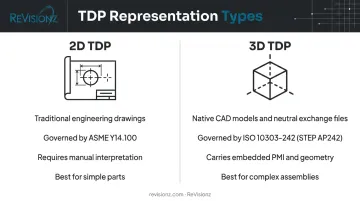
2D TDPs are traditional engineering drawings and static documents, governed by ASME Y14.100, requiring manual interpretation by whoever reads them. They work well for simple parts and are still common where legacy tooling or contract requirements demand paper-style deliverables.
3D TDPs are digitally connected: native CAD models, neutral exchange files, and 3D PDFs carrying geometry, Product and Manufacturing Information (PMI), and embedded attributes. The current governing standard for neutral 3D exchange is ISO 10303-242:2025 (STEP AP242), which supports managed model-based 3D engineering.
Complex assemblies with tight tolerances favor 3D. Process industries often blend both, using 3D plant models during design and generating 2D isometrics and as-built drawings for field crews and maintenance records.
TDP Levels Explained: From Concept to As-Built
MIL-STD-31000B recognizes three official maturity levels. Each reflects how far a design has progressed, not the format of the data itself.
| Level | What it contains | Typical use |
|---|---|---|
| Conceptual | Early sketches, renderings, and basic performance data | Feasibility analysis, concept evaluation |
| Developmental | Refined design data supporting a specific approach, prototype-ready | Testing, limited production, engineering development |
| Product | Complete manufacturing-ready data | Full production, procurement, inspection, and support by any competent manufacturer |
A Level 2, or Developmental, TDP supports prototype fabrication and testing. It includes unique item specifications and design data detailed enough for engineering evaluation, but it typically isn't sufficient for competitive, unsupervised production. That final step belongs to Level 3.
A note on "as-built" data: Despite common industry shorthand, MIL-STD-31000B does not define an official "Level 4" or "as-built" TDP level. As-built documentation is better understood as a configuration state, the validated record of what was actually built or installed.
This state sits alongside the three formal levels rather than above them. In process industries, the distinction matters at operational handover.
Mapped to a capital project, these concepts roughly track:
- FEED (Front-End Engineering Design) aligns with Conceptual-level thinking
- Detailed engineering produces Developmental and Product-level data
- Construction generates redlines and field changes
- Operational handover requires validated as-built records, the configuration state operations will rely on for the next 20 years
ReVisionz's Digital Handover Readiness practice works directly in this space, helping owner-operators validate as-built records before they become the operational baseline.
What's Inside a TDP: Elements and Examples of Technical Data
A complete TDP typically includes:
- Bill of Materials (BOM): Parts, quantities, and approved suppliers needed to build or maintain the item
- Drawings and models: 2D drawings or 3D models carrying PMI such as GD&T callouts and material specifications
- Specifications and datasheets: Performance and technical requirements defining how the item must function
- Quality assurance and inspection criteria: Documented procedures, including First Article Inspection under SAE AS9102C, confirming conformance to design intent
What Is an Example of Technical Data?
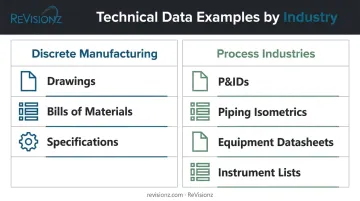
In discrete manufacturing, that's drawings, BOMs, and specifications. In process industries, the equivalent set looks different but serves the same purpose:
- Piping and Instrumentation Diagrams (P&IDs)
- Piping isometrics
- Equipment datasheets (pumps, vessels, heat exchangers)
- Instrument lists and specification forms
Frameworks like CFIHOS standardize how these process-industry elements get classified and exchanged during capital-facility handover. This is exactly where ReVisionz's work on bridging ISO 15926 and CFIHOS becomes relevant, helping owner-operators standardize equipment and tag data across multiple EPCs.
Why TDPs Matter: Key Benefits Across the Lifecycle
A well-built TDP functions as the mechanism that keeps engineering, procurement, and operations working from the same facts.
Improved communication and collaboration
When engineering, procurement, and maintenance teams reference one structured data set instead of competing spreadsheets, fewer decisions get made on outdated information. Miscommunication during handover, historically one of the most expensive failure points on a capital project, drops sharply.
Stronger compliance and traceability
Structured technical data supports safety audits, regulatory reporting, and configuration control. When an auditor asks for proof that an installed component matches its approved specification, a well-governed TDP answers that question in minutes instead of days.
The cost of getting it wrong is well documented. A NIST study estimated that inadequate interoperability cost the U.S. capital-facilities industry $15.8 billion per year, with owners and operators absorbing roughly two-thirds of that figure through manual data re-entry, rework, and fragmented information exchange. That's an industry-wide interoperability estimate, not a TDP-specific number, but it shows how much money is riding on getting data structure right.
ReVisionz has seen this play out directly. In one mining engagement, laser scan reality capture validated a client's asset registry against the physical equipment on site. That work cut the time and cost needed to rebuild the registry across three facilities, proof that structuring asset data properly from the start pays off.
Common TDP Challenges and Best Practices
Even organizations with mature engineering practices run into the same recurring problems.
Common challenges:
- Inconsistent formats between contractors, disciplines, and legacy systems
- Outdated revisions circulating alongside current ones, with no clear source of truth
- Data siloed across EPCs, vendors, and internal departments, especially at handover
Best practices worth adopting:
- Establish data governance standards before a project starts, not after handover
- Use model-based definition to reduce dependence on disconnected 2D drawings
- Validate TDP completeness against a defined checklist before accepting handover from a contractor
Specialized digital asset partners solve exactly these problems. ReVisionz's Asset Information Management (AIM) programs help owner-operators convert unstructured engineering data into lifecycle-ready information.
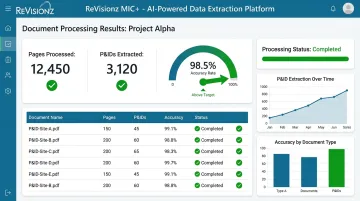
Its AI-powered Main Information Contractor+ (MIC+) service extends that work, using natural language processing and machine learning to extract tags, metadata, and asset information directly from scanned documents.
In one petrochemical engagement, MIC+ processed 14,823 pages and 300 P&IDs, achieving a 98.7% accuracy rate with zero critical errors, delivered on budget. That's the kind of outcome that turns a chaotic document dump into a TDP operations can actually trust.
Frequently Asked Questions
What is a technical data package?
A TDP is a structured set of files, drawings, models, specifications, and BOMs that fully describes a product or asset for design, manufacturing, and maintenance. It lets anyone besides the original designer work from the same technical information.
What is a Level 2 technical data package?
A Level 2, or Developmental, TDP supports prototype fabrication and testing. It contains refined design data detailed enough for engineering evaluation, but it is not yet complete enough for unsupervised full production.
What is an example of technical data?
Examples include engineering drawings, BOMs, and specifications in discrete manufacturing. Process industries use equivalent items such as P&IDs, piping isometrics, and equipment datasheets.
How is a TDP different from a digital twin?
A TDP is a controlled technical definition describing an item at a point in time. A digital twin is a continuously synchronized virtual representation of an operating asset, often built using TDP data as its foundation.
Who is responsible for creating and maintaining a TDP?
Design authorities, EPCs, or engineering teams typically create the initial TDP during design and construction. Owner-operators become responsible for maintaining and updating it once the asset moves into operations.
What standard governs the structure of a TDP?
MIL-STD-31000B is the primary standard defining TDP levels, types, and required elements. Process industries also reference standards like ASME Y14.100 and frameworks like CFIHOS for equivalent structured data.