This guide is written for leaders in asset-intensive industries: energy, chemicals, manufacturing, and mining. These sectors carry a unique burden. Legacy systems, safety compliance requirements, and decades of complex engineering data make transformation harder to execute than in most other industries.
Only 48% of digital initiatives meet or exceed their business-outcome targets, according to Gartner's 2024 global survey of more than 3,100 CIOs and technology executives. That's a coin flip, at best.
This article breaks down what a roadmap actually is, why your organization needs one, and the step-by-step process for building one that gets executed, not shelved.
Key Takeaways
- A roadmap turns strategic vision into a sequenced, accountable plan with measurable outcomes
- Building one means assessing current state, defining future state, and naming initiative owners
- Most roadmaps fail from weak change management and unrealistic scope, not wrong technology picks
- Asset-intensive organizations add complexity: legacy data, regulatory compliance, and multi-site operations
What Is a Digital Transformation Roadmap?
A digital transformation roadmap is a structured, time-phased plan that maps the initiatives, technologies, resources, and milestones an organization needs to move from its current state to a defined future state. It's the document that turns intent into action.
A roadmap's purpose goes beyond technology adoption for its own sake. It's about aligned execution and resource prioritization: making sure every department works toward the same goals in the right order, with the right investment behind each step.
Roadmap vs. Strategy: What's the Difference?
People often use these terms interchangeably. They shouldn't.
| Aspect | Strategy | Roadmap |
|---|---|---|
| Focus | The "why" and "what": vision, goals, strategic bets | The "how" and "when": sequencing, ownership, timelines, execution mechanics |
This distinction matters in practice: skipping straight to a roadmap without a clear strategy often produces a detailed, well-sequenced plan for the wrong initiatives.
BCG describes strategy work as selecting an organization's strategic digital bets and their order, while the roadmap is the resulting plan with timelines, targets, and accountabilities for each program.
Core Components of a Roadmap
Most roadmaps, regardless of industry, include:
- Vision and measurable objectives
- Current-state assessment
- Future-state goals and capability gaps
- Prioritized initiatives
- Phased timeline
- Named ownership and governance
- KPIs tied to each phase

For asset-heavy organizations, there's an additional layer. Roadmaps must also account for asset information management and lifecycle data handover, not just enterprise software rollouts. A roadmap that ignores how engineering data moves from project delivery into operations is missing one of the biggest risk factors in the entire transformation.
Why Your Organization Needs a Digital Transformation Roadmap
Without a roadmap, digital initiatives tend to become disconnected pilots that stall before they ever reach scale. Teams launch projects with enthusiasm, then lose momentum when nobody owns the next step.
The data backs this up. BCG's survey of more than 1,000 companies found that only 30% of large-scale technology programs fully met expectations on time, budget, and scope. Nearly half of companies in power, utilities, and machines and automation were classified as laggards — failing to meet all three delivery criteria.
A roadmap addresses what ad hoc initiatives simply can't:
- Cross-department alignment on priorities and dependencies
- Resource prioritization so budget goes to the highest-impact work first
- A shared definition of success so IT, operations, and engineering aren't measuring different things
Why Generic Strategies Fall Short in Asset-Intensive Industries
In process and energy industries, roadmaps have to address problems that generic digital strategies overlook entirely: safety-critical data, regulatory compliance obligations, and legacy engineering systems that have accumulated for decades.
These complexities create a strong temptation to skip straight to technology selection, a shortcut that proves expensive. Without a documented current state and prioritized initiative list, organizations end up buying platforms that don't fit their actual capability gaps. Building the roadmap first is what makes technology selection a rational decision instead of a guess.
How to Build a Digital Transformation Roadmap: Step-by-Step Guide
Building a roadmap is a sequential process: understand where you are, define where you want to be, then map the initiatives, technology, and people changes required to close that gap.
Start with how the business actually delivers value, not with an org chart or your existing tech stack. Too many roadmaps begin with "what systems do we already own" instead of "what outcome are we trying to create."
Step 1: Define Your Vision, Objectives, and Business Case
This step anchors the entire roadmap to a clear North Star. Vague goals like "becoming more digital" don't survive budget season. Specific, measurable outcomes do.
Link every objective to a concrete business driver:
- Cost reduction
- Safety performance
- Regulatory compliance
- Asset performance and uptime
Tying objectives to drivers secures leadership buy-in early, because executives fund outcomes, not initiatives.
Step 2: Assess Your Current State
This isn't just an IT infrastructure audit. It's a full audit of existing systems, workflows, data quality, and organizational culture.
For asset-heavy organizations, this step needs to include an audit of engineering and asset data across its full lifecycle. Fragmented data is one of the leading causes of transformation delays.
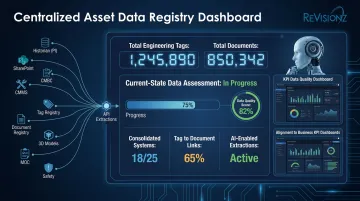
ReVisionz has seen this firsthand: in one LNG operator engagement, the current-state assessment uncovered more than 300,000 tags and 800,000 documents spread across disconnected systems with no centralized registry. That's not an edge case. It's typical of what decades of capital projects leave behind.
Step 3: Define the Future State and Prioritize Capability Gaps
Build a capability map showing which business capabilities (people, process, and technology) need to change to close the gap between current and future state.
Prioritize gaps based on business impact and feasibility, not technical interest. A capability gap that excites your engineering team but delivers marginal ROI shouldn't jump the queue ahead of one that reduces unplanned downtime.
Step 4: Identify Initiatives and Technology Enablers
Each capability gap should translate into specific initiatives, or packages of change. Group related actions together so they can be resourced and tracked as a unit.
Evaluate technology through a technology-agnostic lens: select platforms based on the business capability they enable, not vendor preference or what a previous project used.
Specialized consultancies like ReVisionz help asset-intensive organizations avoid costly platform mismatches at this stage, since the wrong tool selected early often can't be undone without significant rework later.
Step 5: Sequence Initiatives Into a Phased Timeline
Group initiatives into logical phases or waves across the transformation horizon based on:
- Dependencies between initiatives
- Urgency and risk exposure
- Expected business impact
McKinsey's heavy-industry framework uses three horizons: fundamentals in the first 3 to 12 months, growth and scalability over the next 12 to 24 months, and repositioning or reinvention after 24 months. Visualizing phases by strategic theme, department, or asset lifecycle stage helps ensure interdependent initiatives are sequenced correctly instead of colliding mid-execution.
Step 6: Assign Ownership, KPIs, and Governance
Every initiative needs a named owner, defined decision rights, and locked-in resourcing before execution begins. Without this, initiatives quietly stall while everyone assumes someone else is driving them.
Define two types of indicators for each phase:
- Leading indicators: adoption rates, training completion, data quality scores
- Lagging indicators: ROI, efficiency gains, reduced rework
Change management should be built into governance from day one. Treating it as an afterthought is one of the fastest ways to watch a well-designed roadmap fail in practice.
Key Factors That Affect Roadmap Success
A handful of factors consistently determine whether a roadmap gets executed or gets shelved:
- Data maturity and quality: Unstructured or siloed asset and engineering data slows every downstream initiative, regardless of how good the plan looks on paper
- Organizational change readiness: Leadership alignment and employee buy-in determine adoption more than the technology choice itself
- Industry-specific regulatory and safety constraints: These shape which initiatives can move quickly in process and energy environments, and which ones require extended validation
- Scale and complexity: Multi-site, multi-system organizations require longer sequencing and stronger governance than single-site businesses
- Resourcing and budget discipline: Underfunded initiatives are one of the top reasons roadmaps stall mid-execution, often after the first phase shows early promise

Common Mistakes to Avoid When Building Your Roadmap
Even well-intentioned roadmap efforts run into the same handful of traps:
- No underlying strategy: The roadmap becomes a list of initiatives with no connection to business objectives — a project inventory dressed up as a transformation plan.
- Overambitious scope: Trying to transform everything at once spreads teams thin. PMI research found scope creep affects 28% of projects at organizations with strong project management discipline, rising to 40% where that discipline is weak.
- A one-time deliverable mindset: A roadmap is a living document that needs regular review as conditions and priorities shift, not something filed away after the kickoff meeting.
- Underestimated data readiness: Legacy engineering and asset data often need more remediation than expected. Partnering with an experienced firm like ReVisionz for data migration and roadmap definition helps catch these issues during planning, not mid-execution.
Frequently Asked Questions
What is a digital transformation roadmap?
A digital transformation roadmap is a phased execution plan that translates a digital strategy's vision into sequenced initiatives, timelines, resources, and accountability. It answers how and when a transformation happens, not just what the goal is.
What are the 5 steps of digital transformation?
Most frameworks converge on five steps: assessing the current state, defining the future state, identifying enablers and initiatives, sequencing into phases, and measuring progress with KPIs. The exact naming varies by consultancy, but the sequence stays consistent.
What are the 7 pillars of digital transformation?
Commonly cited pillars include strategy and vision, leadership, technology, data, people and culture, process, and customer experience. Various frameworks group these categories differently, but they overlap heavily.
How long does it take to build a digital transformation roadmap?
Timelines vary by organizational scale and data maturity. Drafting the roadmap itself typically takes several weeks to a few months. Full execution across all phases usually spans multiple years.
How is a digital transformation roadmap different from a digital transformation strategy?
Strategy defines the why and what: vision, goals, and strategic priorities. The roadmap defines the how and when: sequencing, ownership, timelines, and execution details.
What tools are commonly used to build and manage a digital transformation roadmap?
Organizations typically use enterprise architecture and roadmapping software, capability mapping tools for gap analysis, and data governance platforms to track data quality and stewardship progress throughout execution.