Data integrity and data quality solve different problems. One protects trustworthiness. The other measures usefulness. Confuse the two, and you risk compliance failures, unsafe operations, or a digital twin built on data nobody can trust.
This article breaks down what separates the two concepts, where each matters most in asset-heavy environments, and how organizations build both into a durable data strategy.
Key Takeaways
- Data integrity protects accuracy and trust over a data's lifecycle; data quality measures fitness for a specific use case.
- High quality and strong integrity don't guarantee each other, and neither alone is enough.
- Poor integrity raises safety and compliance risks; poor quality leads to bad maintenance and operational decisions.
- Both require governance, validation, and structured migration and enrichment methods built for industrial data.
Data Integrity vs Data Quality: Quick Comparison
Before going deeper, here's how the two concepts compare for engineering and asset data environments.
| Dimension | Data Integrity | Data Quality |
|---|---|---|
| Definition/Focus | Protecting data from unauthorized alteration, loss, or corruption across its lifecycle | Measuring whether data is accurate, complete, and fit for its intended use |
| Primary Goal | Trustworthy, traceable records with an intact chain of custody | Usable, decision-ready data for operations and analytics |
| Key Methods & Tools | Access controls, audit trails, migration validation, version control | Data cleansing, standardization, deduplication, validation rules |
| Risk If Neglected | Regulatory penalties, unsafe operations, compromised audit trails | Bad maintenance decisions, unplanned downtime, low tool adoption |
| Typical Owner/Discipline | IT/records management, cybersecurity, compliance teams | Engineering, asset management, data governance teams |
Neither column works in isolation. A record can be untouched and secure (high integrity) while still being incomplete or outdated (poor quality) — and vice versa.
What Is Data Integrity?
Data integrity is the maintenance of data's accuracy, consistency, and trustworthiness throughout its lifecycle, with protection against unauthorized alteration or corruption. The National Institute of Standards and Technology defines it as the property that data has not been altered in an unauthorized manner, whether it's at rest, in transit, or being processed.
For engineering and asset data, this matters enormously. P&IDs, tag data, and maintenance records need to remain traceable and unaltered for safety and compliance purposes.
If someone modifies a piping spec without documentation, or a legacy system corrupts a tag during migration, that error can flow straight into a CMMS, EAM, or digital twin, driving a maintenance decision based on false information.
Types and Root Causes of Integrity Failures
Practitioners generally describe integrity in two forms: physical integrity, which protects data at rest or in transit through backups, transfers, and storage hardware, and logical integrity, which keeps data consistent across departments, disciplines, and platforms so the same asset tag means the same thing everywhere.
In industrial settings, a single mismatched tag between engineering and operations records can cascade into faulty work orders or missed inspections.
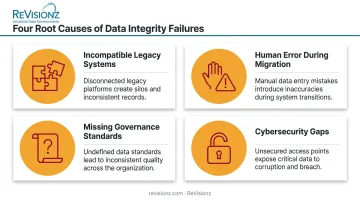
Integrity breaks down for a handful of predictable reasons in industrial data environments:
- Incompatible legacy systems that don't map cleanly to modern platforms
- Human error during data migration or project-to-operations handover
- Missing governance standards, leaving no single source of truth
- Cybersecurity gaps that expose records to unauthorized changes
Use Cases of Data Integrity
Integrity matters most where a broken chain of custody creates safety or legal exposure:
- EPC-to-owner handover: the moment data changes hands is also the moment it's most vulnerable to gaps
- Historical asset records: inspection and repair history that regulators or insurers may audit years later
- Safety-critical documentation: process safety information, batch records, and financial transaction logs
The consequences of getting this wrong are well documented. The U.S. Chemical Safety Board's investigation into the 2005 BP Texas City refinery explosion found that instrument data sheets for a key level transmitter weren't kept current or made available to maintenance staff.
That gap likely contributed to a miscalibration and false level signal during startup, a failure that killed 15 people and injured 180. The report also noted the work-order system lacked crucial repair-history information, compounding the problem.
That's an extreme case, but it illustrates the stakes: outdated or inaccessible engineering records aren't just an inconvenience. In safety-critical environments, they're a contributing cause of catastrophic failure.
What Is Data Quality?
Data quality measures how well data serves its intended purpose. It's typically assessed across dimensions like accuracy, completeness, consistency, timeliness, uniqueness, and validity. For asset-heavy industries, this means equipment attribute data needs to be complete and accurate enough to drive reliable maintenance planning, not just technically "unaltered."
The Core Dimensions
| Dimension | What It Means for Asset Data |
|---|---|
| Accuracy | Does the recorded spec match the physical asset? |
| Completeness | Are all required fields populated? |
| Consistency | Do values agree across systems (ERP, CMMS, EDMS)? |
| Timeliness | Is the data current enough to act on? |
| Uniqueness | Are there duplicate equipment records? |
| Validity | Does the data conform to expected format and range? |
Quality also splits into two flavors worth distinguishing: master data quality (equipment registers, asset hierarchies) and transactional data quality (work orders, inspection logs). Master data tends to be more stable but higher-stakes when wrong; transactional data is high-volume and easier to let slip.
Use Cases of Data Quality
Quality issues surface most often during:
- Asset register or master data cleanup as part of digital transformation
- Materials management and supply chain digitization
- Predictive maintenance program rollouts
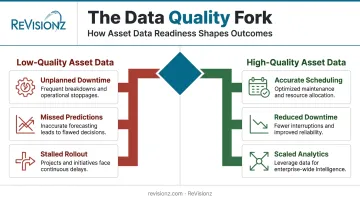
High-quality asset data directly enables better predictive maintenance scheduling and reduces unplanned downtime. McKinsey's research on industrial predictive maintenance at scale identifies insufficient, inaccessible, or low-quality data as a core obstacle preventing organizations from scaling these programs. Data readiness, not technology capability, determines whether these programs succeed.
Data Integrity vs Data Quality: Which Matters More for Asset-Intensive Industries?
The honest answer: it depends on the use case, and treating this as a competition misses the point.
When integrity should lead:
- Process safety information and audit trails
- Regulated batch or transaction records
- Anything reviewed by auditors, regulators, or insurers
When quality should lead:
- Predictive maintenance modeling
- Reporting and operational dashboards
- Analytics feeding business decisions
Here's the catch: data can't be high quality if its integrity has already been compromised. If a tag record was corrupted during migration, no amount of cleansing makes it trustworthy again — you're polishing a number that might be wrong. Conversely, intact data with strong access controls can still be incomplete, outdated, or unusable for the decision at hand.
A Representative Scenario
Consider a typical challenge ReVisionz has encountered with large capital project operators: an LNG facility inheriting legacy systems tied to more than 300,000 tags and 800,000 documents, with no structured turnover process between project and operations teams. That's a textbook case of both problems at once: fragmented integrity (data scattered across incompatible systems) and poor quality (inconsistent tagging, incomplete records).
The fix wasn't choosing one discipline over the other. It combined:
- Migration and enrichment: consolidating tag and document data into a centralized registry (in this case, using Octave InConcert) to restore a reliable chain of custody
- Cleansing and standardization: applying governance frameworks and structured workflows so the same tag meant the same thing across every system
- Auditability: building in project execution workflows for structured turnover, so future handovers wouldn't repeat the same gaps
This is the logic behind ReVisionz's Asset Information Management approach, and it's part of why the company built its AI-powered Main Information Contractor+ (MIC+) service.
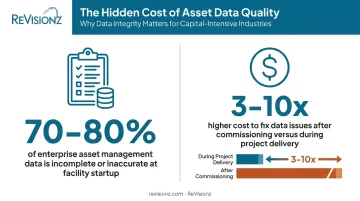
Industry-wide, 70% to 80% of asset data in enterprise asset management systems is incomplete or inaccurate at facility startup. Fixing it after commissioning costs three to ten times more than catching it during project delivery. That gap is exactly what MIC+ and structured AIM programs are designed to close before it becomes an expensive, safety-relevant problem.
Mature digital transformation programs don't pick a side. They build integrity controls and quality management in parallel, because a digital twin fed by corrupted or unusable data is a liability, not an asset.
Conclusion
Integrity and quality are both necessary layers of trustworthy data. Where you put the emphasis depends on whether you are solving a compliance problem or a decision-making problem: safety-critical records need airtight integrity, while predictive maintenance and analytics need genuinely usable quality. Most asset-intensive organizations need both, running simultaneously, not sequentially.
For oil & gas, petrochemical, mining, and manufacturing operators managing decades of engineering data, getting this right connects directly to safety outcomes, regulatory standing, and total cost of ownership. Organizations that treat integrity and quality as complementary, rather than picking one, tend to see smoother EPC handovers and more reliable digital twins, with fewer expensive surprises after startup.
ReVisionz has spent over two decades helping owner-operators in these industries build integrity and quality into their data strategy from day one, drawing on deep experience in asset information management and digital handover readiness.
Frequently Asked Questions
What are the key principles of data integrity?
Data integrity rests on accuracy, consistency, completeness, security, and traceability throughout the data lifecycle. The goal is ensuring records remain unaltered and verifiable from creation through archival.
What are the main pillars of data quality?
The commonly cited dimensions are accuracy, completeness, consistency, validity, uniqueness, and timeliness. Together they determine whether data is fit for a specific operational or analytical purpose.
Can you have data quality without data integrity, or vice versa?
Yes, but neither guarantee holds up alone. Teams can cleanse and standardize data for quality without full integrity, but corrupted or altered source records undermine that work from the start.
Which is more important for asset-intensive industries: data integrity or data quality?
It depends on the use case. Integrity takes priority for compliance and safety-critical records, while quality matters more for analytics and day-to-day operational decision-making.
How do data integrity and data quality impact digital twin and AIM programs?
Both are foundational. Corrupted source data undermines a digital twin's trustworthiness, while low-quality data makes even intact records useless for accurate modeling or decision-making.
What tools or frameworks help maintain both data integrity and data quality?
Data governance frameworks, access controls, audit trail systems, and standards like CFIHOS and ISO 15926 support integrity, while cleansing, standardization, and structured migration/enrichment methodologies support quality.