
Introduction
A turnaround crew pulls up an equipment spec sheet before opening a vessel. The tag number matches. The materials of construction don't. Somewhere between the original P&ID, three CMMS migrations, and a decade of undocumented field changes, the record drifted from reality.
This happens more often than most owner-operators admit. As capital-intensive industries digitize assets and build out digital twins, the data feeding those models often carries decades of unresolved errors. Mismatched tags, incomplete equipment lists, and orphaned records carry real risk, undermining safety margins and cutting into the ROI on technology investments.
This article breaks down what data remediation actually means, why it matters more in asset-heavy environments than almost anywhere else, and what a practical path to better data quality looks like.
Key Takeaways
- Data remediation is an ongoing discipline, not a one-time cleanup project
- Poor data quality costs organizations at least $12.9 million annually, according to Gartner
- Asset-intensive industries face unique risks: safety documentation, compliance, and digital twins depend on trustworthy data
- A five-step framework (assess, classify, clean, validate, govern) prevents recurring data firefighting
- Sustainable data quality requires clear ownership, not just better tools
What Is Data Remediation?
Data remediation is the ongoing process of identifying, cleaning, and correcting inaccurate, incomplete, duplicate, or irrelevant data to improve its reliability and usability. Reliabilityweb frames it specifically for CMMS environments as auditing and correcting asset data and documentation so that maintenance systems reflect what's actually installed in the field.
That framing matters. Remediation isn't a sprint you finish and check off. It's a continuous discipline built into how an organization manages information over time. New errors get introduced constantly through system migrations, vendor handovers, and manual entry.
Data Remediation vs. Data Cleansing vs. Data Governance
These three terms get used interchangeably, but they describe different layers of the same problem.
| Term | What it does | Scope |
|---|---|---|
| Data cleansing | Identifies and corrects errors in raw data | Tactical, reactive fix |
| Data remediation | Systematically audits and corrects data at the root cause | Ongoing, structured discipline |
| Data governance | Sets accountability, policy, and decision rights | Framework that sustains both |
Cleansing removes today's duplicates. Remediation asks why duplicates keep appearing and fixes the underlying process. Governance makes sure nobody has to ask that question again in six months.
Why This Matters More for Engineering and Asset Data
Asset-intensive organizations face a remediation challenge most industries don't: their data lives across P&IDs, tag registers, equipment lists, and legacy systems accumulated over decades of capital projects. A pipe spec buried in a 2004 as-built drawing has to reconcile with a 2024 CMMS record.
Unreliable asset data doesn't stay contained to one system. It undermines:
- Digital twin accuracy: a model is only as good as the tags and attributes feeding it
- Predictive maintenance models: bad inputs produce false confidence, not predictions
- Regulatory documentation: audits expose gaps between what's recorded and what's real
Why Data Remediation Matters for Asset-Intensive Industries
Bad data leads to bad decisions everywhere. In asset-intensive operations, the consequences get physical fast : misrouted work orders, wrong parts pulled for a turnaround, or a technician working from an equipment spec that no longer matches the installed unit.
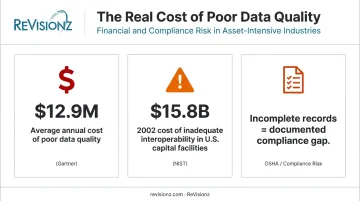
The cost adds up quickly. Gartner found that poor data quality costs organizations at least $12.9 million a year on average, based on research from 2020. That's an all-industry figure, not an oil-and-gas-specific benchmark, but it establishes the baseline financial exposure every organization carries.
Capital-facilities work carries its own documented cost. NIST's 2004 study estimated that inadequate interoperability cost the U.S. capital-facilities industry $15.8 billion in 2002, with roughly $10.6 billion falling directly on owners and operators, driven largely by manual re-entry, redundant systems, and repeated verification. It's a conservative, historical estimate, but the underlying mechanism (fragmented systems forcing rework) hasn't gone away.
Safety and compliance risk compound the financial risk. OSHA's Process Safety Management standard requires complete process-safety information covering chemical hazards, process technology, and process equipment. Its own guidance calls complete and accurate written information essential to managing that risk. Incomplete equipment records or outdated P&IDs aren't just an inconvenience during an audit; they're a documented compliance gap.
There's an upside worth naming directly: clean, trustworthy data drives adoption. When engineers and operators trust the numbers in a new digital platform, they use it. When they don't, they build workarounds in spreadsheets, and the ROI on that platform investment disappears fast.
Reliable data also moves organizations from reactive maintenance toward predictive analytics and long-term asset performance planning.
Common Root Causes of Poor Data Quality in Asset-Intensive Environments
Most engineering data problems trace back to a handful of recurring sources:
- Human error during manual entry: tagging inconsistencies, transposed values, and typos introduced during legacy system migrations
- Contractor and vendor inconsistency: multiple EPC firms and software platforms apply different data standards, so tag naming and units of measure rarely align at handover
- Missing or incomplete metadata: incomplete handover packages, undocumented field changes, or as-built records never updated after construction
The National Academies' 2024 review of asset information handover points to a related structural issue: design and construction firms often work from internal standards that don't match what the owner actually needs operationally. By the time the data reaches operations, it may be technically complete but practically unusable.
The Data Remediation Process: A Step-by-Step Framework
A structured approach keeps remediation from becoming an endless, undirected cleanup effort. Here's a practical five-step framework.
- Assess and inventory. Build a complete picture of data sources, systems, and known quality gaps before touching anything. You can't prioritize what you haven't mapped.
- Classify and prioritize. Not every bad record carries equal risk. Rank datasets by business, safety, or compliance exposure, and tackle the highest-risk gaps first.
- Clean and correct. Remove duplicates, standardize formats, fill missing values, and fix known errors using scripts or specialized data quality tools.
- Validate and test. Verify corrected data against source systems. For engineering data, also check against physical asset conditions in the field, not just internal system logic.
- Govern and prevent recurrence. Establish validation rules, ownership, and governance policies so the same errors don't quietly resurface in eighteen months.
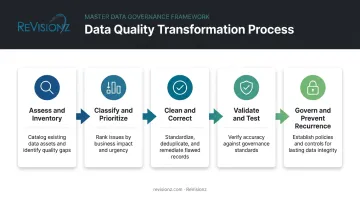
That fourth step deserves emphasis for engineering data specifically. A record can pass every internal system check and still be wrong, because the equipment in the field changed and nobody updated the drawing. Field verification (walking down equipment, checking nameplates, comparing against redlined drawings) is what closes that gap.
Data Remediation Techniques and Tools
The core techniques behind most remediation efforts are straightforward:
- Deduplication: eliminates repeated records that inflate counts and confuse reporting
- Standardization: applies consistent naming conventions and formats across systems
- Enrichment: adds missing attributes like model numbers, materials of construction, or serial numbers, often through field walkdowns
- Validation rule enforcement: builds automated checks that catch errors before they enter the system, rather than after
Scaling Techniques With AI and Automation
At scale, manual correction stops working. Data profiling and observability tools help teams spot anomalies across millions of records instead of thousands. Crossrail's Asset Information Management Framework, for instance, used automated CAD-environment checks and monitoring across roughly 500,000 assets. That scale is beyond what manual processes can handle.
AI-powered tools are accelerating this further, particularly for extracting structured data from legacy P&IDs and engineering drawings. Industrial research has demonstrated AI systems identifying symbols and equipment characteristics directly from scanned drawings to automate material take-offs. That said, extraction isn't the same as verified correctness.
AI accelerates pattern detection, but validation rules and engineering review still have to confirm the output is right.
How ReVisionz Helps Organizations Achieve Lifecycle-Ready Asset Data
This is exactly the gap ReVisionz was built to close. For asset-intensive industries like oil and gas, petrochemicals, mining, and manufacturing, unstructured engineering data doesn't need a one-time scrub. It needs a methodology that turns scattered tag registers, legacy drawings, and disconnected systems into structured, trustworthy information that operations teams can actually rely on.
ReVisionz's data migration and enrichment approach has been shaped by more than two decades of asset information management work. One documented example: an oil and gas client struggling with low-quality asset data in Maximo received cleaned, validated records delivered offline, with no rework required on the client's side. This shows remediation can happen without disrupting live operations.
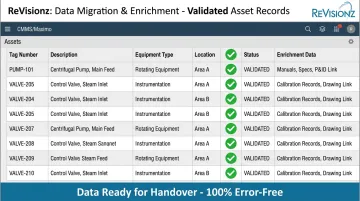
At the center of this work sits Main Information Contractor+ (MIC+), ReVisionz's AI-powered service designed to prepare asset data for digital handover, analytics, and long-term lifecycle management. MIC+ addresses a specific failure point: the moment where capital project teams hand off to operations, and information quality either holds up or falls apart.
This approach bridges project delivery and operational readiness by:
- Structuring engineering, procurement, and maintenance data so it's validated and accessible across lifecycle phases
- Enriching raw project data to meet operational standards before handover, not after
- Applying standardized frameworks like CFIHOS and ISO 15926 to reduce risk between capital teams and operations
This focus extends beyond delivery day. The resulting data continues to strengthen compliance, support safer operations, and hold up under the weight of predictive maintenance and digital twin programs for years afterward.
Frequently Asked Questions
What does data remediation mean?
Data remediation is the ongoing process of identifying, cleaning, and correcting inaccurate, incomplete, or irrelevant data to improve its reliability for decision-making. It's a continuous discipline, not a single cleanup project.
What are the 4 types of data integrity?
The four recognized types are entity integrity (unique records), referential integrity (valid table relationships), domain integrity (valid values per field), and user-defined integrity (custom business rules).
What are the 5 C's of data?
Salesforce's version of this framework lists consistency, completeness, credibility, currency, and correctness. It's a useful mental checklist, though it's not a universally standardized framework from a body like ISO or DAMA.
How long does a data remediation project typically take?
Timelines vary based on data volume, system complexity, and asset criticality, so there's no universal benchmark. Most teams track progress against specific datasets rather than chasing a single completion date.
What's the difference between data remediation and data migration?
Migration moves data from one system to another. Remediation corrects and improves the data itself. They're often needed together, since moving bad data to a new system just relocates the problem.
Who should be responsible for data remediation in an organization?
Remediation works best as a shared responsibility across data owners, IT/engineering teams, and business stakeholders, with defined accountability for each dataset. No single group can catch every gap alone.