Most of that cost is preventable. Yet many energy, chemical, mining, and manufacturing operators still run maintenance programs built on reactive fixes or calendar-based schedules. Both approaches either wait for equipment to fail or replace parts that still have useful life left, inflating total cost of ownership and adding safety and compliance risk.
Predictive analytics changes that equation. This guide covers what predictive analytics for asset management actually means, the four types of analytics that feed into it, the data foundation it requires, the benefits it delivers, and how to implement it without overhauling your entire tech stack.
Key Takeaways
- Predictive analytics blends historical and real-time data with ML models to forecast failures early
- It triggers maintenance based on actual asset condition, not a fixed calendar
- Data quality and governance determine success more than model sophistication
- Benefits include less downtime, lower costs, longer asset life, and safer operations
What Is Predictive Analytics for Asset Management?
Predictive analytics for asset management uses historical failure data, real-time condition monitoring data, and statistical or machine learning models. These models forecast when a specific asset is likely to fail or degrade.
They learn from years of maintenance records, vibration readings, and inspection reports. The output flags which pump, compressor, or valve needs attention next, and when.
This shift moves organizations away from two older strategies. Reactive maintenance fixes assets only after failure, while time-based preventive maintenance replaces parts on a fixed schedule regardless of actual wear.
Predictive analytics triggers intervention based on the asset's real condition instead. This approach catches problems early without wasting good remaining life on components that do not yet need replacement.
Predictive vs. Preventive vs. Reactive Maintenance
| Approach | Trigger | Cost Impact | Disruption |
|---|---|---|---|
| Reactive | Failure occurs | Highest, emergency repairs and expedited parts | Severe, unplanned |
| Preventive | Fixed schedule | Moderate, some unnecessary part replacement | Planned but frequent |
| Predictive | Actual asset condition | Lowest, interventions only when needed | Minimal, scheduled around real risk |
Predictive maintenance typically reduces machine downtime by 30% to 50% compared with reactive approaches, according to McKinsey's research on manufacturing analytics. That gap is why so many operators are shifting budget toward condition-based strategies rather than adding more preventive work orders.
Why Predictive Analytics Matters Now
Three drivers have converged to make predictive analytics practical for a much wider range of operators:
- IoT sensors are now cheap enough to deploy fleet-wide, not just on a handful of critical assets
- Cloud and AI compute costs have dropped sharply, putting machine learning within reach of mid-size operators
- Capital constraints are pushing owner-operators to extend the life of existing assets rather than replace them
These converging trends show up in adoption data: ninety-two percent of manufacturing executives believe smart manufacturing initiatives, including predictive analytics, will drive competitiveness over the next three years, according to Deloitte's 2025 Smart Manufacturing and Operations Survey.
For capital-intensive owner-operators in oil and gas, petrochemicals, and mining, this is not optional innovation. It directly supports lifecycle cost reduction, worker safety, and the regulatory compliance obligations tied to operating aging infrastructure.
The Four Types of Analytics in Asset Management
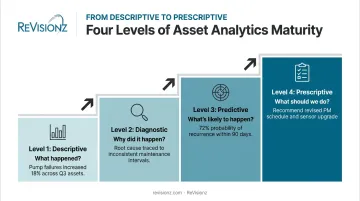
Data scientists categorize asset analytics into four types, each answering a different question and requiring more sophistication than the last: descriptive, diagnostic, predictive, and prescriptive. Knowing where each fits helps you match the right approach to the decision in front of you.
| Type | Question | Example Output |
|---|---|---|
| Descriptive | What happened? | Failure count by asset class over the last 12 months |
| Diagnostic | Why did it happen? | Correlation between vibration spikes and bearing wear |
| Predictive | What's likely to happen? | 85% probability of seal failure within 30 days |
| Prescriptive | What should we do? | Replace during next outage vs. immediate shutdown |
Descriptive analytics summarizes historical data through KPI dashboards, failure logs, and maintenance history. It shows what happened without explaining why.
Diagnostic analytics correlates multiple data sets, cross-referencing failure logs with temperature and vibration readings to identify root cause.
Predictive analytics uses statistical modeling and machine learning on historical and real-time data to forecast what's likely to happen next. This is where condition-based maintenance triggers originate.
Prescriptive analytics goes further, recommending specific actions and quantifying the tradeoffs between them, such as weighing an immediate shutdown against the risk of running an asset a few more weeks.
Organizations don't need to jump straight to prescriptive analytics to see value. Match the analytics type to the decision at hand:
- Descriptive dashboards for reliability reviews
- Diagnostic tools for post-failure investigations
- Predictive models for maintenance scheduling
- Prescriptive systems once you've built confidence in the underlying data
The Data & Technology Foundation Behind Predictive Analytics
Predictive analytics is only as reliable as the data feeding it. Incomplete, siloed, or poorly structured asset data is the leading cause of failed predictive analytics initiatives. Before evaluating algorithms, four categories of data need to be in place:
- Historical maintenance and failure records
- Real-time sensor and IoT condition data
- Engineering and asset master data, including tags, specs, and criticality rankings
- Operating context: environment, duty cycle, and usage patterns
Why Asset Data Quality Determines Predictive Analytics Success
Years of capital projects, system migrations, and multiple EPC contractors typically leave asset data unstructured and inconsistent, with duplicate tags, missing specs, and conflicting naming conventions across systems. That data has to be cleansed, enriched, and structured before any model can be trusted with it.
This is a bigger problem than most operators realize. Roughly 70% to 80% of asset data in enterprise asset management systems is incomplete or inaccurate at facility startup, and fixing it after commissioning costs three to ten times more than addressing it during project delivery.
This is where ReVisionz's Asset Information Management (AIM) practice and its Main Information Contractor+ (MIC+) AI-powered managed service come in. Both are built to take fragmented engineering and maintenance data and turn it into lifecycle-ready, structured information — the foundation predictive models need to produce results worth acting on.
Building the Technology Stack
The typical predictive analytics stack has three layers:
- IoT sensors and condition monitoring for vibration, temperature, pressure, and corrosion data
- A centralized data platform, usually your EAM or APM system, acting as the single source of truth
- Machine learning models layered on top to analyze patterns and generate predictions
The mistake many operators make is assuming they need to rip out existing systems to get here. A technology-agnostic approach, one that integrates with what's already running rather than forcing a wholesale platform swap, gets you to predictive capability faster and with far less disruption.
That's the practical value of working within an established alliance ecosystem, such as AVEVA, Hexagon, Cognite, VEERUM, and OpenText, rather than betting everything on a single vendor.
Key Benefits of Predictive Analytics for Asset-Intensive Operations
For an operator facing $253 million a year in downtime exposure, even modest efficiency gains translate into real budget relief. Predictive analytics consistently delivers three categories of returns:
- Reduced unplanned downtime and lower emergency costs: The same McKinsey research cited earlier shows predictive maintenance cutting downtime by 30% to 50%, with mature programs reporting breakdown reductions as high as 70% to 75%.
- Extended asset life and improved reliability: Condition-based interventions replace guesswork with evidence. Instead of swapping a bearing at month 18 because a schedule says so, you replace it when data shows real wear, often extending useful equipment life by 20% to 40%.
- Stronger safety and compliance outcomes: Catching corrosion, seal degradation, or vibration anomalies before they become incidents keeps assets operating within safe limits and supports the documentation regulators expect.
These wins compound over time. Lower downtime frees up maintenance budget to invest in the sensors and platforms that drive further gains, turning a one-time improvement into an ongoing cycle.
Overcoming Challenges: Best Practices for Implementation
Most predictive analytics initiatives stall for the same three reasons:
- Insufficient historical failure data to train reliable models
- Fragmented or unstructured asset information across legacy systems
- Skills gaps in building, or trusting, predictive model outputs
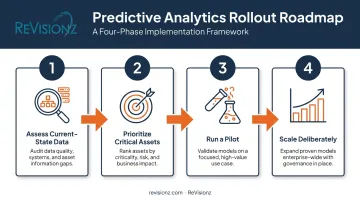
A phased roadmap addresses all three without requiring a plant-wide leap of faith:
- Assess current-state data to understand what exists, what's missing, and where the gaps are before selecting any tool
- Prioritize a critical subset of high-risk, high-consequence assets rather than attempting a plant-wide rollout
- Run a pilot to prove the model against real failure events on a manageable scope
- Scale deliberately, expanding asset coverage once the pilot demonstrates trustworthy results
As coverage expands, pair predictive outputs with experienced engineering judgment rather than replacing it outright. Operators who succeed treat model outputs as a second opinion at first, letting the track record earn full trust over time.
Experienced digital asset partners like ReVisionz help owner-operators and EPCs build this exact roadmap. They bridge the gap between the project data delivered at handover and the predictive-ready operational information these programs actually need to run.
Frequently Asked Questions
What are the 5 P's of asset management?
The commonly cited framework covers Policy, People, Process, Plant (physical assets), and Performance measurement. Each element supports a mature asset management program, from setting strategic direction to measuring whether it's working.
What is predictive asset management?
Predictive asset management uses historical and real-time data, combined with statistical and machine learning models, to anticipate equipment failures and guide maintenance before problems occur, rather than reacting after the fact.
What are the four types of asset analytics?
Descriptive analytics shows what happened, diagnostic explains why, predictive forecasts what's likely to happen next, and prescriptive recommends specific actions. Complexity and value increase at each stage.
How much historical data is needed before predictive analytics can work?
Consistency and quality matter more than volume. You need enough documented failure events, alongside healthy-condition data, for a model to reliably tell the difference between the two.
Can smaller operations benefit from predictive analytics, or is it only for large enterprises?
Smaller operations can start with a handful of critical assets rather than a plant-wide deployment. That scoped approach makes predictive analytics accessible regardless of company size.
What's the difference between predictive maintenance and predictive analytics for asset management?
Predictive maintenance is one application of predictive analytics, focused on maintenance timing. The broader discipline also informs capital planning, lifecycle cost decisions, and asset replacement strategy.