Introduction
Aging infrastructure. Tightening compliance mandates and relentless pressure to cut total cost of ownership are mounting too. Asset-intensive operators are juggling all three at once, and the old playbook of reactive maintenance isn't cutting it anymore.
The numbers make the case. Unplanned downtime costs Fortune Global 500 industrial companies $1.4 trillion a year, roughly 11% of their revenue, according to Siemens' 2024 True Cost of Downtime report. The average large plant alone loses an estimated $253 million annually to downtime events.
Digital twins are becoming a central answer to this problem. This article breaks down what digital twins actually are, how they drive measurable performance gains, and the data foundation most companies overlook until it's too late.
Key Takeaways
- Shift from reactive to predictive maintenance to reduce costly, unplanned outages.
- Selecting the right twin type—from component to enterprise—is crucial for project success.
- Prioritize high-quality data over specific software platforms for successful implementation.
- Market growth to $149.81B by 2030 shows digital twins are a core business strategy.
What is a Digital Twin in Asset Management?
A digital twin is a dynamic, data-driven virtual replica of a physical asset, system, or facility. It mirrors real-world condition, behavior, and performance across the entire asset lifecycle, not just a snapshot in time.
The Digital Twin Consortium defines it as a virtual representation synchronized with its real-world counterpart at a specified frequency and fidelity. That single word, "synchronized," is the defining requirement.
Pulling Siloed Data Into One Model
Most asset-intensive organizations have engineering, maintenance, and operations data scattered across disconnected systems:
- CAD drawings and P&IDs sitting in engineering archives
- Inspection records buried in maintenance logs
- IoT sensor feeds streaming into a separate monitoring platform
- Historical work orders locked inside legacy EAM systems
A digital twin connects these sources into a single, contextualized model that both people and systems can query in real time.
Digital Twin vs. Static 3D Model
This is where much of the confusion starts. A 3D model or BIM file can describe geometry and design intent beautifully, but it's frozen the moment it's published.
A true digital twin maintains a bidirectional feedback loop: sensor data flows into the model, and the model informs real-time decisions in return. Without that live connection, the result is a static image, not a digital twin.
For asset-intensive industries like energy, chemicals, mining, and manufacturing, this distinction matters. Twins extend well beyond visualization into predictive analytics, safety monitoring, and lifecycle decision support, exactly where the ROI lives.
Types of Digital Twins Used in Asset Management
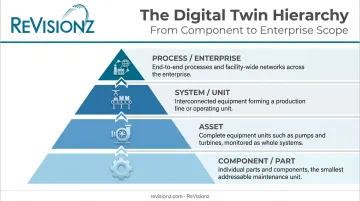
Not every twin serves the same purpose, and scope drives everything from data requirements to implementation cost. IBM's industrial digital twin taxonomy breaks industrial twins into four levels:
| Twin Type | What It Covers |
|---|---|
| Component/Part | An individual part, replicated for granular insight into that specific piece of equipment |
| Asset | A complete functional unit (a pump, turbine, or vessel) showing how its components interact |
| System/Unit | Multiple assets working together as an integrated process unit or production line |
| Process/Enterprise | The broadest view, modeling entire workflows across a facility, supply chain, or operation |
Component-level twins answer narrow questions, like why a specific bearing keeps failing early. Asset-level twins zoom out to the full equipment picture, useful for a compressor or reactor vessel where multiple parts interact.
System-level twins model interconnected assets across a process unit or facility, revealing how one asset's performance ripples through the rest of the line. Process and enterprise-level twins go furthest, simulating end-to-end operations for organization-wide performance decisions.
Most companies don't start at the enterprise level. They start with one critical asset, prove the value, then scale.
How Digital Twins Optimize Asset Management Performance
A digital twin's real value shows up in performance outcomes, not the 3D visualization: fewer failures, longer asset life, tighter compliance, and faster decisions.
Predictive & Prescriptive Maintenance
IoT sensors feed vibration, temperature, and pressure data into the twin model continuously. When readings drift from expected baselines, the twin flags the anomaly before it becomes a failure.
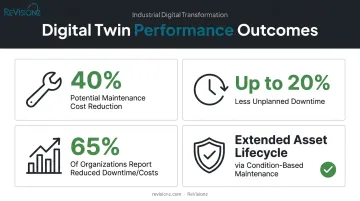
This shifts maintenance teams from a reactive posture, fixing equipment after it breaks, to a predictive one that catches problems beforehand. Siemens estimates that full predictive-maintenance adoption could reduce maintenance costs by 40%, equivalent to $233 billion across Fortune Global 500 industrial companies.
That's a projection tied to predictive maintenance broadly, not a digital-twin-specific guarantee. But the twin is often what makes predictive maintenance operationally possible at scale, since it's the layer that contextualizes raw sensor data into something a maintenance planner can actually act on.
Reduced Downtime & Improved Reliability
Real-time visibility into asset condition lets teams intervene before a small issue becomes a catastrophic outage. Hexagon's industry data puts the impact at up to 20% less unplanned downtime from digital twin deployment.
For context, Hexagon translates that figure into millions saved per rig annually in offshore operations. Separately, a Process Excellence Network survey found that 65% of organizations using digital twin technology reported reduced downtime and operational costs.
That's not a universal average, but it's a strong signal. Two-thirds of adopters are seeing real reliability gains, not marginal ones.
Extended Asset Lifecycle & Lower Total Cost of Ownership
Continuous performance tracking across design, construction, and operations phases changes how maintenance gets timed. Instead of servicing equipment on a fixed calendar schedule, teams intervene based on actual condition data.
This precision timing matters for two reasons:
- Prevents over-maintenance, which wastes labor and parts on equipment that doesn't need attention yet
- Catches degradation early enough to extend useful life instead of accelerating replacement
This is where reducing total cost of ownership across the full asset lifecycle stops being a slogan and becomes measurable. Every deferred replacement and every avoided emergency repair reduces costs directly.
Enhanced Safety, Compliance & Decision-Making
Real-time monitoring surfaces risk conditions, such as corrosion, leaks, and structural stress, as they emerge rather than during the next scheduled inspection. That gap between "when a problem starts" and "when someone notices" is exactly where safety incidents happen.
Centralized, accurate asset data also changes how fast teams can act. Maintenance, engineering, and executive leadership are pulling from the same source of truth instead of reconciling conflicting spreadsheets. Decisions that used to take weeks of data-chasing happen in days.
The Data Foundation That Powers Effective Digital Twins
A digital twin is only as good as the data feeding it. This is the part vendors gloss over, and it's usually where projects stall.
Most digital twin failures don't trace back to bad software. They trace back to poor, incomplete, or unstructured underlying asset data. Common culprits include:
- Fragmented legacy systems that never talked to each other
- Inconsistent tagging conventions across facilities or even within the same plant
- Missing documentation from EPC handover, the classic "document rich, information poor" problem
- Siloed maintenance records that live outside the engineering system of record
Asset Information Management Closes the Gap
This is where Asset Information Management, or AIM, comes in. AIM is the discipline that transforms raw, unstructured data into lifecycle-ready, trusted information a digital twin can actually use.
ReVisionz has built its data migration and enrichment methodology around exactly this problem. In one 13-year enterprise engagement, the team addressed and enriched 100% of migrated content to meet enterprise standards for completeness and trust.
That work created the standardized foundation the client needed before deploying AI-driven tools and digital twin initiatives.
The company's AI-powered MIC+ (Main Information Contractor+) managed service extends this further, helping owner-operators close the data-readiness gap before or during a digital twin rollout instead of discovering data problems mid-implementation.
Staying Technology-Agnostic
One more piece matters here: platform choice. Locking into a single software vendor before you understand your data maturity and business goals often backfires.
A technology-agnostic approach evaluates platforms like AVEVA, Cognite, or Hexagon based on fit rather than familiarity. This tends to produce better long-term outcomes because the technology gets matched to the problem, not the other way around.
Implementation Challenges and Cost Considerations
Digital twin costs vary widely, and there's no single number that applies across the board. Scope is the biggest driver:
- Single asset vs. enterprise-wide: A twin for one pump costs a fraction of a facility-wide deployment
- Data maturity: Clean, well-tagged data costs far less to prepare than fragmented legacy records
- Real-time IoT integration: Adding live sensor feeds increases both platform licensing and integration costs
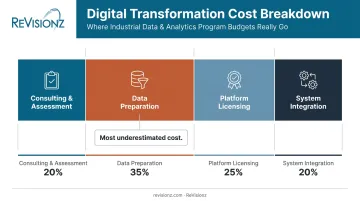
Costs typically span four buckets: consulting and assessment, data preparation, platform licensing, and system integration. Data preparation is consistently the most underestimated line item, since it's easy to scope the software and hard to scope how messy your existing records actually are.
Beyond cost, three barriers show up again and again:
- Technical expertise gaps: internal teams often lack the data governance skills to architect a twin-ready environment
- Organizational change resistance: new digital workflows require buy-in, not just a new login
- Ongoing model maintenance: a twin drifts out of sync with reality if nobody keeps the underlying data current
ReVisionz's Master Data Governance and change enablement services are built specifically to close these gaps, turning fragmented records and resistant teams into digital twin-ready foundations.
These challenges haven't slowed adoption. MarketsandMarkets projects the global digital twin market will grow from $21.14 billion in 2025 to approximately $149.81 billion by 2030, a 47.9% compound annual growth rate. That trajectory reflects how central digital twins have become to modernization plans across asset-heavy industries.
Why Partner with ReVisionz for Digital Twin Success
ReVisionz has spent 25 years working inside the exact problem this article covers: turning messy, siloed asset data into something a digital twin can actually run on. The firm's roots trace back to a 2001 rescue project inside a failing software implementation. That same challenge, bridging what owner teams need with what platforms promise, still defines the work today.
A few things set the approach apart:
- Technology-agnostic delivery through alliances with AVEVA, OpenText, Cognite, VEERUM, and Hexagon/Octave, so clients pick the platform that fits their operation, not the one a vendor is selling
- Deep AIM and digital twin implementation experience across energy, chemicals, mining, and manufacturing
- Third-party validation, including the 2025 Hexagon Award for Digital Projects Outstanding Alliance Partner, North America
If your organization is weighing a digital twin program, the data readiness question usually matters more than the platform question. Consult with ReVisionz to assess where your asset data stands before you commit to a deployment.
Frequently Asked Questions
What is a digital twin in asset management?
A digital twin is a real-time virtual replica of a physical asset that integrates engineering, maintenance, and sensor data. It supports continuous condition monitoring and lifecycle decision-making, not just visualization.
What are the 4 types of digital twins?
The four levels are component/parts-level (individual equipment parts), asset-level (a full piece of equipment like a pump or turbine), system-level (interconnected assets across a process unit), and process/enterprise-level (entire operations or workflows).
Is digital twin still relevant?
Yes. The global digital twin market is projected to grow at a 47.9% CAGR from 2025 to 2030, reaching nearly $150 billion. Adoption across energy, chemicals, and manufacturing continues to expand, not contract.
How much does a digital twin cost?
Cost depends on scope (single asset vs. enterprise-wide), existing data maturity, and whether real-time IoT integration is included. Data preparation and AIM work are typically the most underestimated cost driver, more so than platform licensing.
How does asset data quality affect digital twin success?
Incomplete or inconsistent asset data produces inaccurate, unreliable twin models. Asset Information Management practices, like tagging standardization and data enrichment, are essential groundwork before a twin can be trusted.
Which industries benefit most from digital twins in asset management?
Capital-intensive, highly regulated industries such as energy, chemicals, mining, and manufacturing see the greatest ROI. Their complex, high-value assets and strict safety and compliance requirements make predictive insight especially valuable.