
Introduction
Asset failures in energy facilities rarely start with an explosion or a leak. They start weeks or months earlier — with a missed inspection note, a risk assessment sitting in someone's inbox, or two teams working from different versions of the same piping drawing.
By the time the failure shows up physically, the real breakdown already happened in the data.
The financial stakes are real. According to Siemens' 2024 True Cost of Downtime report, unplanned downtime costs at oil and gas plants spiked to three times 2019 levels in 2022.
By 2023, those costs settled near half of 2019 levels, a swing driven largely by oil price volatility, not equipment condition alone.
Aging infrastructure and tighter regulatory scrutiny mean periodic inspections alone no longer cut it. Energy operators need a connected, data-driven integrity strategy.
This guide breaks down what Asset Integrity Management (AIM) actually involves: its core methodologies (RBI, FFS, PIMS), the data foundation most programs overlook, and how digital transformation is changing what's possible.
Key Takeaways
- AIM unifies inspection, engineering, and maintenance data into one lifecycle framework
- RBI, FFS, and PIMS only work as well as the data feeding them
- Siloed or incomplete data is one of the biggest hidden risks to asset integrity
- Digital twins, AI, and integrated platforms now enable proactive integrity strategies
- Phased, data-first rollouts lower total cost of ownership and strengthen compliance
What Is Asset Integrity Management in Energy?
Asset Integrity Management is the structured approach used to keep equipment, piping, pipelines, and facilities safe, reliable, compliant, and fit for service across their entire operating life. Rather than a single technical task, it's a connected process that pulls together risk assessment, inspection, damage mechanism review, repair planning, and documentation.
That connection matters more in energy than almost anywhere else. Upstream, midstream, downstream, and petrochemical assets share three traits:
- Capital-intensive: replacing a distillation column or a pipeline segment costs millions
- Long-lived: many assets operate for 30, 40, even 50+ years
- High-consequence: a single failure can mean fatalities, environmental damage, or regulatory shutdown
Asset Integrity vs. Inspection vs. Maintenance
These three terms get used interchangeably, but they answer different questions:
| Function | Core Question | Example Action |
|---|---|---|
| Inspection | What is the current condition? | Measure wall thickness on a pipe |
| Maintenance | What work keeps it running? | Repair, clean, or replace a component |
| AIM | Is it safe and fit for service over its lifecycle? | Decide run, repair, re-rate, or replace based on risk |
Take wall thinning in a piping run. Inspection finds the reading and logs it, while maintenance schedules a patch or replacement.
AIM asks a different question: does that thinning change the equipment's remaining life, does it trigger a Fitness-for-Service review, and should the inspection interval for similar piping shorten? Same finding, three distinct but connected responses.
Why Asset Integrity Matters More for Capital-Intensive Energy Assets
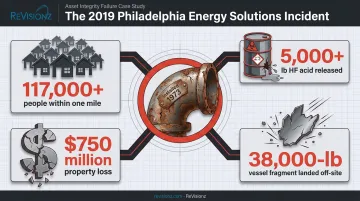
The 2019 Philadelphia Energy Solutions refinery incident is a stark illustration. The U.S. Chemical Safety Board's investigation found the failure began with a pipe elbow installed in 1973 that ruptured after decades of accelerated corrosion. The consequences:
- More than 5,000 lb of hydrofluoric acid released
- A 38,000-lb vessel fragment landed off-site
- An estimated $750 million in property loss
- More than 117,000 people lived within one mile of the facility
Energy operators face regulatory, environmental, and reputational exposure that most industries simply don't. A single integrity failure can trigger PHMSA or CSB investigations, multi-year litigation, and community trust damage that outlasts the repair itself.
Core Elements & Methods of an AIM Program: RBI, FFS, PIMS and More
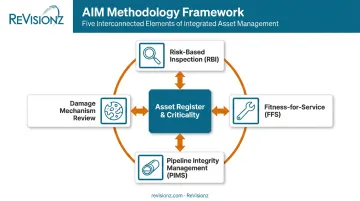
A mature AIM program combines several interconnected methodologies, each feeding the others, rather than a single inspection activity repeated on a schedule.
Asset Register, Criticality & Risk Assessment
Everything starts here. Before any inspection plan makes sense, operators need a clean inventory of what they own and a ranking of what matters most, based on safety, production, and environmental consequence. Skip this step and every downstream decision inherits the same gaps.
Risk-Based Inspection (RBI)
RBI, guided by API RP 580 and API RP 581, replaces fixed inspection intervals with risk-driven ones. It combines:
- Probability of failure: based on damage mechanisms, materials, and operating history
- Consequence of failure: safety, environmental, and financial impact
The result: inspection scope, method, and frequency that match actual risk, not a generic calendar.
Fitness-for-Service (FFS) Assessments
When inspection finds a flaw, such as corrosion, a crack, or a dent, FFS assessments (per API 579-1/ASME FFS-1) determine whether the equipment can keep running, needs repair, requires re-rating, or must be replaced. This is where engineering judgment meets real operating data.
Pipeline Integrity Management Systems (PIMS)
For pipelines, integrity management follows a parallel but distinct track. PIMS covers threat identification, in-line inspection data, cathodic protection monitoring, and repair prioritization, following frameworks required under 49 CFR Part 192 Subpart O for gas transmission lines and 49 CFR 195.452 for hazardous liquid lines.
Damage Mechanisms & Inspection Planning
None of the above works without understanding why equipment fails. Credible damage mechanisms, including corrosion, cracking, fatigue, and corrosion under insulation (CUI), determine which inspection method actually detects the threat, and they feed directly into RBI probability scoring and FFS assumptions. Get the damage mechanism wrong, and every downstream calculation is wrong too.
Why Data Is the Foundation of Effective Asset Integrity Management
Here's the uncomfortable truth: RBI, FFS, and PIMS are only as reliable as the data feeding them. A perfectly executed methodology built on fragmented data still produces bad decisions.
Common data challenges we see across energy operations:
- Engineering records split across legacy systems that don't talk to each other
- Inconsistent equipment tagging between design, construction, and operations
- Siloed inspection, maintenance, and operations platforms
- Incomplete data handover from EPC contractors to owner-operators at project startup
Each of these creates real downstream damage:
- Inconsistent risk ranking across similar assets and business units
- Delayed repair decisions while teams argue over which dataset is correct
- Duplicated inspection effort because nobody trusts the last dataset
- Audit gaps that surface at the worst possible time — during a regulatory review
The real fix is a trusted, structured, lifecycle-ready information environment, one where engineering, inspection, maintenance, and operations all pull from the same data model instead of five different spreadsheets.
This is where ReVisionz's work sits. Through the Main Information Contractor+ (MIC+) service, we apply AI-assisted bulk processing paired with disciplined QA to migrate and enrich legacy asset data at scale. In one engagement, that meant over 800,000 documents and version histories with a 99.99% migration success rate.
The objective is turning unstructured legacy records into information integrity teams can act on.
When that data is trustworthy in real time, predictive insight becomes possible. That insight is what strengthens compliance and safety performance, far more than another audit checklist.
How Digital Transformation Is Reshaping Asset Integrity Management
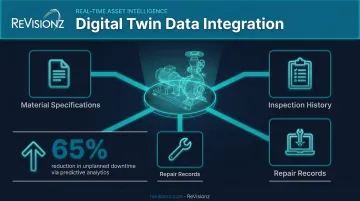
Digital twins and 3D engineering models are changing how integrity decisions get made. Instead of referencing outdated drawings, teams now work from a single source of truth that links design intent directly to the physical asset. A corrosion finding on a live model connects instantly to:
- Material specifications
- Inspection history
- Repair records
AI and predictive analytics are pushing the shift from reactive inspection to proactive risk identification. The results can be significant. At Saudi Aramco's Uthmaniyah Gas Plant, advanced analytics and predictive maintenance reduced unplanned downtime by 65%, according to World Economic Forum reporting.
One caution worth naming: predictive tools are only valuable when the underlying workflow is sound. A poorly tuned model that generates excess false positives can erase projected savings just as fast as it creates them. That risk almost always traces back to data quality, the foundation this guide keeps returning to.
A technology-agnostic mindset matters here too. No single platform covers every integrity need, so ReVisionz maintains strategic alliances across multiple platforms:
- AVEVA
- Hexagon
- Cognite
The firm integrates whichever platform fits the client's environment, rather than forcing a single vendor's architecture onto every asset.
The end goal across all of this: closing the gap between EPC project handover and operational readiness, so asset data is usable from day one instead of being reconstructed months after startup.
Best Practices for Building a Mature AIM Program
Building AIM maturity depends on sequencing the right work in the right order, not on buying more software.
- Secure executive sponsorship: cross-functional alignment between inspection, reliability, maintenance, engineering, and operations teams prevents AIM from becoming an isolated technical project
- Start with a clean asset register and criticality assessment: before layering on RBI, FFS, or PIMS, know what you own and what matters most
- Take a phased, iterative approach: pilot on your most critical assets first, prove the data model works, then scale governance and digital tools across the wider portfolio
- Define clear KPIs: asset availability, inspection efficiency, and compliance rate give leadership a way to measure progress instead of guessing
Programs that skip step two (the clean asset register) almost always end up rebuilding it later, at a higher cost, under time pressure. Building it first is the fastest path to a program that actually holds up.
Frequently Asked Questions
What is Asset Integrity Management (AIM)?
AIM is a structured, lifecycle-wide approach that connects inspection, risk assessment, and asset data to keep energy equipment, piping, and pipelines safe, reliable, and compliant. It goes beyond periodic checks to guide run, repair, or replace decisions.
What is the difference between asset integrity management and maintenance?
Maintenance focuses on the corrective and preventive work that keeps equipment running day to day. AIM takes a broader view: a risk-based framework that decides whether an asset is fit for continued service across its full lifecycle.
What are the core elements of an asset integrity management program?
A mature program includes:
- Asset register and criticality assessment
- Risk-Based Inspection (RBI)
- Fitness-for-Service (FFS) assessments
- Pipeline Integrity Management Systems (PIMS)
- Damage mechanism review and documentation control
How does poor asset data affect integrity management decisions?
Fragmented or unstructured data leads to inconsistent risk ranking, delayed repair decisions, duplicated inspection work, and gaps that surface during regulatory audits. Strong methodology can't compensate for unreliable data.
Why is digital transformation important for asset integrity management?
Digital twins, AI, and integrated data platforms shift teams from reactive inspection to proactive risk identification. They create a single source of truth linking design data to physical asset condition in real time.
Which industries rely most on asset integrity management?
Oil and gas, petrochemicals, power generation, and pipeline operators depend heavily on AIM, along with other capital-intensive energy infrastructure sectors where equipment failures carry high safety and financial stakes.