Many operators struggle with a familiar problem: siloed systems, aging infrastructure, and engineering data that never quite makes it from the project team to the operations team. Digital ambitions grow every year, but the foundation underneath them often doesn't.
The global digital oilfield market illustrates the stakes. It was valued at $30.1 billion in 2023 and is projected to reach $43.0 billion by 2029, according to MarketsandMarkets. That's real money chasing a real problem.
This article breaks down what data management actually means in oil & gas, where the biggest obstacles live, proven strategies to fix them, and how the right transformation partner turns raw data into a lifecycle-ready asset.
Key Takeaways
- Lifecycle-ready data strengthens safety, compliance, and cost control across the entire value chain
- Siloed systems, IT/OT misalignment, and inconsistent governance remain the top barriers to reliable data
- A phased approach involving governance, infrastructure, analytics, and continuous quality management beats a disruptive big-bang rollout
- The digital oilfield market will reach $43.0 billion by 2029, a clear signal for operators still on the sidelines
- Choosing the right implementation partner often determines whether technology investment pays off or becomes long-term technical debt
What Is Data Management in the Oil & Gas Industry?
Oil & gas data management covers the practices, tools, and governance used to capture, store, integrate, and use data across an asset's entire life. This work spans teams and systems, not one platform or department. The discipline keeps engineering records, sensor feeds, and financial data trustworthy enough to act on.
The data types involved are enormous and varied:
- Seismic surveys and reservoir characterization models
- Drilling and production metrics tracked in real time
- IoT sensor telemetry from pumps, valves, and compressors
- Engineering documents including P&IDs, 3D models, and laser scans
- Maintenance and reliability records tied to specific asset tags
- Compliance documentation required for audits and regulatory review
Data Across the Asset Lifecycle: Upstream, Midstream, Downstream
Each segment depends on trustworthy, integrated data in its own way. Upstream teams need exploration and well data that reflects reservoir reality, not outdated assumptions. Midstream operators rely on pipeline and transport monitoring to catch leaks and pressure anomalies before they escalate. Downstream refiners need production and distribution data that's accurate enough to optimize yield.
The gap that costs operators the most, though, sits between project delivery and operations. As-built records and tag data generated during EPC handover routinely get lost, buried, or never fully validated once a facility starts up. That gap follows an asset for years.
Why Data Quality Is the Foundation of Digital Transformation
Digital twins, predictive maintenance models, and AI initiatives are only as good as the data feeding them. Garbage in, garbage out still applies, no matter how sophisticated the algorithm.
McKinsey describes most oil and gas technology estates as fragmented combinations of modern and legacy IT and OT, where business-critical data is often difficult to access, interpret, and trust. In manufacturing contexts, McKinsey has found that data engineers can spend weeks just locating and diagnosing broken data — and high-value AI use cases get shelved for years as a result.
The pattern in oil & gas isn't different. It's worse, given the volume of legacy paper and disconnected systems still in play.
Key Challenges in Oil & Gas Data Management
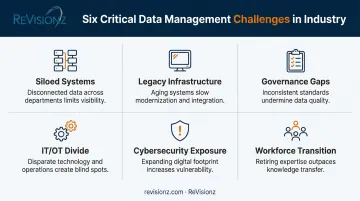
Six obstacles show up again and again across operator and EPC engagements.
- Siloed systems: Sites and business units operate disconnected platforms, preventing any unified operational view
- Legacy infrastructure: Aging systems buckle under the volume of structured and unstructured data pouring in from sensors, field logs, and historical records
- Governance gaps: Inconsistent standards, unclear data ownership, and manual validation create risk across departments and regions
- IT/OT divide: Business systems and field/engineering technology run on different priorities, tools, and update cycles, and rarely talk to each other cleanly
- Cybersecurity exposure: Dragos identified 176 ransomware attacks targeting oil and gas along with 9 distinct threat groups, alongside an 87% increase in ransomware against industrial organizations broadly
- Workforce transition: Paper-based habits and legacy-tool familiarity create resistance as teams shift to digital-first workflows
That IT/OT divide deserves a closer look. Engineering and operations teams frequently discover their systems weren't built to reflect how work actually flows between departments. Engineering, maintenance, supply chain, and document control end up working around each other instead of with each other.
The result: workarounds, duplicate data entry, and eroded trust in the numbers everyone's supposed to rely on.
Core Strategies for Digital Transformation & Data Management
Fixing these problems takes more than new software. It takes sequence and discipline.
Establish Data Governance and a Phased Roadmap
Start by assigning clear data ownership, standards, and KPIs, then put IT and OT teams under one governance framework instead of two competing ones. From there, build a phased roadmap:
- Current-state assessment: Document what exists, where it lives, and who owns it
- Future-state design: Define the target architecture and governance model
- Staged implementation: Roll out changes in manageable phases, not a disruptive big-bang launch
Modernize and Integrate Data Infrastructure
Legacy point solutions can't keep pace with today's data volumes. Shifting to integrated cloud or hybrid environments unifies engineering, operational, and business data under one accessible structure.
Open standards matter here. The OSDU Data Platform now counts 206 participating organizations across operators, service companies, and technology providers, according to The Open Group. Standards like this improve interoperability across vendors, sites, and partners, reducing the custom integration work that used to make every system swap a multi-year headache.
Apply Analytics, AI, and Big Data for Actionable Insight
Once infrastructure and governance are in place, analytics start delivering real value. The IEA identifies applications spanning resource evaluation, predrill risk reduction, production optimization, leak detection, and predictive maintenance.
Real-world results back this up:
- SLB cut water-bottom seismic interpretation time from 80 hours to 8 hours in Angola's Kwanza Basin
- bp's Optimization Genie added 2,000 barrels a day at its Atlantis hub using AI on digital-twin models
None of that works without clean, structured inputs. This is where AI-powered data enrichment earns its place, turning unstructured legacy asset data into something usable. ReVisionz's Main Information Contractor+ (MIC+) service applies natural language processing and machine learning to extract and standardize information buried in scanned documents, maintenance logs, and legacy tags, producing lifecycle-ready records instead of another pile of unreadable files.
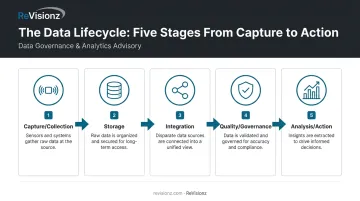
Follow the Data Lifecycle: The Core Stages of Data Management
A practical framework operators can apply across any engagement:
- Capture/collection: Pull data from sensors, documents, and field systems
- Storage: House it in accessible, secure, scalable environments
- Integration: Connect it across ERP, EAM, and engineering platforms
- Quality/governance: Validate, standardize, and assign clear ownership
- Analysis/action: Turn validated data into decisions, not just dashboards
Business Benefits of Getting Data Management Right
The payoff shows up in three places operators care about most.
- Lower total cost of ownership: Fewer rework cycles, fewer data-related delays, and smoother handover from project delivery into operations
- Stronger safety and compliance: Real-time, auditable data and reliable documentation trails replace scattered paper and guesswork
- Better asset performance: Predictive maintenance built on trusted data catches problems early instead of after failure
SLB's OptiSite platform, for example, predicted 88% of equipment failures with 21 days of advance warning at two facilities, helping avoid 15 days of shutdown.
McKinsey notes that large-scale predictive maintenance programs can require more than 100 models to cover the full range of failure modes. The economics only work when underlying data stays consistent enough to build on across those models. This makes data quality a smart upfront investment that pays for itself in fewer failures and less downtime.
How ReVisionz Helps Oil & Gas Companies Bridge the Data Gap
ReVisionz is a technology-agnostic digital transformation consultancy, not a software vendor. The company has spent 25 years focused specifically on Asset Information Management and digital twin implementation for asset-intensive industries.
That distinction matters. Rather than pushing one platform, ReVisionz maintains strategic alliances with AVEVA, OpenText, Cognite, VEERUM, and Hexagon/Octave, choosing the right combination based on what a client's operations need, rather than what a single vendor wants to sell.
Much of the work centers on the handoff point that trips up most operators: the gap between project delivery and operational readiness.
EPCs and owner-operators across energy, chemicals, and other asset-intensive sectors bring ReVisionz in during this handoff. The goal is straightforward: make sure as-built records, tag data, and engineering documentation survive the transition from construction to startup, rather than becoming next year's cleanup project.
Frequently Asked Questions
What is petroleum data management?
It's the governance, processes, and tools used to capture, store, and use data across upstream, midstream, and downstream operations. It covers everything from seismic surveys to compliance records.
How is big data used in the oil and gas industry?
Big data powers predictive maintenance, seismic and reservoir analysis, production optimization, and real-time equipment monitoring. It also supports leak detection and safety analytics across facilities.
What are the 5 stages of data management?
Capture/collection, storage, integration, quality/governance, and analysis/action. Together, they form a practical lifecycle operators can apply to any data type.
What is the difference between IT and OT in oil and gas data management?
IT covers business systems used to store, manage, and transmit data. OT covers field and engineering technology that directly monitors or controls physical processes. Aligning the two is essential for a unified data view.
What is Asset Information Management (AIM) and how does it relate to digital transformation?
AIM is the discipline of organizing engineering and asset data for use across an asset's full life. It's foundational to digital twins and forms the backbone of most broader digital transformation efforts.
How long does a digital transformation initiative typically take for an oil & gas operator?
Timelines vary widely by scope and asset complexity. Phased roadmaps (assessment, pilot, then scale) typically run from several months for a single site to multi-year programs for enterprise-wide rollouts.