Many organizations still manage maintenance through spreadsheets, sticky notes, and tribal knowledge held by a handful of senior technicians. That approach makes downtime unpredictable and expensive. When asset data lives in five different places, nobody has a clear picture of what needs attention next.
This article breaks down eight practical equipment asset management strategies that asset-intensive operators use to reduce downtime and extend equipment life. Each one builds on the last, moving teams from reactive firefighting toward proactive, data-driven operations.
Key Takeaways
- EAM covers the full asset lifecycle, not just maintenance scheduling
- Clean, centralized asset data is the foundation for reducing downtime
- Criticality analysis and root cause analysis focus resources on critical assets
- Technology works only with governed data and experienced implementation partners
What Is Equipment Asset Management?
Equipment asset management is the systematic process of managing physical assets from acquisition through disposal. It covers tracking, maintenance planning, and lifecycle optimization, not just knowing where a piece of equipment sits on the plant floor.
EAM is broader than simple inventory tracking. It integrates asset data, maintenance history, and performance analytics to guide decisions like when to repair versus replace, or where to invest capital next.
EAM is often confused with CMMS (computerized maintenance management systems), but the two serve different purposes. According to IBM, CMMS tools focus mainly on maintenance execution—meaning work orders, schedules, and parts—while EAM extends across the entire asset lifecycle, including financial performance and long-term strategy. We'll dig deeper into that distinction in the FAQ section below.
Why Equipment Downtime Costs More Than You Think
Most teams underestimate downtime because they only count the repair invoice. The real number is much larger.
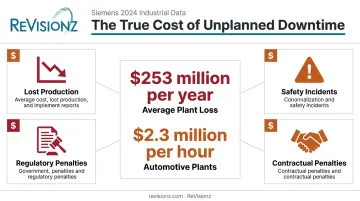
Siemens' 2024 True Cost of Downtime report estimated that a large plant loses an average of $253 million per year to unplanned downtime across surveyed sectors.
Automotive plants alone reported losses averaging $2.3 million per hour. These figures come from 181 interviews with maintenance, engineering, and IT professionals, so treat them as directional rather than a universal guarantee for every facility.
The hidden costs go well beyond the repair bill:
- Lost production that can't be recovered even after the line restarts
- Safety incidents triggered by rushed repairs or equipment operating outside spec
- Regulatory penalties for missed emissions or environmental reporting windows
- Contractual penalties when downstream customers don't receive product on time
Once you add up these hidden costs, a "minor" failure starts looking like a major financial event.
8 Equipment Asset Management Strategies to Reduce Downtime
These eight strategies move organizations from reactive firefighting to proactive, data-driven asset management. They build on each other, starting with data foundations and ending with a continuous improvement loop.
Strategy 1: Centralize Asset Information Into a Single Source of Truth
Fragmented data is the root cause behind most missed maintenance. When specs live in one spreadsheet, work orders in a legacy CMMS, and drawings in a shared drive nobody updates, technicians end up guessing.
Consolidating equipment specs, maintenance history, and engineering documentation into one lifecycle-ready system is foundational to every other strategy on this list. Without it, predictive maintenance models have nothing reliable to learn from, and criticality rankings get built on incomplete information.
Closing that gap usually requires outside expertise. ReVisionz, for instance, works with owner-operators to migrate and enrich legacy engineering data, turning scattered records into structured, usable formats that support long-term asset strategy rather than one-time cleanup projects.
Strategy 2: Shift From Reactive to Preventive Maintenance
Preventive maintenance means servicing equipment based on OEM specifications, run-hours, or calendar intervals, not waiting for something to break.
Common preventive triggers include:
- Fixed operating cycles (every 500 hours of runtime)
- Usage thresholds (miles driven, batches processed, tons handled)
- Seasonal inspections tied to weather or shutdown windows
- Manufacturer-recommended service intervals from the OEM manual
The shift sounds simple, but it requires trustworthy asset records. You can't schedule maintenance around run-hours if nobody's tracking run-hours accurately.
Strategy 3: Adopt Predictive Maintenance With IoT and Condition Monitoring
Predictive maintenance goes a step further than preventive schedules. Sensors, vibration analysis, and thermal imaging catch early warning signs, like a bearing running hot or a motor vibrating outside normal range, before failure actually happens.
The upside is well documented. Deloitte's analysis of predictive maintenance programs found potential reductions of 5% to 10% in maintenance costs and increases of 10% to 20% in equipment uptime and availability. These are potential ranges based on client work, not guaranteed outcomes for every deployment.
Predictive maintenance only delivers these gains when it's built on clean historical data. Sensor readings mean nothing if they can't be matched against accurate equipment records and failure history.
Strategy 4: Prioritize Assets Using Criticality Analysis
Not every asset deserves equal attention. Criticality analysis ranks equipment by safety impact, production impact, and repair cost, so maintenance teams spend limited resources where failure actually hurts.
Two established methodologies formalize this ranking in process industries:
- FMECA (Failure Mode, Effects, and Criticality Analysis) identifies how equipment might fail and ranks those failure modes by risk, per IEC 60812
- RCM (Reliability-Centered Maintenance) evaluates functions, failure consequences, and appropriate maintenance responses, per SAE JA1011
A pump feeding a critical reactor deserves a different maintenance strategy than a backup unit sitting idle in the yard. Criticality analysis makes that distinction explicit instead of leaving it to gut instinct.
Strategy 5: Standardize and Govern Asset Master Data
Inconsistent naming conventions, duplicate records, and missing attributes sound like minor annoyances until they delay a repair by three days because nobody could find the right pump spec.
Data governance keeps records accurate as systems, teams, and equipment change over time. Without it, every system migration or personnel change reintroduces the same mess.
Strong governance typically addresses three recurring symptoms:
- Lack of data trust, caused by inconsistent quality standards and incomplete cleansing
- No clear ownership, where data management is scattered across facilities with no accountable party
- No single source of truth, with information spread across formats and systems that don't talk to each other
Ongoing governance, not a one-time cleanup project, is what keeps asset records usable for the long haul.
Strategy 6: Use Digital Twins for Visualization and Simulation
Digital twins combine 3D models with live operational data, giving teams a virtual representation of a piece of equipment, a production unit, or an entire plant.
This matters for downtime reduction because it supports remote diagnostics and scenario planning. Instead of sending a technician to physically locate and inspect a component, engineers can review current conditions and simulate outcomes before committing labor and parts.
The practical payoff is time. Technicians spend less time walking the plant floor hunting for equipment and more time actually diagnosing and fixing the problem, especially valuable across sprawling multi-unit facilities where a single walk-down can eat up an entire shift.
Strategy 7: Optimize Spare Parts and MRO Inventory
Stockouts delay repairs. Overstocking ties up working capital in parts sitting on a shelf. Neither extreme is good asset management, and most facilities lean toward one or the other without realizing it.
Demand forecasting helps balance the two by matching stock levels to actual failure patterns and lead times, rather than gut-feel reorder points set years ago.
The bigger lever is integration. When inventory systems talk to maintenance planning software, technicians know a part is in stock (or on order) before they even schedule the job. That connection alone eliminates a lot of the "waiting on parts" downtime that shows up in MTTR reports.
Strategy 8: Conduct Root Cause Analysis and Continuous Improvement
Fixing the same failure over and over is a symptom of skipping root cause analysis. RCA digs into why a failure keeps happening instead of just patching the immediate problem and moving on.
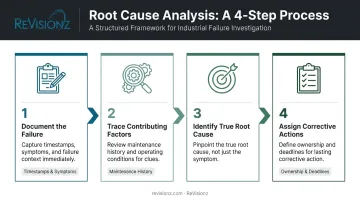
A basic RCA process typically works through:
- Document the failure with timestamps, symptoms, and immediate cause
- Trace contributing factors back through maintenance history and operating conditions
- Identify the true root cause, which is often different from the obvious trigger
- Assign corrective actions with clear ownership and deadlines
RCA findings shouldn't sit in a report and gather dust. They need to feed back into asset data, criticality rankings, and preventive maintenance plans. That feedback loop is what turns isolated fixes into genuine reliability improvement over time.
How Technology and Expert Partners Accelerate These Strategies
Executing all eight strategies well requires the right technology platforms and clean, structured asset data behind them. Most teams have the first part figured out. It's the second part that trips them up.
Legacy or fragmented data makes it genuinely difficult to implement predictive maintenance, digital twins, or governance programs alone. You can buy the best sensor platform on the market, but if it's feeding on inconsistent equipment records, the outputs won't be reliable.
That's the gap a specialized data partner needs to close. ReVisionz works as a digital transformation consultancy focused on turning unstructured asset data into lifecycle-ready information for energy, chemicals, and manufacturing operators. A few things worth knowing:
- Takes a technology-agnostic approach, partnering across platforms like AVEVA, Cognite, and Hexagon so clients aren't locked into a single vendor's roadmap
- Applies AI through its MIC+ (Main Information Contractor+) service to help owner-operators maintain lifecycle-ready asset data on an ongoing basis, not just during a one-time project
- Brings 25 years of experience to the table, backed by Hexagon's 2025 Outstanding Alliance Partner award for execution on complex digital asset programs
The strategies above work in theory for almost any organization. What separates the ones that actually reduce downtime is whether the underlying data can support them.
Measuring the Success of Your Asset Management Strategy
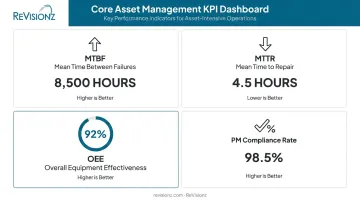
None of these strategies mean much without a way to prove they're working. A handful of core KPIs give teams a consistent way to track progress and make the case to leadership.
| KPI | What It Measures |
|---|---|
| MTBF (Mean Time Between Failures) | Total operating time divided by number of failures; higher is better |
| MTTR (Mean Time to Repair) | Total repair time divided by number of repairs; lower is better |
| OEE (Overall Equipment Effectiveness) | Availability x Performance x Quality, combined into one effectiveness score |
| PM Compliance Rate | Percentage of scheduled preventive maintenance completed on time |
Consistency matters more than most teams realize. MTBF and MTTR only mean something if every site defines "failure" and "repair start/end" the same way, and comparing plants using different definitions produces numbers that look meaningful but aren't. This is the exact gap ReVisionz's master data governance work closes, giving every site a shared definition to benchmark against.
With consistent definitions in place, benchmark against these KPIs quarterly rather than waiting for year-end review. Continuous tracking lets teams catch drift early and adjust strategy priorities before small problems turn into big ones.
Frequently Asked Questions
What is equipment asset management?
Equipment asset management is the lifecycle management of physical assets, from acquisition through disposal, aimed at maximizing uptime, safety, and value. It covers tracking, maintenance planning, and performance analytics together, not maintenance alone.
How does CMMS differ from equipment asset management (EAM)?
CMMS is a tool focused on maintenance scheduling and work orders. EAM is the broader discipline covering the full asset lifecycle, including financial performance, data governance, and long-term strategy, of which maintenance is just one part.
What is an example of an equipment asset?
Equipment assets include pumps, compressors, generators, production machinery, and fleet vehicles: any physical equipment critical enough to require tracking, maintenance, and lifecycle planning.
Is equipment asset management (EAM) part of SAP?
SAP offers an EAM module within S/4HANA for maintenance planning and asset operations. However, EAM as a discipline exists independently of any single software vendor; ISO 55000 standards define it, not SAP.
How often should preventive maintenance be scheduled to reduce downtime?
Frequency depends on OEM guidelines, usage intensity, and asset criticality rather than one fixed universal schedule. A high-criticality pump running continuously needs far more frequent servicing than a low-use backup unit.
What role does AI play in modern equipment asset management?
AI supports predictive maintenance by analyzing equipment data to forecast faults before they cause failures. It also helps enrich historical maintenance records and surface patterns in failure data that human review often misses.