Most asset-intensive organizations sit on mountains of sensor readings they can't fully trust or use. Disconnected OT and IT systems, inconsistent data formats across vendors, and legacy equipment that speaks its own dialect all create blind spots. Those gaps translate directly into unplanned downtime, safety exposure, and compliance headaches.
This guide breaks down what industrial IoT (IIoT) data management actually involves, the architecture behind it, where most organizations get stuck, and the practices that separate facilities running on trusted data from those still guessing.
Key Takeaways
- Unplanned downtime costs Fortune Global 500 firms nearly $1.5 trillion annually (Siemens/Senseye)
- Data professionals spend nearly 45% of their time prepping and cleaning data before analysis
- OT/IT convergence, not just sensor deployment, is the real challenge in IIoT data management
- Contextualizing data early in the asset lifecycle prevents costly rework later in operations
- Technology-agnostic strategies outperform single-platform approaches for complex, multi-vendor environments
What Is Industrial IoT Data Management?
Industrial IoT data management covers the full journey your operational data takes: collection, processing, storage, security, and contextualization. It applies to data generated by sensors, PLCs, SCADA systems, and other industrial machinery across a facility or fleet of assets.
It's not the same discipline as traditional enterprise data management. Enterprise IT deals with structured transactional data at predictable volumes.
IIoT deals with continuous streams from thousands of devices, often in formats that vary by vendor, protocol, and equipment age. That mismatch is exactly why IT/OT convergence has become a core requirement rather than a nice-to-have.
The National Institute of Standards and Technology (NIST) draws a sharp line here: operational technology systems are time-critical and often continuous. Unexpected outages can be unacceptable, since failures may risk safety, the environment, or equipment integrity.
That's a different risk profile than a dropped connection on a smart thermostat.
IoT vs. Industrial IoT: What's the Real Difference?
Consumer IoT is about convenience — your smart speaker, your fitness tracker, your connected doorbell. If it goes offline for an hour, nothing breaks.
Industrial IoT operates under entirely different stakes:
- Safety-critical: A missed reading on a pressure sensor is more than an inconvenience: it's a potential incident
- Compliance-bound: Regulatory reporting requires accurate, auditable data trails
- Uptime-dependent: Continuous processes can't tolerate the kind of latency consumer devices shrug off
- Accuracy-sensitive: A few degrees of sensor drift can mean the difference between normal operation and equipment failure
Why It Matters for Asset-Intensive Industries
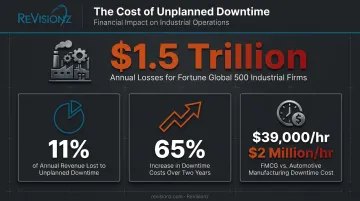
The financial case is hard to ignore. Siemens' 2023 analysis estimated that Fortune Global 500 industrial organizations lose almost $1.5 trillion a year to unplanned downtime (equal to roughly 11% of annual revenue). That figure had climbed 65% over the prior two years, per Siemens/Senseye's earlier 2022 report.
One lost production hour runs about $39,000 for a typical FMCG facility and can exceed $2 million in automotive manufacturing, according to the same Siemens analysis.
Here's the part organizations often miss: data value compounds across the asset lifecycle. Decisions made during engineering and construction about how data gets structured, tagged, and governed determine whether that same data is usable, or a liability, decades later in operations.
Core Components of an Industrial IoT Data Management Architecture
A functioning IIoT data architecture works as a layered stack, with each layer solving a different problem.
Data collection layer. Sensors, PLCs, SCADA systems, and meters capture raw operational data using industrial protocols. The three you'll encounter most:
- OPC UA: handles interoperability and carries structured industrial meaning across systems
- Modbus: a simpler request/reply protocol for device-level communication
- MQTT: a lightweight publish/subscribe transport built for constrained, low-bandwidth environments
These protocols aren't interchangeable. Each plays a distinct role, and conflating them is a common architecture mistake.
Edge processing. Filtering, aggregating, and analyzing data close to its source reduces latency and cuts bandwidth costs before anything transmits upstream.
The Industry IoT Consortium's reference architecture reflects this approach: time-sensitive control and initial data acquisition happen at the edge tier, while broader persistence and analytics happen further up the chain.
Data transformation and contextualization. Raw signals mean nothing without context. This layer converts them into structured, semantically tagged information linked to specific assets, tolerances, and operating conditions.
Storage strategy. Most mature architectures use a hybrid model:
- Edge storage for immediate, time-sensitive access
- Historians for high-frequency time-series data
- Cloud data lakes/warehouses for long-term retention and enterprise-wide analytics
Integration layer. None of this matters if it stays siloed. Connecting IIoT streams to ERP, MES, EAM/CMMS, and digital twin platforms is what turns raw operational data into enterprise-wide visibility.
Common Challenges in Industrial IoT Data Management
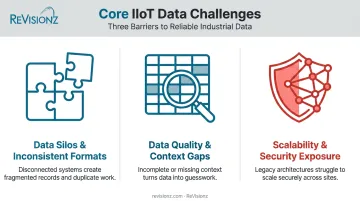
Even well-funded digital transformation programs run into the same three roadblocks.
Data Silos and Inconsistent Formats
Multi-vendor environments and legacy equipment rarely speak the same data language. One facility's SCADA export doesn't match another's, and decades-old equipment often lacks the metadata newer systems assume exists. The result: fragmented, non-standardized data spread across facilities that should be operating as one system.
Data Quality and Context Gaps
Raw sensor streams frequently arrive without tags, units of measure, or asset context — information analytics tools need to produce anything trustworthy. This isn't a minor inconvenience.
Anaconda's 2020 State of Data Science survey of over 2,300 data professionals across 100+ countries found they spend an average of 45% of their time just loading and cleansing data before any real analysis begins.
That's a general data-science benchmark, not an industrial-only figure, but it tracks with what plant teams describe: more hours fixing data than using it.
Scalability and Security Exposure
Device counts keep climbing. So does the attack surface. As OT and IT networks converge, every new connected sensor is a potential entry point. NIST recommends caution here: active scanning can disrupt sensitive OT devices, so passive monitoring is often the safer approach for critical environments.
Industrial IoT Data Management Best Practices
Getting from "we collect data" to "we trust and use our data" requires a deliberate approach. Here's what actually moves the needle.
1. Establish a unified data governance framework. Define ownership, naming conventions, quality checks, and accountability across the entire data lifecycle, not just at the point of collection. Without clear ownership, data quality erodes the moment nobody's watching.
2. Standardize on open protocols and semantic data models. Using OPC UA, MQTT, and frameworks like ISA-95 ensures interoperability across legacy and modern assets alike. This is what prevents your newest sensor deployment from becoming another silo.
3. Apply edge computing strategically. Process time-critical data at the source. Stream only contextualized events (not raw noise) to cloud or enterprise systems. This keeps bandwidth costs manageable and latency low where it matters most.
4. Enrich and contextualize data early. Tagging raw data with asset metadata, tolerances, and lineage as it's created, rather than retroactively, is what makes data decision-ready instead of just collected. This enrichment discipline underpins ReVisionz's asset data migration methodology, built over more than two decades in engineering and operational data environments.
5. Design for lifecycle-readiness. Information created during engineering and construction should remain usable and accessible through operations and maintenance. Too many organizations treat handover as an afterthought, then spend years untangling data that should have been structured correctly from day one.
6. Invest in continuous monitoring and security governance. Role-based access controls, encryption, and periodic security reviews need to scale alongside your IIoT footprint, not bolted on after the fact.
Predictive maintenance programs built on this kind of clean, contextualized data can cut machine downtime by 30% to 50% and extend machine life by 20% to 40%, according to McKinsey's analysis of manufacturing analytics.
Industrial IoT Data Management Across Key Industries
IIoT data management doesn't look the same across sectors. The core architecture holds, but priorities shift.
| Industry | Primary Use Cases |
|---|---|
| Oil & gas / energy | Real-time pipeline and rotating equipment monitoring, predictive maintenance, regulatory compliance reporting |
| Chemicals, petrochemicals, mining | Process safety monitoring, environmental compliance and multi-site asset performance tracking |
| Discrete and process manufacturing | OEE tracking, real-time quality control, supply chain synchronization |
In oil and gas, continuous rotating equipment monitoring feeds directly into predictive maintenance models — and into the compliance reports regulators expect. Chemical and petrochemical operations raise the stakes further, where process safety and environmental tracking span sprawling, multi-site footprints and a data gap at one site can mask an emerging issue at another.
Manufacturing environments lean heavily on continuous data flow to keep OEE calculations accurate and quality control real-time rather than retrospective. Across all three, the underlying requirement holds: data that's accurate, contextualized, and available where decisions get made.
Choosing the Right Partner for Industrial IoT Data Management
Technology alone doesn't solve IIoT data management challenges. Plenty of organizations have deployed sensors, platforms, and dashboards only to end up with more data and no better insight. What's missing is usually a clear data strategy paired with domain expertise that can actually bridge the OT/IT gap.
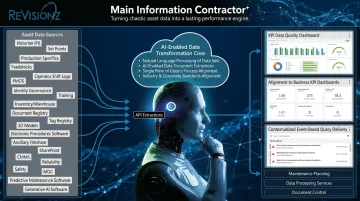
ReVisionz approaches this as a technology-agnostic problem. Rather than pushing a single platform, the firm's Main Information Contractor+ (MIC+) service is built to transform unstructured asset data into lifecycle-ready, usable information for owner-operators. Launched in December 2025, this AI-powered offering puts that same philosophy into practice.
That approach is backed by strategic alliances with:
- AVEVA
- Cognite
- VEERUM
- Hexagon/Octave
These partnerships give owner-operators and EPCs the flexibility to implement whichever tool fits their existing data environment, rather than forcing a one-size-fits-all platform onto systems that were never designed to work together.
That flexibility carries more weight after more than two decades focused on digital asset enablement across process and energy industries — experience that outweighs any single vendor's feature list.
Frequently Asked Questions
What is IoT data management?
IoT data management refers to the practices and technologies used to collect, process, store, and secure data generated by connected devices. The goal is reliable, analysis-ready data that supports confident decision-making.
What are the 5 C's of IoT?
This framework (Connection, Communication, Collection, Computation, and Content/Context) describes how data moves through an IoT system. It isn't a formally standardized taxonomy from bodies like NIST or IEEE, but it's a useful mental model.
What are the 4 types of IoT platforms?
IoT platforms are often grouped into connectivity management, device management, application enablement, and analytics/data platforms. Some industry research identifies additional categories, and many vendors span more than one type.
What is the difference between IoT and industrial IoT?
IoT generally refers to consumer-focused connected devices designed for convenience. IIoT applies similar connectivity concepts to mission-critical industrial processes, where the stakes for safety, uptime, and regulatory compliance are far higher.
What is the biggest challenge in industrial IoT data management?
Data quality and missing context top the list, closely followed by integrating legacy equipment with modern systems. Raw sensor data without proper tagging or asset context is difficult to trust and even harder to act on.
How does AI improve industrial IoT data management?
AI and machine learning enable automated data enrichment, anomaly detection, and predictive analytics at a scale manual review can't match. This shifts maintenance strategies from reactive to condition-based and predictive, reducing surprise failures.