Introduction
Asset-intensive operators are running on borrowed time. Pipelines, reactors, mills, and rotating equipment installed decades ago are still carrying today's production loads, and the margin for error keeps shrinking.
The financial exposure is real. A 2023 ABB survey of over 3,200 plant-maintenance leaders found median unplanned-outage costs of $124,669 per hour, with energy and power operators reporting even higher losses. Tightening compliance mandates, like the EPA's stricter emissions and safety reporting requirements, compound the pressure further.
Calendar-based maintenance and manual walkdowns simply can't keep pace with distributed, multi-site operations. That's where IoT comes in, turning static asset records into continuous, actionable intelligence. Here's how it fits into a broader Asset Performance Management (APM) strategy.
Key Takeaways
- IoT connects real-time condition data to predictive and prescriptive maintenance programs.
- Sensor deployment alone won't deliver value; data quality and structure determine ROI.
- AI and digital twins depend entirely on the data streams IoT generates.
- Phased rollouts, prioritized by asset criticality, outperform blanket sensor deployment.
What Is IoT in Asset Performance Management?
In an APM context, IoT refers to a network of connected sensors and devices that continuously capture operational, condition, and environmental data from physical assets, then transmit that data to systems where it can inform maintenance decisions.
This differs from how most asset-intensive operations have historically tracked equipment health.
- Manual inspections capture a snapshot, often weeks or months apart.
- Periodic data logging relies on technicians manually recording readings, introducing delays and human error.
- IoT-driven monitoring streams condition data continuously, closing the gap between when a problem starts and when someone notices it.
For assets with 20- to 40-year service lives, spread across remote or hazardous sites, that continuous visibility often makes the difference between catching a bearing failure early and shutting down a unit unexpectedly.
The 4 Pillars of IoT in Asset Management
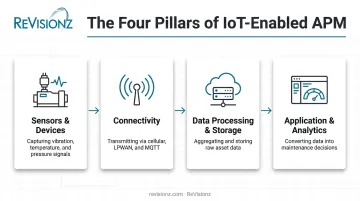
Every functioning IoT-enabled APM program rests on four interdependent layers:
| Pillar | Function | Examples |
|---|---|---|
| Sensors & Devices | Capture raw signals from physical assets | Vibration, temperature, pressure, flow sensors |
| Connectivity | Transmit sensor data to central systems | Cellular, LPWAN, Wi-Fi, MQTT, OPC-UA |
| Data Processing & Storage | Aggregate and contextualize raw data | Cloud platforms, edge gateways |
| Application & Analytics | Convert data into maintenance decisions | Dashboards, predictive models, APM software |
Miss any one pillar and the whole chain breaks down. A plant can have flawless sensors and still generate no value if the analytics layer can't contextualize what those sensors are reporting.
How IoT Powers Modern APM: Core Components and Technology Stack
Real-time condition monitoring is the most immediate shift IoT brings to APM. Instead of waiting for a quarterly inspection to catch a developing fault, sensors flag anomalies as they emerge, cutting the lag between issue onset and detection from weeks to minutes.
That continuous data stream also enables predictive maintenance. Vibration and temperature readings feed analytics models trained to recognize early failure signatures, allowing maintenance teams to schedule repairs before a breakdown happens rather than after.
Connecting IoT to Existing APM Systems
None of this works in isolation. IoT platforms need to integrate with the systems operators already rely on:
- EAM/CMMS platforms like IBM Maximo, where live sensor data joins historical work orders and asset records.
- APM software such as SAP APM, which consolidates condition data with reliability analytics.
- Digital twin environments, where live IoT feeds animate a virtual replica of the asset for scenario testing and performance simulation, without touching the physical equipment.
This integration matters because IoT data sitting in a silo, disconnected from maintenance history, delivers little value. The value shows up when sensor readings and work order records live in the same context.
The scale of this shift is measurable. The global predictive-maintenance market reached $5.5 billion in 2022, up 11% from the prior year, and IoT Analytics projects roughly 17% annual growth through 2028. This is not hype. It reflects real budget commitments from operators who have already seen the payoff.
Business Benefits and Implementation Challenges of IoT-Driven APM
Key Benefits for Asset-Intensive Operations
The upside of IoT-driven APM shows up across four areas:
- Reduced downtime and lower maintenance costs. One offshore operator deployed predictive analytics across nine platforms and reported a 20% reduction in downtime, adding more than 500,000 barrels of annual production.
- Extended asset lifecycle. Condition-based monitoring replaces fixed-interval servicing, meaning components get replaced when they actually need it, not on an arbitrary schedule.
- Stronger safety and compliance. Automated alerts and audit-ready data trails support regulatory reporting under frameworks like EU IED 2.0 or OSHA's Process Safety Management standard.
- Smarter capital planning. Utilization data reveals which assets are underperforming and which deserve reinvestment, turning capital decisions into data-backed calls instead of guesswork.

Common Challenges to Address
None of this comes without friction. Three challenges show up repeatedly:
- Cybersecurity risk. Constant data transmission across dozens or hundreds of sensors expands the attack surface. Aligning with ISO/IEC 27001 for information-security governance and ISA/IEC 62443 for industrial control-system security helps close gaps.
- Legacy system integration. Older EAM and control systems weren't built to talk to IoT platforms, which creates data silos. Middleware and interoperable data platforms are the usual fix.
- Scalability and cost. As sensor counts and data volume grow, infrastructure costs climb too. Hybrid cloud/edge architectures let operators process time-sensitive data locally while offloading heavier analysis to the cloud.
Careful planning addresses each of these challenges directly. Getting the rollout sequence and governance structure right from the start determines whether an IoT program delivers measurable results or stalls in pilot phase.
The Future: IoT, AI, and Digital Twins in APM
A common question worth answering directly: is IoT being replaced by AI? No. AI models are only as good as the data feeding them, and that data comes from IoT devices. Without continuous sensor streams, there's nothing for an AI model to analyze.
Edge computing is changing where that analysis happens. Rather than sending every reading to a distant cloud server, more processing now happens near the asset itself. This reduces latency and speeds up response time when a failure signature appears. ISA identifies this as one of the clearest drivers of edge adoption across industrial settings, since local decision-making cuts the delay between detection and action.
The bigger shift, though, is from predictive to prescriptive maintenance. Predictive models flag that something is likely to fail; prescriptive systems, often powered by AI layered on top of a digital twin, go a step further and recommend the specific corrective action.
That action might include:
- Adjusting a setpoint to correct drift before failure occurs
- Scheduling a specific repair based on the predicted failure mode
- Reallocating a spare part from another line or site
Plant Engineering notes this adds real decision-support value, though it comes with added complexity and cost compared to predictive maintenance alone. IoT remains the foundation underneath all of it.
Implementing IoT for APM: Best Practices and the Role of a Digital Transformation Partner
Sensor data is only as valuable as the asset information architecture it feeds into. A network of perfectly calibrated sensors won't help if the underlying asset registry is incomplete, inconsistent, or disconnected from maintenance records. Poor data structure undermines even the most advanced sensor deployment.
Best practices worth following:
- Start with critical assets. Rank equipment by failure risk and business impact, then deploy sensors there first rather than instrumenting everything at once.
- Tie investment to business objectives. Safety, compliance, and cost reduction should drive sensor placement decisions, not vendor pressure or blanket coverage.
- Fix the data foundation first. Clean, structured, lifecycle-ready asset information has to exist before sensor data can be trusted.

Where a Digital Transformation Partner Fits In
A digital transformation partner earns its place here. ReVisionz has spent over two decades helping owner-operators in energy, chemicals, and mining build this kind of asset data foundation.
Through its Intelligent Asset Management (AIM) practice, the company works with clients to structure and govern asset information so it's ready to support IoT and analytics investments, not just capable of hosting them. Its AI-powered Main Information Contractor+ (MIC+) service extends this further, keeping asset data lifecycle-ready as it moves from capital projects into operations.
For operators layering IoT onto legacy systems, that groundwork often separates a sensor rollout that pays for itself from one that just adds noise.
Frequently Asked Questions
What is IoT in asset management?
IoT in asset management refers to connected sensors and devices that track asset condition, location, and performance in real time. This continuous data supports proactive maintenance decisions instead of reactive repairs.
Is IoT replaced by AI?
No. AI complements IoT rather than replacing it. AI and machine learning models depend on the real-time data streams that IoT devices generate to produce predictive or prescriptive insights.
What are the 4 pillars of IoT?
The four pillars are sensors and devices, connectivity, data processing and storage, and the application and analytics layer. Each one has to function for IoT to deliver usable asset intelligence.
How does IoT improve predictive maintenance?
Continuous sensor data reveals performance anomalies, like rising vibration or temperature, before they cause failure. This lets maintenance teams schedule repairs based on actual asset condition rather than a fixed calendar.
What industries benefit most from IoT-enabled APM?
Asset-intensive sectors like oil and gas, chemicals, mining, and manufacturing see the greatest gains. Their equipment tends to be complex, high-value, and spread across geographically distributed sites.
What is the difference between IoT and IIoT in asset management?
General IoT covers connected devices across both consumer and industrial settings. Industrial IoT (IIoT) is purpose-built for industrial-grade reliability, security, and integration with operational technology systems, where failures carry higher stakes.