Introduction
Walk into most refineries, chemical plants, or mining operations built before the year 2000, and you'll find something surprising. The physical equipment has been upgraded repeatedly, but the information systems tracking it often haven't changed since the original capital project closed out.
Engineering drawings live in repositories built for software that vendors stopped supporting years ago. Tag registers exist as spreadsheets passed between shift supervisors. Maintenance history sits disconnected from the ERP system that's supposed to plan around it.
A 2020 ATS/Plant Engineering industrial maintenance study found that 50% of organizations relied on CMMS platforms, while 47% still leaned on in-house spreadsheets or manual schedules to manage maintenance data. That near-parity is telling. In many plants, spreadsheets aren't a backup — they're the primary system.
This guide breaks down what legacy information systems actually are, why they've survived this long, the risks hiding inside them, and how to modernize without shutting down operations to do it.
Key Takeaways
- Legacy information systems store critical engineering and operational data but lack the integration, security, and usability modern operations need
- Migration costs, regulatory record requirements, and fear of disruption keep legacy systems running years past their intended lifespan
- Risks include compliance exposure, data silos, blocked analytics initiatives, and slower capital project handovers
- Modernization rarely requires full replacement: data migration and enrichment can unlock legacy information without disrupting daily operations
What Are Legacy Information Systems?
A legacy information system is any outdated platform, database, or repository that still stores business-critical data, including engineering documents, tag registers, maintenance history, or process safety records. It can no longer integrate, secure, or present that data the way modern operations require.
This is a different problem than the generic "legacy software" conversation most IT articles cover.
Legacy ERP or CRM tools are annoying because they're clunky. Legacy information systems tied to engineering and asset data are dangerous because the data inside them often can't be verified, cross-referenced, or trusted without manual effort.
How These Systems Came to Exist
Most weren't built as long-term infrastructure. They were custom-built during a specific capital project, often by an EPC contractor working under deadline pressure, and never fully transitioned into structured, lifecycle-ready formats during handover to operations.
Ownership also becomes murky as project teams disband and IT budgets shift toward newer initiatives. A system built for one project's five-year lifespan ends up running operations-critical workflows a decade or two past its intended retirement, with no formal owner assigned to maintain it.
The result: functionally critical systems nobody planned to keep running for 20-plus years, but nobody can safely shut off either. There's no clean off-switch when the data inside supports daily safety decisions.
Common Examples of Legacy Information Systems in Asset-Intensive Industries
If you work in oil & gas, chemicals, mining, or manufacturing, you've probably encountered several of these already:
- Outdated SmartPlant or PDMS-based engineering repositories built for a single capital project and never upgraded
- Siloed EDMS platforms holding controlled documents that don't sync with current operational systems
- Spreadsheet-based tag or equipment registers maintained manually by whoever inherited the task
- Disconnected CMMS/ERP systems that don't share a common asset ID structure
- Scanned or paper-based P&IDs stored as static images instead of structured, searchable data
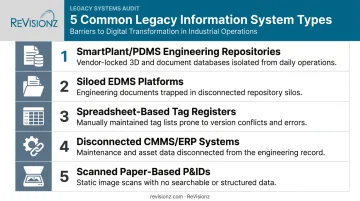
Each of these shares a common trait: the information exists, but it's not usable at the speed and accuracy modern operations demand.
Why Do Organizations Still Rely on Legacy Information Systems?
If these systems are so limited, why hasn't everyone replaced them? Three forces keep them in place.
Migration Is High-Cost and High-Risk
Decades of asset data accumulated across multiple capital projects, EPC contractors, and software generations don't sit in one clean format. They're scattered across systems that were never designed to talk to each other.
Consolidating that history means reconciling conflicting tag numbers, resolving duplicate equipment records, and validating data nobody has touched in years. Most owner-operators look at that scope and decide to delay rather than tackle it without a clear plan.
Regulatory Record Continuity Matters More Than System Age
Process safety and environmental compliance depend on continuity of records, not on running the newest software. Regulatory retention requirements illustrate the stakes:
- OSHA's Process Safety Management standard requires process hazard analyses to be retained for the life of the process, with incident investigation reports kept for five years
- Canada's Environmental Emergency Regulations require specific plan-review records to remain on-site for at least seven years
That regulatory reality means migration has to preserve applicable records and their revision history. It's a reason to plan the transition carefully, not to leave a fragile platform untouched indefinitely.
Operational Risk Aversion Runs Deep
In always-on plants, any disruption to core information systems carries real consequences. A failed migration mid-shift can affect safety visibility, uptime, and production schedules simultaneously.
Teams that manage the risk of a multi-million-dollar production line every day tend to apply the same caution to the systems tracking that line, even when those systems are showing their age.
The Risks and Hidden Costs of Legacy Information Systems
The costs of staying on legacy platforms rarely show up as a single line item. They accumulate quietly, then surface at the worst possible moment: during an audit, an incident investigation, or a handover deadline.
Safety and Compliance Exposure
Outdated or incomplete asset data undermines the accuracy of process safety management programs. OSHA's enforcement action against the BP-Husky refinery cited failure to ensure P&ID accuracy among its process safety violations, contributing to proposed penalties totaling $3.042 million across 42 willful and 20 serious violations (OSHA, 2010).
Inaccurate controlled engineering information creates a documented compliance exposure with real financial consequences attached.
Data Fragmentation and Technical Debt
When engineering teams, EPC handover packages, and O&M teams each maintain separate versions of tag or equipment data, nobody has a single source of truth. Reconciling these versions manually is slow, error-prone, and often skipped under deadline pressure.
This fragmentation deepens as platforms age. Keeping specialized legacy systems running requires:
- Ongoing licensing or support costs for systems that vendors have deprioritized
- Custom workarounds to bridge incompatible data formats
- A shrinking pool of professionals who know how to operate older platforms
That last point compounds every year, since fewer engineers entering the workforce have hands-on experience with 15-year-old engineering software.
Blocked Innovation and Slower Handovers
Predictive maintenance, advanced analytics, and digital twin programs all depend on data that's structured and contextualized. Legacy information trapped in disconnected formats simply isn't ready for those tools, no matter how advanced the analytics platform is.
That same fragmentation slows capital project handovers. Legacy data locked in disconnected formats delays the transition from construction to operations, and poor handover practices can put entire projects behind schedule. Operational readiness depends on populated, validated systems being available before transfer, not delivered as a last-minute data dump.
Security compounds the risk. Unsupported, unpatched legacy platforms often can't meet current cybersecurity expectations, and CISA notes that many legacy industrial control system devices still run outdated operating systems and older protocols that lack encryption or authentication (CISA) — a meaningful exposure for any plant connecting these systems to broader networks.

Signs It's Time to Modernize Your Legacy Information Systems
Not every legacy system needs immediate attention. But certain patterns signal that the risk has outgrown the comfort of "it still works."
Watch for these warning signs:
- Frequent data inconsistencies or duplicate records across engineering, maintenance, and operations systems, with the same asset showing different specs in different places
- Integration failures with digital twin, analytics, or cloud-based platforms, as modern tools simply can't ingest your legacy data structure
- Heavy reliance on manual spreadsheets or workarounds just to reconcile or locate accurate asset information, echoing the near-50/50 split between CMMS and spreadsheet use found in industry maintenance studies
If your team spends more time verifying data than using it, that's the clearest modernization signal you'll get.
Modernization Strategies for Legacy Information Systems
Modernization doesn't have to mean tearing everything out and starting over. The right strategy depends on what's actually broken versus what's simply old.
Start With a Current-State Assessment
Before choosing a path, inventory what you have:
- Which systems hold business-critical information versus obsolete records
- Where data quality gaps and duplicate records exist
- Which platforms are integration-ready and which are dead ends
Choose the Right Strategy: Migration and Enrichment vs. Full Replacement
| Approach | Best fit when... |
|---|---|
| Data migration and enrichment | Legacy data has value but needs structuring, validation, and contextualization into lifecycle-ready formats |
| Full platform replacement | The underlying system itself is the constraint: unsupported, insecure, or fundamentally incompatible with your operations |
Both are legitimate paths. Neither is automatically the "correct" one.
Stay Technology-Agnostic
Prioritizing business capability over any single software vendor reduces risk and future-proofs the investment. A modernization plan built around one platform's roadmap is only as durable as that vendor's next strategic pivot.
Roll Out in Phases, Not All at Once
A phased, business-outcome-driven rollout minimizes disruption compared to a rip-and-replace approach. Deliver value in stages, releasing validated packages of data one priority system at a time, rather than betting an entire operation on a single cutover date.
How ReVisionz Helps Modernize Legacy Information Systems
ReVisionz has spent over two decades helping owner-operators in oil & gas, chemicals, mining, and manufacturing convert unstructured legacy asset data into usable, lifecycle-ready information. That work draws on standards like CFIHOS and ISO 15926 to keep engineering and asset data structured and exchangeable across project and operational teams.
In practice, this looks like:
- Data validation and enrichment: enriched asset and location records in a client's Maximo CMMS, producing a master asset register and tag register with a 0% rework rate
- Full platform replacement when warranted: replaced a legacy Aconex system with OpenText Content Server, delivering $800,000 in annual savings and about 30 minutes of daily productivity gain per person in document retrieval
- AI-powered handover support through the Main Information Contractor+ (MIC+) service, built to accelerate the transition from capital project delivery to lifecycle-ready operational data
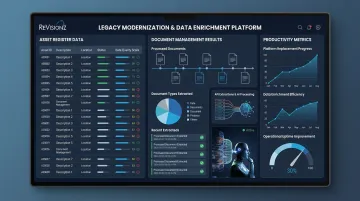
ReVisionz maintains technology-agnostic alliances with AVEVA, Hexagon, Cognite, OpenText, and VEERUM, meaning the recommended path depends on what a client's operation actually needs, not which platform ReVisionz is incentivized to sell.
Frequently Asked Questions
What is an example of a legacy information system?
Common examples include outdated engineering document repositories and spreadsheet-based tag registers. Disconnected CMMS and ERP systems that still manage asset data separately, along with scanned, paper-based P&IDs, are also common examples.
Why are legacy information systems still used in asset-intensive industries?
High migration costs and the need for regulatory record continuity discourage rapid replacement, especially given operational risk aversion in always-on plants. Teams often delay action until the risk of staying outweighs the risk of change.
What is the difference between a legacy system and legacy data?
A legacy system is the outdated platform or infrastructure itself. Legacy data is the information stored within it, which may be fragmented or trapped in unstructured formats regardless of the system's condition.
How do you know if it's time to replace a legacy information system?
Watch for frequent data inconsistencies and failed integrations with analytics or digital twin platforms. A growing reliance on manual spreadsheets to reconcile information is another red flag, signaling the system can no longer support current operational needs.
What is legacy information system modernization?
It's the process of migrating, enriching, restructuring, or replacing outdated asset data and platforms so they meet current business and compliance requirements. It can range from targeted data enrichment to full platform replacement.
Is replacing a legacy information system worth the investment?
While upfront costs and effort are real, modernization typically pays off through improved safety visibility and better asset performance across the system's remaining lifecycle, along with stronger compliance positioning.