Many engineering teams try to manage this chaos with the same tools they use for invoices and HR files. A folder structure in SharePoint feels familiar, but it was never built to track Rev C superseding Rev B, or to prove a contractor received and acknowledged a transmittal three years ago. That gap between generic document storage and engineering-grade document control is where capital projects run into trouble.
This guide breaks down what an Engineering Document Management System (EDMS) actually is, why asset-intensive industries can't operate without one, and how to choose and implement the right solution.
Key Takeaways
- An EDMS controls engineering drawings, data, and workflows across the asset lifecycle, not just file storage
- Revision control, transmittal management, and document numbering set an EDMS apart from generic tools like SharePoint or Google Drive
- Poor documentation drives capital project rework and creates compliance, safety, and litigation risks once assets reach operations
- Successful EDMS implementation depends more on governance and data migration expertise than on the license itself
What Is an Engineering Document Management System?
The Association for Intelligent Information Management (AIIM) defines document management as using computer systems to store, manage, and track electronic documents and images, covering things like check-in/check-out, version control, and audit trails. That definition works fine for a general business DMS.
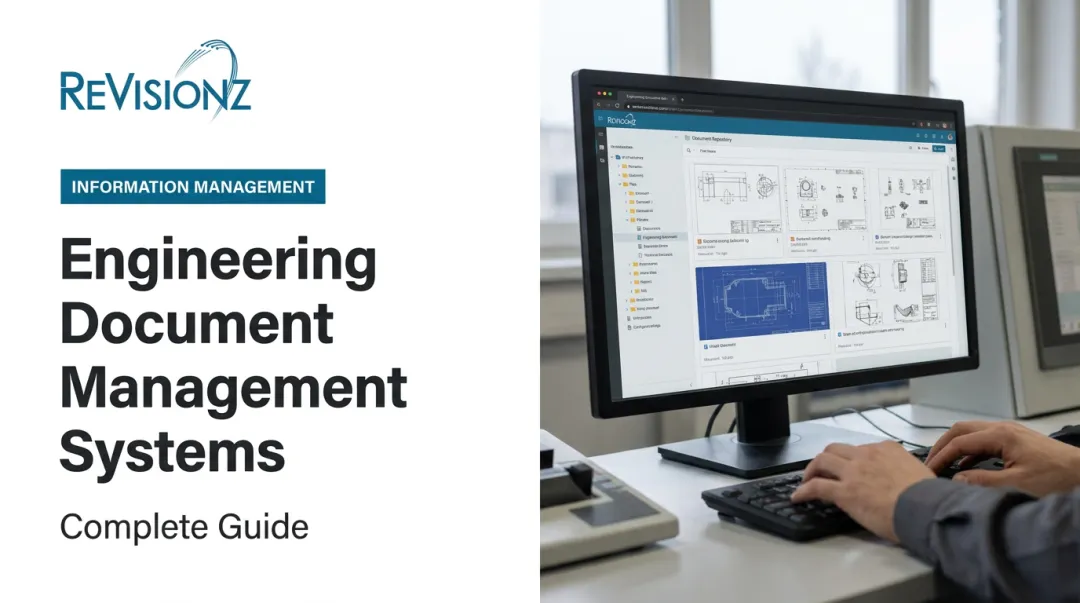
An Engineering Document Management System builds a far more specialized structure on top of that foundation. An EDMS is purpose-built to control engineering drawings, technical documents, and project data across the full capital project lifecycle and into asset operations. It manages the relationships between documents, equipment tags, revisions, and approval status that generic platforms were never designed to handle.
Think of it as the difference between a general-purpose toolbox and a torque wrench calibrated to a specific spec. Both are tools, but only one is built for the job at hand.
A generic DMS can store a PDF of a P&ID. It can't tell you whether that PDF is the current approved revision, who reviewed it, or whether it was formally transmitted to the client for record.
Core Concepts That Make an EDMS Unique
Four capabilities separate an EDMS from a standard file repository:
- Revision control: Every document version, from Rev A through Rev B and beyond, carries a full change history so teams always know which file is the current approved one.
- Transmittal management: Formal logs record every document exchange between owners, EPCs, contractors, and regulators, tracking when a package was sent, received, and acknowledged.
- Document numbering conventions: Configurable, client-specific numbering standards run alongside internal numbering, enabling consistent cross-referencing across thousands of documents and multiple contractors.
- Document status codes: Lifecycle statuses such as Issued for Review (IFR), Issued for Construction (IFC), Issued for Approval (IFA), As-Built, and Superseded are enforced so the wrong version never reaches the field.
These four elements work together. A drawing might move from IFR to IFA to IFC over its lifecycle, each transition logged, transmitted, and numbered according to project standards. Miss one of these controls, and the system stops functioning as a control layer. It just becomes expensive storage.

Why Engineering & Asset-Intensive Industries Need a Dedicated EDMS
The Rework and Productivity Cost of Bad Documentation
A survey of nearly 600 construction leaders found that respondents spent 5.5 hours per week just searching for project data, and attributed 52% of all rework to poor data and miscommunication, according to PlanGrid and FMI's Construction Disconnected report.
That survey covered construction leaders broadly, not engineering teams alone. But the pattern holds across capital-intensive work: when nobody trusts which document is current, people redo work that was already done correctly the first time.
Contrast that with what happens when document control is tight. In one legacy system migration ReVisionz completed, moving content from Aconex to OpenText Content Server preserved nearly all historical records and cut document retrieval time by roughly 30 minutes per person, per day. Multiply that across a project team of even 50 people, and the recovered hours add up fast.
Contractual, Legal, and Compliance Exposure
Beyond wasted hours, weak documentation control creates direct financial and legal risk:
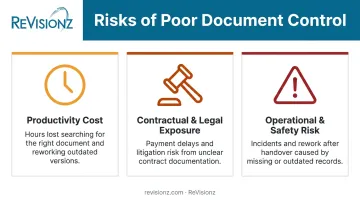
- Contractual risk: Missing client-specific numbering or status conventions can trigger delayed payment milestones, breach of contract claims, or costly change orders.
- Litigation exposure: Without a complete, timestamped transmittal record, proving who sent what and when becomes guesswork during a dispute.
- Audit failures: Incomplete document trails leave organizations unable to demonstrate compliance during regulatory or client audits.
Operational and Safety Risk After Handover
The risk doesn't end at project completion. Poor-quality handover data follows an asset into operations, where it can compromise both cost and safety. The CSB's investigation report into a 2022 refinery incident found that missing operating instructions and deficient management-of-change documentation preceded a naphtha release and fire that killed two employees.
The review process had inaccurately concluded the change created no new hazard, in part because the underlying documentation wasn't there to catch it.
That single case shows how a documentation gap treated as an administrative headache during a project can turn into an operational and safety liability once the asset is running.
Key Features and Capabilities of an EDMS
A modern EDMS goes well beyond storing files. It actively manages how documents move, who can see them, and how they connect to other systems across the asset lifecycle.
Workflow Automation
Multi-discipline review cycles are where documents get stuck without automation. A capable EDMS keeps them moving through:
- Automated routing that pushes documents to the right reviewers based on discipline
- Markup and redlining tools that capture comments directly on the drawing
- Automated notifications and escalations when a review sits idle past its due date
Access Control and Secure Distribution
Capital projects involve dozens of external parties, from EPCs to regulators, each needing different levels of access. Role-based permissions ensure a subcontractor sees only their scope. Secure external sharing, often through expiring links, lets owners distribute controlled documents without losing track of who has the current version.
Integration With CAD, BIM, and Asset Systems
An EDMS delivers the most value when it doesn't operate in isolation. Key integrations carry that value across design, scheduling, and operations:
- CAD and BIM platforms keep design data synchronized as drawings evolve
- Primavera P6 and similar scheduling tools tie document milestones to project timelines
- Downstream EAM and CMMS platforms, such as IBM Maximo, extend that value from design through to maintenance and operations
That last integration point matters more than most teams realize. In one refinery engagement, ReVisionz helped build an automated tag register in Maximo that connected engineering documents to asset records with zero rework. It's the difference between a tag register teams trust and one they build workarounds for.
Types of Documents Managed in an EDMS
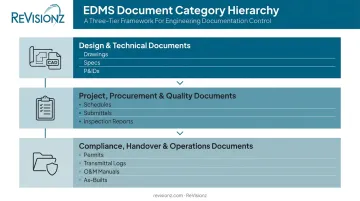
An EDMS handles a wide range of document types across a project and its operating life. Grouping them by purpose clarifies what the system actually needs to control:
Design and technical documents:
- 2D and 3D drawings and CAD files
- Engineering specifications and calculations
- P&ID diagrams and other technical schematics
Project, procurement, and quality documents:
- Project schedules and requisitions
- Vendor submittals
- Inspection and test plans
- Non-conformance reports
Compliance, handover, and operations documents:
- Permits and safety data sheets
- Transmittal logs
- Operations and maintenance (O&M) manuals
- As-built drawings
That last category deserves particular attention. As-built drawings and O&M manuals don't disappear once a project closes out. They carry forward into the asset's operating life, feeding maintenance planning, turnaround scope, and regulatory inspections for decades.
An EDMS that treats these as a temporary project artifact, rather than a permanent operational record, sets the asset up for the same documentation gaps that caused problems during construction.
Business Benefits of an EDMS Across the Asset Lifecycle
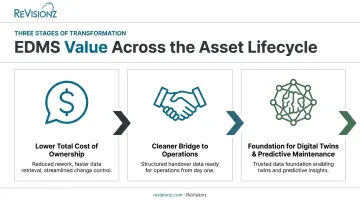
Lower Total Cost of Ownership
Reduced rework and faster document retrieval don't just save time during construction. They compound over an asset's operating life, often for decades after the original project team has moved on.
Every hour a maintenance technician spends hunting for the correct as-built drawing is an hour of downtime that didn't need to happen. Multiply that across hundreds of work orders a year, and the cost adds up fast — in labor, in schedule delays, and in avoidable equipment failures caused by working from outdated drawings.
Structured document control removes that friction at the source. Instead of technicians cross-checking multiple document versions before starting a job, they pull one verified record and get to work.
A Cleaner Bridge to Operations
Cost savings are only part of the story. A well-implemented EDMS also closes the gap between project delivery and operational readiness, and too often, operations teams inherit a stack of red-lined drawings, unresolved punch list items, and transmittals that were never formally closed out.
When document status, revision history, and transmittal records are clean at handover, commissioning teams start operations with data they can trust, rather than data they have to reconstruct after the fact. That difference alone can shave weeks off a startup schedule, since technicians aren't stopping mid-commissioning to track down which drawing revision actually matches the as-installed equipment, or waiting on engineering to resolve a discrepancy that should have been caught months earlier.
The Foundation for Digital Twins and Predictive Maintenance
That same operational discipline sets up an even bigger payoff. Structured, validated engineering data doesn't just support day-one operations. It becomes the raw material for downstream initiatives that owners increasingly expect their asset data to support:
- Digital twin models that mirror the physical asset accurately, tag for tag
- Predictive maintenance programs that depend on trustworthy equipment and document relationships
- Broader analytics initiatives that need clean, tagged data to function at all
None of that works on top of disorganized documentation. Organizations that skip EDMS discipline during the project phase typically pay for a remediation effort later, reconciling tags, drawings, and equipment records just to make their data usable for the analytics they wanted in the first place. That rework is a form of legacy data remediation many owner-operators end up budgeting for separately, years after their original capital project closed out.
Choosing and Implementing the Right EDMS: Why Strategy Matters More Than Software
Most failed EDMS rollouts don't fail because the software was wrong. McKinsey's research on digital transformations found that only 16% of organizations surveyed achieved both improved performance and sustained change from their efforts.
The pattern in EDMS implementations tracks closely. Governance and change management, not platform features, tend to separate the rollouts that stick from the ones that fade back into old habits within a year.
What to Evaluate When Selecting a Platform
Before comparing vendor feature lists, organizations should weigh:
- Scalability: Can the system handle millions of documents and tags as the portfolio grows, not just the current project?
- Native integration: Does it connect directly to CAD/BIM tools, scheduling systems, and EAM platforms, or will every connection require custom development?
- Configurability: Can it adapt to client-specific and industry document numbering and status standards without a full redesign?
- User adoption: Will engineers and contractors actually use it, or will they route around it through email and shared drives?
Why Migration Strategy Matters as Much as the Platform
Choosing the right software solves only part of the problem. Consolidating legacy documents, whether from a decommissioned system or years of inconsistent numbering across contractors, requires a migration and enrichment methodology that catches errors instead of copying them forward.
A poor migration buries bad data inside a brand-new, expensive system. That's often worse than leaving it in the old one, since now everyone assumes it's clean.
How ReVisionz Approaches EDMS and AIM Strategy
ReVisionz takes a technology-agnostic consulting approach to Asset Information Management, helping owner-operators and EPCs across energy, chemicals, mining, and manufacturing select and implement the right EDMS and AIM solution for their environment.
Rather than pushing a single platform, ReVisionz works through strategic alliances with Hexagon, AVEVA, OpenText, Cognite, and VEERUM, matching the technology to the client's actual data, workflows, and industry standards.
That approach extends into post-handover support through ReVisionz's AI-powered Main Information Contractor+ (MIC+) service, which helps organizations repair inherited data gaps and keep engineering information lifecycle-ready long after a system goes live.
It reflects more than two decades of digital twin and AIM program experience. That depth is built on a simple idea: software is only as good as the strategy and data discipline behind it.

Frequently Asked Questions
What is the difference between an EDMS and a general document management system?
A general DMS manages routine business files like contracts and HR records. An EDMS adds engineering-specific capabilities such as revision control, transmittal tracking, and CAD/BIM integration built for capital project workflows.
What document statuses are typically managed in an EDMS?
Common statuses include Issued for Review (IFR), Issued for Construction (IFC), Issued for Approval (IFA), As-Built, and Superseded. The system enforces which status applies at each project phase, preventing outdated versions from reaching the field.
How does an EDMS reduce rework and project risk?
Enforced version control and transmittal tracking ensure every team works from the current approved document. That removes the guesswork that leads to costly rework and disputed change orders on capital projects.
Is an EDMS the same as an Asset Information Management (AIM) system?
No. EDMS focuses specifically on document control, while AIM encompasses broader structured data, tags, and lifecycle information. EDMS often feeds directly into a larger AIM strategy rather than replacing it.
Can an EDMS integrate with CAD, BIM, or EAM/CMMS systems?
Yes. Most modern EDMS platforms support integrations with design tools like CAD and BIM, plus downstream asset management systems such as Maximo, extending value from design through operations.
How long does it take to implement an engineering document management system?
Timelines range from a few weeks to several months, depending on data volume, workflow complexity, and migration needs. Experienced implementation partners can compress that timeline through structured data migration and proven change management practices.