Introduction
Picture a plant floor where the OEE numbers in the morning huddle don't match what the operator wrote on a clipboard an hour earlier. Multiply that across three shifts, a legacy MES, a separate SCADA system, and a spreadsheet someone built in 2015 that "everyone just uses."
Most manufacturers live this exact scenario every day.
Only 16% of manufacturing leaders globally report real-time visibility into work-in-progress across their entire production process, according to Zebra's 2024 study of 1,200 C-suite, IT, and OT leaders.
Everyone else is making decisions on lagging, incomplete, or conflicting information.
This guide breaks down what manufacturing data management actually means, the five pillars behind it, why fragmentation costs more than most leaders realize, and a practical path from floor-level chaos to lifecycle-ready insight.
Key Takeaways
- Real-time visibility remains rare: only 16% of manufacturers have it end-to-end
- Data-rich isn't data-driven: most companies pilot analytics but rarely scale them
- Five pillars drive success: collection, integration, MDM, governance, and analytics
- Fragmentation carries real financial exposure, from duplicate records to missed quality issues
- A focused pilot beats a company-wide rollout for proving ROI fast
What Is Manufacturing Data Management?
Manufacturing data management is the systematic discipline of collecting, organizing, integrating, governing, and analyzing data generated across the full production lifecycle. That spans raw material sourcing, shop floor execution, quality checks, and final delivery.
Rather than a single software category, it functions as the connective tissue linking every system that touches your product.
Data-Rich vs. Data-Driven
Most manufacturers are already data-rich:
- Sensors log temperature and pressure readings in real time
- MES systems track work orders across the shop floor
- QMS platforms flag defects and quality deviations
The problem is that this data sits in isolated silos, cut off from context and from each other.
Data-driven looks different: a unified, governed architecture where information flows automatically to the people who need it, when they need it.
The gap between the two is wide. A WEF and Boston Consulting Group survey of more than 1,700 manufacturing executives found that 81% had implemented at least one data-and-analytics use case. Yet only 37% had scaled applications beyond a specific area of a single plant, leaving most manufacturers stuck in pilot mode instead of scaling those wins across the business.
The Core Components That Make It Work
Four capabilities determine whether raw shop floor data becomes something useful, or just accumulates.
Real-Time Capture
The shift from manual, batch-based logging to continuous, automated capture is foundational. Machines, sensors, and operator apps should feed data streams the moment an event happens, not at end-of-shift when someone finally transcribes a clipboard. A 15-minute lag is often enough to mask a developing quality problem.
Centralized Storage & Integration
ERP, MES, SCADA, and QMS data needs to land somewhere unified. Scalable, cloud-based repositories consolidate these sources into one accessible location instead of forcing teams to reconcile five different exports.
Contextualization
A temperature reading means nothing on its own, becoming valuable only when tied to:
- The specific product and work order
- The machine and operator involved
- A precise timestamp
Without that context, a reading is just a number sitting in a database, disconnected from any decision.
Accessibility
Contextualized data still fails if it doesn't reach the right person at the right moment. An operator needs a different view than a plant manager, while a maintenance engineer needs different alerts than a quality inspector. Accessibility means designing each view around the decision it supports, whether that's adjusting a machine setting or approving a shipment.

Why Fragmented Factory Floor Data Is Costing You More Than You Think
Fragmentation doesn't happen by accident. It builds up over decades.
Root causes include:
- The IT/OT divide — separate teams, priorities, and vocabularies
- Legacy systems layered on top of each other over 20+ years
- No formal data governance to catch inconsistencies before they spread
The operational fallout is predictable: duplicate records, delayed decisions, missed quality issues, and compliance exposure when auditors ask questions your data can't answer.
The friction is widespread. Zebra found that 86% of manufacturing leaders struggle to keep pace with innovation and securely integrate devices, sensors, and technologies across facilities. One-third also cited disagreement between IT and OT over investment priorities as a specific barrier.
That friction has a hidden cost beyond compliance risk. LNS Research reports that industrial data science teams can spend 70% to 80% of their time just preparing data, not analyzing it. That's a workforce cost most plants never line-item, but it's real, and it's recurring every single project.
The Five Pillars of Effective Manufacturing Data Management
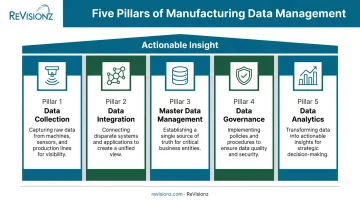
Regardless of plant size or industry, effective data management rests on five interdependent disciplines. Neglect one, and the rest weaken.
Pillar 1: Data Collection
This is the move from clipboards and spreadsheets to continuous, automated data streams. Sensors, PLCs, and operator apps should generate data as a byproduct of normal work, not as an extra task someone forgets under deadline pressure.
Pillar 2: Data Integration
Connecting ERP, MES, SCADA, and QMS into a single data flow eliminates silos between systems that were never designed to talk to each other. One increasingly common architecture for this is the Unified Namespace, a standardized way to organize and name industrial data through a single communication interface. It replaces brittle point-to-point connections between every system pair with one shared source of truth.
Pillar 3: Master Data Management (MDM)
MDM establishes one authoritative, synchronized record for products, suppliers, customers, and equipment across every system that touches them. In a manufacturing context, that means your bill of materials, routings, work centers, and asset records match, whether someone pulls them from the ERP or the shop floor terminal.
Pillar 4: Data Governance
Governance is the framework of ownership, standards, quality metrics, and access controls that makes data trustworthy. Without named data stewards and defined quality thresholds, even well-integrated data drifts back into inconsistency within a year.
Pillar 5: Data Analytics
Governed, integrated data becomes the foundation for:
- Real-time dashboards and KPIs
- OEE and scrap-rate tracking
- Predictive maintenance models
- Autonomous decision-making on the shop floor
Skip the first four pillars and analytics has nothing solid to stand on. Garbage in, garbage out still applies, even with the best algorithm.
Best Practices for Building a Manufacturing Data Management Strategy
A strategy built in the right order avoids months of rework later.
- Audit your current data landscape by mapping every system and manual process, then flag where the same entity, such as a product, supplier, or asset, is defined differently across platforms.
- Set specific, measurable goals tied to business outcomes, like reducing scrap rate on a specific line or improving OEE, rather than vague "digitize everything" mandates.
- Assign data ownership before scaling technology. Define who owns each dataset and how quality gets maintained; technology without accountable owners drifts fast.
- Start with a focused, high-value pilot: one line, one plant, one data domain. Prove ROI before expanding company-wide rather than betting the budget on a big-bang rollout.
- Invest in training and change management. Resistance to new systems, not the technology itself, is typically the biggest barrier to adoption, and teams default to old habits when a rollout skips this step.
That last point deserves emphasis: the best data architecture in the world fails if the people running it revert to spreadsheets by week three.
How ReVisionz Helps Turn Factory Floor Data Into Actionable Insight
ReVisionz takes a technology-agnostic, consulting-led approach to manufacturing data management. Rather than pushing a single platform, the firm combines transformation and digital enablement, intelligent data and insights, and digital technology solutions to fit each client's existing ERP, MES, and SCADA environment.
That approach is grounded in more than two decades of Asset Information Management and digital twin work across process and manufacturing industries.
In one engagement, ReVisionz tackled fragmented records for a pipeline operator:
- Reviewed several million documents scattered across dozens of legacy systems
- Enriched and migrated critical records into a single, governed repository
- Supported more than 70 groups across corporate, operations, and project teams
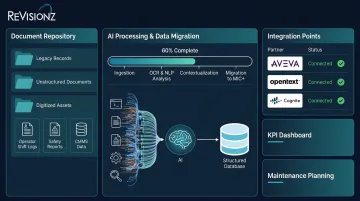
For clients dealing with unstructured legacy data specifically, ReVisionz's Main Information Contractor+ (MIC+) service uses AI-powered processes to turn that data into lifecycle-ready information. The service is backed by strategic alliances with AVEVA, OpenText, Cognite, VEERUM, and Hexagon/Octave.
If you're still mapping where your own fragmentation lives, ReVisionz's Digital Journey Notebook is a useful starting point before scoping a pilot.
Frequently Asked Questions
What are the 5 pillars of data management?
Data collection, integration, master data management, governance, and analytics. Each pillar depends on the others; weak governance undermines even well-integrated data.
What is MDM in industry?
Master Data Management is the practice of maintaining one authoritative, synchronized record for products, suppliers, customers, and equipment across every enterprise system that touches them.
What is the biggest challenge in manufacturing data management?
The IT/OT divide and decades of layered legacy systems are the most common structural barriers. Industry analysts consistently flag the IT/OT stack as a major stumbling block for digital initiatives.
How do you start a manufacturing data management strategy?
Start with a current-state audit that maps every system and manual process. Follow it with a focused, high-value pilot before scaling company-wide.
What is the difference between manufacturing data management and an MES?
An MES is one operational system that monitors shop floor production. Data management is the broader discipline connecting the MES with ERP, QMS, and other sources into one governed flow.
How does manufacturing data management support predictive maintenance?
It combines real-time equipment data with historical maintenance records and process context. That combination lets models flag failure signals before a breakdown happens.