
Too often, "integrated operations" gets treated as an IT buzzword, something bolted onto an SAP upgrade or a new dashboard rollout. That framing misses the point. The real payoff shows up in fewer unplanned shutdowns, faster decisions in the control room, and a lower cost per barrel.
This article breaks down what integrated operations actually delivers, the strategy behind implementing it well, and why it's a fundamentally different concept from being an "integrated oil and gas company."
Key Takeaways
- IO connects people, workflows, and real-time data across sites for faster decisions
- Core benefits: lower maintenance spend, fewer field trips, higher asset uptime
- IO fails without a reliable data foundation, no matter how much software you buy
- A phased rollout (assess, centralize, integrate, optimize) avoids major upfront capital
What Is Integrated Operations (Brief Context)
Integrated Operations (IO) is the deliberate integration of people, workflows, and technology to make faster, better-informed operational decisions. That's it, in one sentence. It's not the same thing as being an "integrated oil and gas company," which describes a firm operating across upstream, midstream, and downstream segments of the value chain.
IO typically shows up in:
- Centralized command centers where multidisciplinary teams monitor multiple assets
- Remote operations monitoring for offshore platforms, remote pads, or unmanned facilities
- Cross-functional collaboration between production, maintenance, and reliability teams who previously worked from separate data sets
IO is a means to an outcome, not a purchase order. The outcome is profitability, safety, and uptime. A new command center or a shiny analytics platform means nothing if the underlying data feeding it is inconsistent or incomplete.
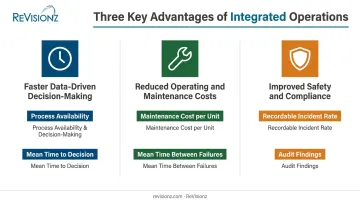
Key Advantages of Integrated Operations
The advantages below map directly to metrics operators already track: cost per barrel, downtime hours, safety incidents, and maintenance spend. None of this is theoretical.
One caveat worth stating upfront: these advantages compound when they're built on clean, reliable asset data. Skip that step, and even the best command center underperforms. We'll come back to that in the strategy section.
Advantage 1: Faster, Data-Driven Decision-Making
IO breaks down the traditional wall between operations, maintenance, and production teams by putting real-time data into shared dashboards everyone can see. Instead of three teams pulling three different reports, one team pulls up one screen.
In command-center settings, cross-functional staff use situational awareness graphics (think plant status maps with color-coded alerts) to assess conditions in seconds instead of spending hours on phone calls and spreadsheet reconciliation.
Why this matters:
- Faster access to validated data shortens the gap between spotting an issue and acting on it
- Equinor's operations support centers added more than 2 million barrels of oil equivalent across five fields in their first months, via remote production and geoscience support
- Shorter decision cycles mean fewer production losses and better capital efficiency overall
KPIs impacted: process availability, mean time to decision, unplanned downtime hours, production variance.
This advantage hits hardest for multi-site or geographically dispersed operations, where specialist expertise is scarce and flying an engineer to a remote pad costs both time and money.
Advantage 2: Reduced Operating and Maintenance Costs
When maintenance schedules are integrated with production plans and condition-monitoring data, unnecessary interventions drop off. Calendar-based servicing, "replace it because it's been six months," gives way to condition-based triggers built on actual equipment behavior.
The savings add up fast:
- Fewer redundant maintenance trips and fewer false alarms mean lower labor and parts spend
- Solomon's benchmarking identified more than $25 million per year in potential savings at one North American refinery through maintenance and workforce restructuring
- Freed-up maintenance budget can be redirected to higher-value capital projects instead of firefighting
KPIs impacted: maintenance cost per unit of production, spare parts inventory levels, mean time between failures.
This advantage matters most for aging assets, brownfield sites, and any facility running on thin margins where every dollar of avoidable maintenance spend counts.
Advantage 3: Improved Safety and Regulatory Compliance
Remote monitoring and centralized command centers cut down the need to send personnel into what the industry has long called "dull, dirty, distant, and dangerous" field environments. Real-time compliance dashboards flag deviations before they escalate into reportable incidents.
Fewer field trips means less exposure to two of the industry's persistent risk categories: transportation incidents and process safety events.
- The National Academies concludes remote real-time monitoring can improve offshore safety and cut environmental risk through direct onshore access to operational data
- That same report cautions that monitoring must fit within existing safety management processes and account for human factors like information overload
- Fewer incidents translate to lower insurance costs, fewer audit findings, and less reputational exposure
KPIs impacted: recordable incident rate, number of field trips and exposure hours, compliance audit findings.
This advantage matters most in remote, offshore, or high-hazard environments operating under strict regulatory oversight, where a single missed deviation can trigger a costly investigation.
What Happens When Integrated Operations Is Missing or Ignored
Siloed operations don't collapse overnight. They erode slowly, and the costs compound. Here's what that erosion typically looks like:
- Teams reach inconsistent decisions when they rely on different, sometimes outdated data sets, so two groups can draw opposite conclusions about the same asset
- Disconnected planning between production, maintenance, and logistics drives higher error rates and rework, creating scheduling conflicts and duplicated effort
- Without predictive maintenance triggers, teams fall into reactive firefighting, responding to failures instead of preventing them and pushing unplanned downtime higher
- Small inefficiencies at one site multiply across a portfolio of assets, driving rising costs over time
- Onboarding new staff or opening a new site becomes painful without a single source of truth for asset data, creating scaling difficulty
None of these show up as a single dramatic failure. They show up as a slow accumulation of avoidable cost.
How to Get the Most Value from Integrated Operations
IO only delivers sustained value when it's built on reliable data, applied consistently, and measured against clear KPIs. Skip the data step, and even a well-designed command center becomes an expensive way to display unreliable information.
Start with an honest assessment. Before buying new tools, evaluate current operational practices, technology utilization, and data quality against actual business goals. Most IO initiatives underdeliver for one specific reason: fragmented, unstructured engineering and asset data that isn't lifecycle-ready.
This is where digital asset enablement and asset information management (AIM) become the connective layer. Piping data, electrical schematics, and P&IDs need to be structured and interoperable before they can feed a real-time dashboard or a predictive analytics model.
Firms like ReVisionz specialize in exactly this work, transforming unstructured asset data into a lifecycle-ready foundation that strengthens whatever IO initiative gets built on top of it. One documented case involved an oil refinery client whose low-quality asset data was undermining trust in reporting until a phased, value-first data cleanup restored confidence and cleared the way for broader system improvements.
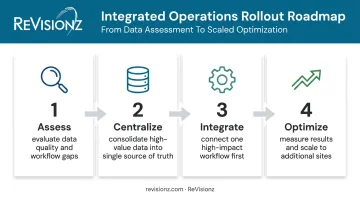
A practical rollout sequence looks like this:
- Assess current data quality, technology usage, and workflow gaps before spending a dollar on new platforms
- Centralize the highest-value data sources into a governed, single source of truth
- Integrate one high-impact workflow first, such as maintenance-production coordination, rather than attempting a portfolio-wide rollout
- Optimize by measuring results, refining the workflow, and scaling to additional sites and disciplines
Treat IO as an ongoing operating model, not a one-time deployment. Insights need to be acted on and workflows refined continuously, or the whole effort reverts to the old silos.
Conclusion
A new screen in the control room won't deliver integrated operations. Real IO creates coordination and consistency across teams and systems that used to work in isolation. The cost, safety, and uptime advantages are real, but they compound only when they're built on clean data and executed consistently over time.
Treat IO as a long-term operating discipline, not a project with an end date. That discipline starts with one unglamorous step: getting the underlying asset data right—the groundwork ReVisionz builds through master data governance and materials management.
Frequently Asked Questions
What are integrated operations?
Integrated Operations (IO) is the practice of connecting people, workflows, and technology or data across disciplines to enable faster, cross-functional decision-making in oil and gas operations. IO functions as an operating model rather than a single piece of software or hardware.
What is an integrated oil and gas company?
An integrated oil and gas company operates across the entire petroleum value chain, from upstream production through midstream transport to downstream refining and retail. This is a corporate structure classification, unrelated to the operational practice of integrated operations.
What is an iOps command center?
An iOps (integrated operations) command center is a centralized hub where cross-functional teams monitor and manage multiple assets using real-time dashboards. Staff can assess plant status and coordinate responses without traveling to the field.
How does integrated operations improve safety in oil and gas?
IO reduces the need for personnel to travel into hazardous field environments by shifting monitoring to remote, centralized teams. Real-time compliance dashboards also flag deviations early, before they escalate into reportable incidents.
What technologies support integrated operations?
Common enablers include remote monitoring systems, predictive analytics, digital twins, and asset information management (AIM) platforms. None of these alone constitutes IO; they work as enablers of integrated people and processes.
Does integrated operations require a large capital investment?
Not necessarily. Most IO initiatives start by better using existing automation, data, and infrastructure before any major new technology spend is required. The bigger barrier is usually data quality, not capital.