Introduction
Enterprises are pouring budget into AI and agentic systems, betting big on faster decisions and predictive insights. Many of those bets aren't paying off.
Gartner forecasts that 60% of AI projects lacking AI-ready data will be abandoned by 2026 (Gartner, 2025). The models aren't the problem. The data feeding them never was ready in the first place.
Here's the trap most organizations fall into: they assume "clean data" is enough. It isn't. AI models need data that's structured, contextual, governed, and continuously updated. That's a much higher bar than what dashboards and spreadsheets require.
That gap hits hardest in capital-intensive industries. Oil & gas, chemicals, mining, and manufacturing sit on decades of engineering and asset data trapped in PDFs, disconnected systems, and inconsistent tagging conventions.
This guide breaks down what AI-ready data actually means, why it matters for asset-heavy operations, how to assess your own readiness, and the roadmap for building a foundation AI can actually trust.
Key Takeaways
- AI-ready data requires structure, context, governance, and continuous refreshes, not just cleaning
- Data silos and poor structure, not the AI model, cause most stalled AI initiatives
- Asset data readiness depends on tagging, metadata, and connectivity across CAD, EAM, and document platforms
- AI-ready data is a phased journey: assess, cleanse, govern, and integrate continuously
What Is AI-Ready Data?
AI-ready data is information that's accurate, complete, structured with metadata and context, governed, and refreshed often enough that AI systems can act on it without someone manually reconstructing it first.
That last part matters. If your team spends weeks reformatting spreadsheets before a model can use them, your data isn't AI-ready — no matter how "clean" it looks.
AI-ready data differs from BI-ready data in one critical way: dashboards tolerate gaps and inconsistencies that AI models can't. A report can run fine on data full of blank fields or inconsistent naming. Feed that same data into a machine learning model, and you get hallucinations, drift, or predictions nobody can trust.
This gap isn't rare. In Accenture's 2024 survey of 2,000 CXOs, 48% said their organizations lacked enough high-quality data to operationalize generative AI (Accenture, 2024). Nearly half of enterprise leaders know their data can't support what they're trying to build.
For asset-intensive industries, AI-ready data means:
- Engineering drawings and P&IDs that are digitized and tagged, not scanned PDFs sitting in a shared drive
- Asset registries with consistent hierarchies, not duplicated or conflicting records across facilities
- Maintenance histories and inspection records linked to the assets they describe, not buried in disconnected work order systems
Core Attributes That Define AI-Ready Data
Five attributes separate AI-ready data from everything else:
- Quality and completeness: Accurate, deduplicated, validated data that reflects real-world conditions, including the edge cases and outliers your AI use case needs to learn from
- Structure and machine-readability: Consistent schemas, taxonomies, and metadata so algorithms process data without human cleanup
- Context and lineage: Clear traceability of where data came from and how it was transformed, essential for debugging models and passing audits
- Governance and security: Access controls, PII handling, and compliance policies built into the data lifecycle, not bolted on afterward
- Freshness and continuity: Updates on a cadence that matches the use case, rather than relying on static extracts that go stale within weeks
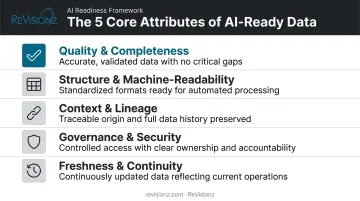
Miss any one of these, and the AI initiative built on top of it inherits the weakness.
Why AI-Ready Data Matters for Asset-Intensive Industries
An AI model is only as reliable as what feeds it. Inconsistent or stale asset data doesn't just produce mediocre predictions. It produces predictions people stop trusting, and that kills adoption before it starts.
The confidence gap is wide even among sophisticated enterprises. Only 29% of technology leaders strongly agreed their data met the quality, accessibility, and security standards needed to scale generative AI (IBM, 2024). That's roughly seven in ten leaders who aren't confident in the foundation their AI programs sit on.
Safety, Compliance, and the Cost of Bad Asset Data
In process and energy industries, this isn't an abstract data problem. Predictive maintenance and incident-prediction models rely entirely on underlying asset and safety data. If inspection records are incomplete or maintenance histories are scattered across three systems, the AI can't flag the failure pattern it's supposed to catch.
Poor asset data also drives rework and delays capital projects, ultimately inflating total cost of ownership. ReVisionz's work in Asset Information Management and Intelligent Asset Management targets this directly, reducing total cost of ownership and enhancing asset performance through lifecycle-ready data. Information quality gets treated as a lifecycle discipline, not a cleanup project.
The EPC Handover Gap
Here's where things break down specifically for asset owners: engineering and construction data is rarely structured for operations or analytics. It's built to get a project through commissioning, not to feed a predictive maintenance model five years later.
AI-readiness requires bridging that gap: connecting project delivery data with operational systems so the information doesn't have to be rebuilt after handover. ReVisionz's work on digital handover readiness and its Main Information Contractor+ (MIC+) service address exactly this transition, turning unstructured asset data into lifecycle-ready, AI-consumable information.
Once that bridge exists, data stops being a one-off pilot resource. It gets reused across predictive maintenance, digital twins, and compliance reporting. That reuse is what separates AI programs that scale from those that stay stuck in pilot mode.
How Do You Know If Your Data Is Ready for AI?
Before investing in any AI initiative, run your data through a straightforward self-assessment.
Ask these questions honestly:
- Is your data centralized, or still siloed across disconnected CAD, EAM, and document management systems?
- Is it tagged with consistent metadata across facilities, or does each site use its own naming conventions?
- Can you trace data lineage — where it originated and how it's been transformed?
- Is it updated continuously, or does it rely on periodic batch extracts that go stale between refreshes?

Readiness isn't universal, though. Gartner is explicit on this point: there's no way to make data AI-ready "in general or in advance," because requirements shift with the use case (Gartner's 2025 analysis on AI-ready data).
Readiness requirements vary by use case:
- Predictive maintenance models need tightly structured, high-frequency sensor and maintenance data.
- Generative AI assistants answering questions about engineering standards need well-tagged documents with strong context and lineage.
Evaluate readiness against your specific application, not against a generic checklist.
Most organizations underestimate how much this self-assessment misses. A formal data readiness audit goes deeper. It's the current-state evaluation digital transformation consultancies run before launching an AI or analytics initiative, and it typically surfaces gaps that internal reviews overlook.
Common Barriers to AI-Ready Data in Asset-Intensive Industries
Three barriers show up again and again in capital-intensive environments.
Data silos and legacy systems. Engineering, maintenance, and operations data typically live in disconnected platforms : CAD tools, EAM systems like Maximo or SAP, and separate document management repositories. Unifying them isn't a simple export-and-merge job; each system structures information differently.
Inconsistent tagging and metadata. Without standardized asset hierarchies and naming conventions, the same piece of equipment might have three different tag formats across three facilities. Humans can usually figure out the pattern. AI models can't.
Unstructured, paper-based legacy documentation. Older facilities still lean on scanned drawings, PDFs, and manual inspection logs. None of that is usable by AI until someone enriches it with structure and context.
A recent example: in a mining industry engagement, ReVisionz used laser scan reality capture and 3D visualization to compare physical assets against decades-old, incomplete engineering documentation. That physical verification exposed missing, duplicate, and incorrectly structured asset records the paper trail alone never would have revealed.
These barriers compound. Most industrial organizations remain in the early stages of closing this gap, with digitization efforts still maturing rather than fully integrated.
How to Build an AI-Ready Data Foundation
Building AI-ready data is a sequence, not a single project. Here's the practical path:
- Assess your current data landscape against specific AI use cases. Don't try to make "all" data AI-ready at once. Map your data against the two or three AI applications you're actually pursuing first.
- Cleanse, standardize, and migrate legacy or unstructured data. This includes scanned drawings, paper records, and inconsistent engineering files, all moved into structured, digitized formats.
- Establish consistent metadata, taxonomies, and asset hierarchies. Machine-readable data requires the same tagging logic applied the same way, everywhere, every time.
- Embed governance, security, and compliance controls into data pipelines. Access policies and PII handling need to be built into the workflow, not added after something goes wrong.
- Enable continuous synchronization between engineering, operations, and AI/analytics environments. Static extracts don't cut it: models need current information, not last quarter's snapshot.

In practice, this looks different from theory. Two client engagements show the range:
- Oil and gas Maximo cleanup: ReVisionz corrected a low-quality Maximo dataset entirely offline, delivering trusted records with no rework and zero disruption to internal teams.
- LNG data consolidation: ReVisionz consolidated over 300,000 tags and 800,000 documents into a centralized registry, guided by a business roadmap, an MVP, and a defined migration strategy.
A specialized partner speeds up this process. ReVisionz's asset information management approach and AI-powered Main Information Contractor+ (MIC+) service are built around these five steps, helping organizations move through them faster than internal teams typically can alone. The result: unstructured asset data becomes lifecycle-ready, AI-consumable information.
Frequently Asked Questions
How do I know if my data is ready for AI?
Check whether your data is centralized, consistently tagged, traceable, and updated continuously rather than through periodic batches. Readiness also depends on your specific AI use case, so evaluate against that application directly.
What is the difference between clean data and AI-ready data?
Clean data is accurate and free of errors. AI-ready data goes further, requiring metadata, context, lineage, governance, and continuous updates so AI models can use it without manual reconstruction.
How long does it take to prepare data for AI?
Timelines vary based on data volume, current-state maturity, and use case complexity. There's no universal duration. A phased, assessment-first approach reduces risk and surfaces realistic timelines early.
What industries need AI-ready data the most?
Data-intensive, regulated, and asset-heavy industries (energy, chemicals, manufacturing, mining, and petrochemicals) have the most to gain from AI readiness and the most legacy complexity to untangle.
Can AI help clean and prepare its own data?
Generative AI tools can assist with cleansing and enrichment tasks, speeding up parts of the process. Human governance and validation remain essential, though, particularly for compliance and safety-critical records.
What is the first step in becoming AI-ready?
Start with a data readiness assessment tied to one defined AI use case. Trying to fix "all" your data before choosing a use case wastes time and rarely produces the structure a specific model actually needs.