Introduction
A capital project team approves a $4 million equipment overhaul based on the maintenance history in the CMMS. Halfway through execution, someone discovers the equipment tag doesn't match the physical nameplate. The "history" belonged to a different asset entirely.
This happens more often than most operators admit. As plants digitize and asset data spreads across ERP, EAM, and engineering platforms, keeping that data trustworthy becomes increasingly difficult. Disconnected systems and inconsistent naming standards turn a routine maintenance decision into a costly guessing game.
This guide breaks down what data quality management (DQM) means and the principles used to measure it. It also covers a practical framework for implementation, with specific attention to engineering and asset data in capital-intensive operations.
Key Takeaways
- DQM is an ongoing discipline spanning a data asset's full lifecycle, not a one-time cleanup
- Data quality is measured against six dimensions: accuracy, completeness, consistency, timeliness, validity, and uniqueness
- Poor data quality costs organizations an average of $12.9 million annually, according to Gartner
- Effective DQM programs need defined standards, automated tooling, continuous monitoring, and clear ownership
- For asset and engineering data, DQM overlaps heavily with Asset Information Management (AIM)
What Is Data Quality Management?
Data quality management is the set of practices, processes, and technologies that keep organizational data accurate, consistent, and reliable enough to support its intended use, from the moment it's created through archival.
For most businesses, that means customer records and sales figures. For asset-intensive operators, it also means tag registers, equipment lists, P&ID data, and maintenance histories that must remain trustworthy across decades of turnarounds, system migrations, and capital projects.
This distinction matters. ISO 8000-61 defines DQM as a process reference model, not a single event, and DAMA's framework describes it as a continuous function built on a repeating plan-monitor-act-deploy cycle. A one-time data cleanse might fix today's errors. It does nothing to stop tomorrow's from piling up.
The Five Core Processes That Make Up a DQM Program
Most mature DQM programs run on five interlocking processes:
- Data Profiling — Analyzing sources like tag registers, equipment lists, and P&ID data to understand structure, content, and existing quality gaps before you try to fix anything
- Data Cleansing/Standardization — Correcting errors, removing duplicates, and aligning naming conventions so a pump tagged "P-101" in the EAM (Enterprise Asset Management) system matches "P-101" in the engineering platform
- Data Validation — Checking that records conform to predefined rules, such as correct tag number formats or valid equipment classifications
- Data Enrichment — Appending missing attributes, like criticality ratings or maintenance specs, so records become usable for decision-making
- Data Monitoring — Continuously tracking data health so new degradation from field changes or capital projects gets caught early instead of compounding
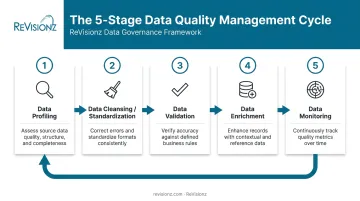
Skip any one of these, and the other four eventually break down. Cleansing without monitoring, for instance, just guarantees you'll be cleaning the same mess again next year.
Why Data Quality Management Matters (Especially for Asset-Intensive Industries)
Poor data quality costs organizations at least $12.9 million per year on average, according to Gartner's data quality research. That figure spans all industries and use cases, not just asset-heavy operations, but the underlying mechanics apply directly to plants and facilities.
In asset-intensive sectors, bad data doesn't just sit quietly in a database. It shows up as:
- Delayed maintenance decisions, because nobody trusts the equipment history enough to act on it
- Higher safety and regulatory compliance risk, when criticality or classification data is wrong or missing
- Inflated total cost of ownership, as errors get corrected repeatedly instead of once
- Rework during capital projects, when handover data doesn't match field conditions
There's also a ripple effect on digital transformation efforts. Predictive maintenance programs, digital twins, and analytics initiatives are only as good as the data feeding them. McKinsey identifies insufficient, inaccessible, or low-quality data as a common barrier preventing predictive maintenance from scaling past the pilot stage.
That means a company can invest heavily in sensors, dashboards, and AI models and still see minimal returns because the equipment master data underneath it is inconsistent or incomplete. The data foundation determines whether those investments pay off, not the technology itself.
The Core Principles of Data Quality Management
Rather than judging data quality subjectively, organizations measure it against defined dimensions. The UK Government's Data Quality Hub, building on DAMA's framework, names six commonly used dimensions.
Accuracy
Does the data reflect reality? An equipment record is accurate when it matches the physical nameplate or field-verified specifications, not just what someone typed into a system years ago.
Completeness
Are all required fields populated? At project handover, this means criticality ratings, maintenance strategy, and safety classification are filled in, not left blank for operations to figure out later.
Consistency
Do values agree across systems? A consistent asset tag reads the same in the CMMS, the EAM, and the engineering P&ID, without three slightly different versions floating around.
Timeliness
Is data available when needed? As-built data should be ready at handover, not surface six months into operations after someone finally chases it down.
Validity
Validity checks whether data conforms to the expected format or rule. A valid tag number follows the organization's naming schema and classification standard instead of an ad-hoc pattern from whoever entered it.
Uniqueness
Uniqueness confirms each asset or equipment record exists only once, with no duplicates competing for the same physical asset. A duplicated pump record in the CMMS, for instance, can split maintenance history across two IDs and throw off reliability metrics.
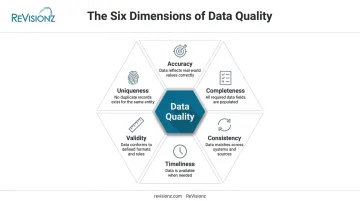
This is why you'll see both "5 principles" and "6 principles" referenced online. Neither is wrong; they're just drawing the line in a different place. GOV.UK's framework includes uniqueness as a standard sixth dimension, while other standards, like ISO/IEC 25012, use as many as 15 characteristics.
DQM vs. Data Governance vs. Asset Information Management (AIM)
People often use these three terms interchangeably, which causes confusion. Here's how they actually differ:
| Discipline | What It Covers | Example in Practice |
|---|---|---|
| Data Governance | Sets policy, decision rights, and accountability for managing data | Deciding who owns tag naming standards and who approves changes |
| Data Quality Management | Executes those rules through profiling, cleansing, and monitoring | Running validation checks that flag mismatched tag formats |
| Asset Information Management (AIM) | Operationalizes data quality across an asset's full lifecycle | Ensuring handover data stays usable from design through decommissioning |
Governance decides the rules. DQM enforces them day to day. AIM applies both across the full span of an asset's life, from engineering design through operations and eventual retirement.
For engineering and asset data specifically, this AIM layer is where the real value shows up. It's also where specialized digital asset consultancies like ReVisionz focus their methodology, since asset data quality problems rarely stay contained to one system.
A bad tag number in engineering ripples into procurement, maintenance planning, and eventually compliance reporting if nobody catches it early.
How to Build a Data Quality Management Framework
A workable DQM framework follows six steps:
Define objectives and Critical Data Elements (CDEs). Identify which data actually matters for safety and business goals, such as safety-critical equipment attributes or tag data required for handover.
Profile and baseline current data. Run an assessment to build a data quality scorecard, and identify root causes, like inconsistent legacy naming conventions or broken system integrations, before attempting fixes.
Standardize rules across systems. Align naming conventions and data handling rules across ERP, EAM, and engineering design tools so the same asset means the same thing everywhere.
Deploy automated and AI-powered validation tools. Manual review doesn't scale when a single capital project generates millions of data points. Automated cleansing catches issues humans would miss.
Establish continuous monitoring and clear ownership. Assign data stewardship so quality issues get caught and resolved as they arise, instead of worsening until the next audit.
Partner with specialists for complex legacy data. Decades-old engineering and asset data often needs more than internal bandwidth to fix. ReVisionz's AI-powered Main Information Contractor+ (MIC+) service transforms unstructured legacy asset data into lifecycle-ready information, taking on accountability for data quality across the delivery lifecycle.
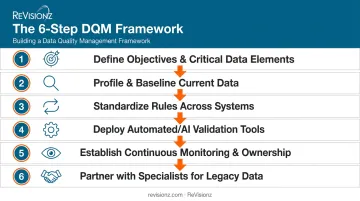
Each step builds on the last. Skip the baseline assessment in step two, and step four's automated tools have no clear target to fix.
Frequently Asked Questions
What is data quality management?
Data quality management is the ongoing discipline of ensuring data accuracy, completeness, and reliability through profiling, cleansing, validation, and monitoring. It supports better decision-making rather than being a one-time cleanup effort.
What are the 5 principles of data quality?
The five commonly cited principles are accuracy, completeness, consistency, timeliness, and validity. Some frameworks, including GOV.UK's data quality framework, add uniqueness as a sixth dimension.
What is the difference between data quality management and data governance?
Governance sets the policies, standards, and ownership rules for data. DQM is the operational execution of those rules, including profiling, cleansing, and continuous monitoring.
How does data quality management differ for engineering and asset data compared to typical business data?
Engineering and asset data must stay accurate across decades of operations, not just a fiscal quarter. It also spans multiple systems, like EAM, CMMS, and engineering tools, and directly affects safety and regulatory compliance.
What tools are used for data quality management?
Common tools include data profiling and monitoring platforms, validation frameworks, and AI-powered cleansing tools. For engineering data specifically, specialized platforms handle tag validation and legacy document structuring.
Who is responsible for data quality within an organization?
Responsibility typically sits with designated data owners and stewards, supported by IT and engineering teams. Leadership plays a role in setting the standards and priorities those teams execute against.