A single-site manufacturer governing product data faces a different challenge than a multi-site oil & gas operator governing equipment tags, engineering documents, and supplier records across a dozen facilities. Complexity compounds fast.
Ownership typically sits with a Chief Data Officer or Chief Data & Analytics Officer, supported by a data governance council, domain-specific data stewards, and IT/business teams working together. For asset-heavy or multi-system environments, specialist consultants often get brought in to bridge gaps generic IT teams weren't built to solve.
Without proper governance, the failures are predictable: duplicate customer or asset records, compliance exposure, unreliable AI outputs built on bad inputs, and expensive rework when systems don't talk to each other. This guide walks through the full MDG framework and a phased approach to implementing it.
Key Takeaways
- MDG keeps customer, product, supplier, and asset data accurate across every connected system
- Unlike MDM (technical consolidation) or broader data governance (all data), MDG operationalizes policy specifically for master data
- Strong frameworks rest on four pillars: ownership, policies/standards, stewardship, and technology/automation
- Phased rollout (foundation, expansion, optimization) beats trying to govern every domain simultaneously
- Success requires tracked metrics, not assumptions about data quality
What Is Master Data Governance?
Master data is the core information describing your organization's key business entities: customers, products, suppliers, employees, and locations. For asset-intensive industries, that scope extends further, covering physical assets, equipment tags, and engineering data.
This data needs to function as a single source of truth. When your ERP says one thing about a supplier and your CRM says another, every downstream decision built on that data becomes suspect.
Master data governance is the discipline that keeps this data accurate, consistent, secure, and reliable across every consuming system. It's the operational layer that turns "data should be clean" into an enforced practice with owners, rules, and audit trails.
MDG vs. MDM vs. Data Governance
These three terms get used interchangeably, and that's a problem. Each has a distinct scope:
- Data governance covers all organizational data — establishing accountability, policies, and decision rights broadly, per DAMA's definition
- MDM (Master Data Management) is the technical discipline of consolidating records into "golden records" through matching, deduplication, and integration
- MDG (Master Data Governance) is the governance layer applied specifically to master data: the policies, stewardship, and controls that keep golden records trustworthy after MDM creates them
Here's where confusion peaks: is SAP the same as MDM or MDG? No. SAP is a software vendor that sells a product literally named "SAP Master Data Governance," which is a governance tool.
MDM and MDG are vendor-agnostic disciplines you can apply using SAP, Informatica, Profisee, or no dedicated platform at all. Don't let a product name define an entire discipline.
Why Master Data Governance Matters
Poor data quality isn't a minor operational headache. Gartner reports that it costs organizations an average of at least $12.9 million annually, based on a 2020 Gartner report (though that figure covers general data quality, not master data specifically).
Master data problems compound because bad records don't stay contained. They propagate into every report, forecast, and transaction that touches them.
The stakes rise further with AI. Gartner predicts that through 2026, organizations will abandon 60% of AI projects that aren't supported by AI-ready data. Master data quality is one meaningful input into that readiness, though not the only variable.
That readiness bar looks different depending on the industry. For asset-intensive industries (oil & gas, chemicals, mining, manufacturing), MDG has to extend beyond customer and product records into engineering and asset data. This is the nuance generic MDG guidance skips.
- Equipment tags, class hierarchies, and reference data need governance just as much as customer records
- Standards like ISO 55013:2024 now specifically address the management of data as an asset within physical asset management programs
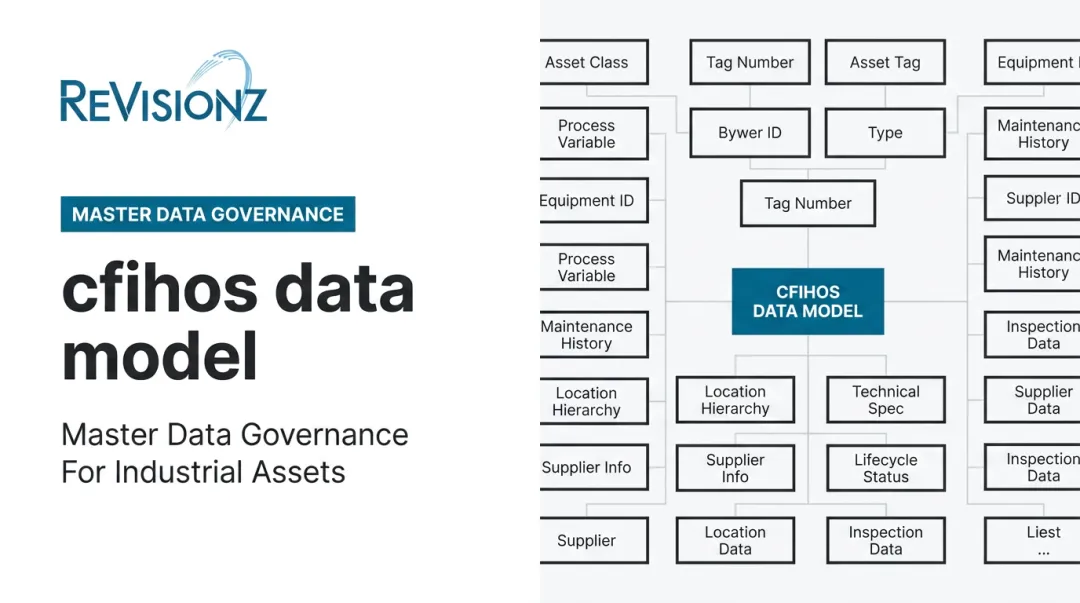
- Firms like ReVisionz specialize in bridging asset information management with governance frameworks, informed in part by active participation in standards efforts like CFIHOS
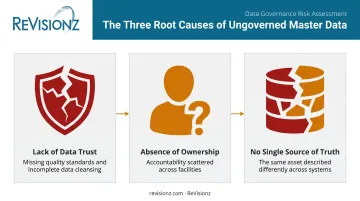
ReVisionz's engagement work with owner-operators consistently surfaces three root causes behind ungoverned master data:
- Lack of data trust: no quality standards, incomplete cleansing
- Absence of ownership: accountability scattered across facilities
- No single source of truth: the same asset described five different ways in five different systems
The Master Data Governance Framework: Core Building Blocks
A working MDG framework rests on defined building blocks that translate policy into daily practice. Skip any one of these, and the whole structure gets shaky.
Governance Structure and Ownership
Every effective program starts with a governance council: an executive sponsor, domain owners for each master data category, and a documented RACI matrix that spells out who's Responsible, Accountable, Consulted, and Informed for every governance decision. Without this, "governance" becomes a suggestion, not a requirement.
Data Policies, Standards, and Quality Rules
This is where abstract intent becomes enforceable rules:
- Business glossaries that define terms consistently across departments
- Naming conventions for records, fields, and identifiers
- Data quality thresholds for completeness, accuracy, and validity
- Survivorship rules determining which source wins when records conflict
Data Stewardship and Accountability
Assign a data steward per domain who resolves quality issues rather than simply flagging them. Pair this with approval workflows for changes and audit trails that log who changed what, when, and why. Stewardship without accountability is just a title.
Technology, Automation, and Lifecycle Management
Manual governance doesn't scale past a handful of domains. Data catalogs, automated quality checks, and AI-assisted matching enforce policy at volume. Governance also needs to cover the full data lifecycle — from creation through archival or retirement, extending well beyond the moment a record gets entered.
Four common operating styles define how organizations structure this technically:
| Style | How it works | Best fit |
|---|---|---|
| Registry | Links records with global IDs; source data stays put | Many disparate sources, low-impact needs |
| Consolidation | Pulls data into a hub to create golden records | Analytics-heavy use cases |
| Coexistence | Hub and source systems sync in real time | Organizations needing both accuracy and operational speed |
| Centralized | One system creates and owns master attributes | Larger organizations with strong central IT |
How to Implement Master Data Governance: Step-by-Step
Organizations that try to govern every domain simultaneously typically stall out and lose executive support within a year. A sequenced approach works better.
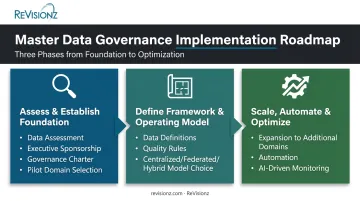
Phase 1: Assess and Establish the Foundation
- Run a current-state data assessment: identify where duplicates, gaps, and conflicting records live today
- Secure executive sponsorship: without it, governance decisions have no teeth
- Draft a governance charter: define escalation paths and meeting cadence upfront
- Select one pilot domain: product master or supplier master are common starting points because wins are visible fast
Phase 2: Define the Framework and Choose an Operating Model
Document data definitions, quality rules, and survivorship logic for your pilot domain specifically — not the whole enterprise yet. Then choose your operating model:
- Centralized: works when regulatory pressure and data maturity are both high
- Federated: better fit for decentralized cultures with strong regional autonomy
- Hybrid: most common in practice, blending central policy with local execution
Phase 3: Scale, Automate, and Optimize
Expand to two or three additional domains per cycle rather than everything at once. Integrate downstream systems, automate stewardship workflows where risk is low, and layer in AI-driven quality monitoring. Refine policies continuously based on what stewardship metrics actually show you.
This staged model mirrors what large-scale asset programs already do in practice. ReVisionz's work consolidating more than 300,000 tags and 800,000 documents for an LNG operator followed a similar logic: establish standards, prove them on a contained scope, then expand.
Measuring Success and Overcoming Common Challenges
Governance without metrics is just good intentions. Track these consistently:
- Data completeness: how much required information is actually present
- Accuracy: how well records reflect real-world state
- Duplicate rate: how many records describe the same entity twice
- Steward issue-resolution time — how fast flagged problems get fixed
No universal industry benchmark exists for these figures (published research from bodies like the EDM Council keeps detailed peer comparisons member-restricted). Set your own baseline during Phase 1, then track improvement against it.
Solid metrics alone won't fix implementation snags. Three recurring roadblocks show up most often:
Challenge 1: Lack of executive buy-in. Reframe MDG in business terms, not IT jargon. Position it as a risk mitigator and revenue enabler that strengthens the bottom line.
Challenge 2: Governance seen as a bottleneck. Apply tiered, risk-based approval workflows so low-risk changes get automated while high-risk changes get scrutiny. This preserves speed where speed doesn't threaten data integrity.
Challenge 3: Fragmented systems across engineering, operations, and IT. This is common in asset-heavy industries where legacy engineering platforms were never designed to talk to modern governance tools.
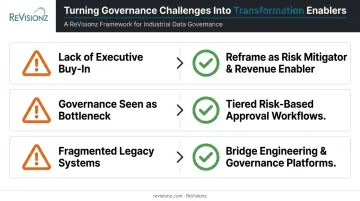
Bridging that gap means connecting decades-old tag registries and document systems with current governance platforms — specialized work that ReVisionz has run repeatedly for owner-operators consolidating fragmented Smart 3D environments and legacy piping specifications into unified systems.
Best Practices for Effective Master Data Governance
- Start with one pilot domain. Prove value before scaling enterprise-wide. Trying to govern everything at once is the single most common reason programs fail early.
- Maintain a living business glossary and data catalog. Definitions drift as departments grow; a static document won't hold.
- Treat governance as continuous, not a project with an end date. Systems change, regulations shift, and AI use cases keep emerging — policies need to keep pace.
- Know when to bring in a partner. Complex, multi-site, or asset-data-heavy environments often need specialists who've navigated this before. ReVisionz brings over two decades of asset information management experience guiding organizations from document-centric to data-centric operations.
Frequently Asked Questions
What are the 4 MDM styles?
Registry, consolidation, coexistence, and centralized. Registry links records without altering sources; consolidation builds golden records in a hub; coexistence syncs hub and source in real time; centralized makes one system the sole system of record.
What are the 7 building blocks of MDM?
Common frameworks reference governance, stewardship, quality management, master data modeling, hierarchy management, data integration, and lifecycle management. No single body publishes this as an exact universal standard, but these capabilities consistently appear across authoritative guidance.
Are SAP, MDM, and MDG the same?
No. SAP is a software vendor offering products like "SAP Master Data Governance." MDM and MDG are vendor-agnostic disciplines you can apply with SAP tools, other vendors' tools, or none at all.
What is the master data governance strategy?
An MDG strategy defines who owns which data domains and what policies and quality rules apply. It also specifies which operating model fits your organization, plus a phased roadmap for rolling governance out domain by domain.
What is the difference between master data governance and data governance?
Data governance covers all organizational data: transactional, unstructured, and everything else. MDG narrows that scope specifically to master data domains like customers, products, suppliers, and assets, operationalizing policy for those entities.
How long does it take to implement master data governance?
A single pilot domain can show measurable results within a few months. Enterprise-wide maturity across multiple domains typically takes well over a year, depending on domain count, system complexity, and organizational readiness.