
They bring in an IT consultant to install new software, or a software vendor to roll out a single platform, and call it "digital transformation." Then the initiative stalls in pilot mode.
That's not an isolated problem. A World Economic Forum and McKinsey study of industrial companies found that 84% remained stuck in pilot mode for more than a year, and 28% stayed there for over two years without ever scaling their digital initiatives enterprise-wide.
The root issue is often a basic misunderstanding: what a digital transformation expert actually is, and how that role differs from a generic IT consultant or software reseller. This article defines the role, breaks down core responsibilities, covers the four main areas digital transformation touches, and explains what to look for when choosing the right expert or partner.
Key Takeaways
- A digital transformation expert bridges strategy and technology, reshaping asset design, operations, and maintenance, not just installing software
- True experts combine deep engineering knowledge, technology-agnostic thinking, and strong change and program management skills
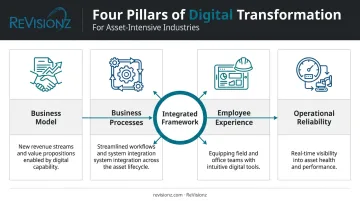
- Transformation efforts typically span four areas: business model, processes, employee experience, and operational reliability
- Choosing between in-house talent and a specialized consultancy often decides the program's speed and success
What Is a Digital Transformation Expert?
A digital transformation expert is a specialized professional, or consultancy, who helps organizations reimagine their business models, processes, and culture using digital technology. That's a different job than installing a new software platform.
Three terms get confused constantly, and the distinction matters:
- Digitization: Converting analog information, such as paper drawings or handwritten logs, into digital format
- Digitalization: Using digital technology for a single-point project, such as rolling out a CRM
- Digital transformation: A fundamental reorientation of how a business creates and delivers value, using digital technology as the enabler
A digital transformation expert operates in the third category. Their job spans every level of an organization, from field engineers and plant operators who touch data daily to C-suite executives who approve capital.
Translating Technical Complexity Into Business Value
Take engineering data governance. A field engineer might flag that revision control on piping and instrumentation diagrams is inconsistent across a facility. That's a technical problem.
A digital transformation expert reframes it: inconsistent data means rework during the next turnaround, delayed permits, and slower troubleshooting when something goes wrong. Suddenly it's a line item that affects budget, schedule, and safety, something a plant manager and a CFO can both act on.
Why Asset-Intensive Industries Need More Than Software Adoption
In capital-intensive sectors like oil & gas, petrochemicals, mining, and manufacturing, the expert's remit extends well beyond a generic software rollout. It typically covers:
- Engineering data structuring and governance
- Asset information management across the facility lifecycle
- Digital twin enablement, from design through operations
- Handover readiness between capital projects and day-to-day operations
This is asset lifecycle work, not a one-time IT project.
Expert vs. Specialist
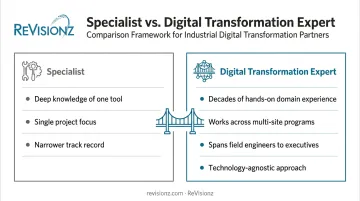
A specialist might have deep knowledge of one tool or one project type. An "expert" typically brings decades of hands-on domain experience and a track record across complex, multi-site programs.
That track record comes from personally working through failed implementations, legacy data cleanups, and multi-year capital programs across different plants and companies. At ReVisionz, for example, several partners carry 25 to 30 years of hands-on experience spanning EPC firms, owner-operators, and multiple industries.
That distinction is why organizations should look past job titles and dig into the actual track record behind them.
What Does a Digital Transformation Expert Actually Do?
Strip away the buzzwords, and the job breaks down into six concrete activities. On multi-site programs, experienced experts often run several in parallel rather than strictly in sequence.
Assess the current state. Before recommending any technology, the expert audits existing data, systems, and processes to find the actual gaps, not the ones a vendor assumes exist. In practice, this initial network-wide scan typically takes one to two months for a multi-facility organization.
Build a phased roadmap. A long-term vision means little without a sequence of achievable programs and projects attached to it. The roadmap ties each phase to a business outcome, not just a technology milestone.
Migrate, enrich, and govern data. Legacy engineering and asset data is usually scattered across formats, systems, and decades of history. The expert converts that unstructured mess into lifecycle-ready information that ERP, EAM, and analytics platforms can actually use.
Select and implement technology, vendor-agnostically. The right platform depends on the client's existing systems and data maturity, not the consultant's preferred vendor. That might mean a records platform for one client and a materials management data model for another, depending on what the problem calls for.
Drive change management. New systems fail when people quietly revert to old habits. McKinsey's research on digital transformation found that transformations with a clear change story were three times more likely to succeed, which demands structured training and honest communication about what's changing.
Establish KPIs and monitor results. Safety incidents avoided, compliance gaps closed, rework hours eliminated — these are the metrics that prove a transformation delivered value instead of just delivering new software.
The 4 Main Areas of Digital Transformation
Digital transformation touches four distinct areas of a business, a framework MIT Sloan researchers Westerman and Bonnet refined in 2021 after originally identifying three. Employee experience became its own category, sitting alongside operations, customer experience, and business-model innovation, according to MIT Sloan's updated model.
For asset-intensive industries, each area looks a little different in practice.
Business Model
This covers how digital technology changes the way a company delivers value. On a capital project, that might mean moving away from a traditional handover, where the EPC delivers documents and the owner-operator spends months untangling them. Instead, information accountability gets built into the contract from day one.
Business Processes
Digitizing workflows, replacing manual data entry, paper travelers, or siloed spreadsheets with governed digital systems, directly improves decision-making speed and productivity. A maintenance planner who pulls accurate equipment history in seconds instead of days works faster and makes better calls.
Employee Experience
Employee experience is about how workers engage with digital tools daily, from onboarding on a new EAM platform to how easily a field technician can pull up an asset's maintenance history on a tablet. Poor tool design here is one of the fastest ways to kill adoption.
Operational Experience and Reliability
For most consumer businesses, this area is "customer experience." For asset-intensive operators, the more useful framing is operational reliability: the actual performance of equipment, systems, and facilities that plant staff, regulators, and downstream customers all depend on. Better data governance feeds directly into fewer unplanned outages and more predictable maintenance.
Skills and Qualities That Define a True Digital Transformation Expert
Job titles are easy to hand out. The skills behind them are harder to verify. Look for these traits:
- Deep domain and industry expertise. Hands-on field experience in piping engineering, process safety, or asset management brings sharper judgment than generic IT credentials alone
- A technology-agnostic mindset. The best experts prioritize business outcomes over loyalty to any one software platform
- Program and project management rigor. Multi-year, multi-site transformation programs need structured governance, not ad hoc project tracking
- Change management and communication skills. Translating a technical roadmap into something a field supervisor and a board member both understand is its own discipline
- A verifiable track record. Certifications, standards-body participation, and third-party recognition serve as trust signals that outside organizations vouch for the work, not just the consultancy itself
At ReVisionz, this blend shows up in how the firm structures its senior team. Senior Partners and Practice Area Leads typically carry decades of hands-on technical roots in engineering, asset information management, or materials management.
That technical grounding is paired with strategic consulting experience across multi-site capital programs. The combination of field-tested expertise and business fluency is what separates an expert from someone who has only read the playbook.
In-House Expertise vs. Partnering with a Digital Transformation Consultancy
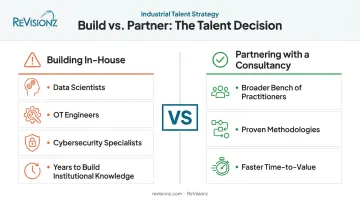
Building an in-house transformation team sounds appealing until you start hiring for it. Finding people who combine deep engineering or asset-management knowledge with business strategy, program management, and change leadership is genuinely hard.
Manufacturers across North America report persistent difficulty filling roles tied to digital initiatives, including:
- Data science and analytics specialists
- OT (operational technology) engineers
- Cybersecurity professionals
That talent gap shows little sign of closing soon. Even when the hires land, building institutional knowledge and proven methodology from scratch takes years, time most organizations don't have while competitors keep modernizing.
Partnering with a consultancy solves this differently. Instead of building capability from zero, an organization gets:
- Access to a broader bench of experienced practitioners across multiple disciplines
- Methodologies already tested across dozens of prior programs
- Faster time-to-value, since the roadmap doesn't start from a blank page
ReVisionz has operated in this space for 25 years, working with capital-intensive owner-operators and EPCs across energy, chemicals, mining, and manufacturing. The firm takes a technology-agnostic approach, meaning recommendations are based on what a client's data and systems actually need rather than which platform ReVisionz prefers to sell.
With one of the largest rosters of dedicated digital asset enablers in North America, ReVisionz helps bridge the gap between project delivery and operational readiness. This is an area where owner-operators and EPCs often struggle to hand off cleanly.
That bridge is also the premise behind the firm's Main Information Contractor+ (MIC+) service, which extends data accountability beyond project handover into day-to-day operations. Organizations weighing their options can schedule a consultation to compare what building in-house would actually cost against a partnership model.
Frequently Asked Questions
What is a digital transformation expert?
A digital transformation expert is a professional or consultancy who bridges technology and business strategy to reshape how an organization designs, operates, and maintains its assets. These experts translate business goals into digital roadmaps spanning systems, data, and organizational change.
What are the 4 main areas of digital transformation?
The four areas are business model, business processes, employee experience, and operational or customer experience. For asset-intensive industries, the last area is often reframed around operational reliability rather than traditional customer service.
How is a digital transformation expert different from an IT consultant?
An IT consultant usually focuses on implementing a specific technology. A digital transformation expert addresses strategy, process, culture, and technology together, with the technology serving the business outcome rather than the reverse.
Which industries need digital transformation experts the most?
Capital-intensive sectors like energy, chemicals, mining, and manufacturing rely heavily on these experts, since asset data accuracy and safety compliance carry direct financial and safety consequences.
How long does a digital transformation initiative typically take?
Timelines vary by scope, but multi-site enterprise programs often span multiple years across assessment, roadmap, and implementation phases. Even the initial assessment phase alone can take one to two months per facility network.
What should I look for when choosing a digital transformation partner?
Look for domain expertise, a technology-agnostic approach, a proven methodology, and demonstrated change management capability. A verifiable track record across complex, multi-site programs matters more than a polished pitch deck.