Introduction
A single haul truck or excavator sitting idle can cost a mining operator more than $1,000 per hour, according to Cummins' analysis of mining machine downtime costs. Multiply that across a fleet running 600+ hours a month, and unplanned downtime stops being a maintenance headache. It becomes a board-level financial problem.
Predictive maintenance (PM) uses sensor data, AI, and analytics to forecast equipment failure before it happens. In an industry defined by remote sites, extreme conditions, and equipment-intensive operations, that forecasting ability is no longer optional.
This article breaks down the AI-driven PM trends reshaping mining, what's fueling their adoption, the operational and business impact already showing up on site, and what's coming next.
Key Takeaways
- IoT sensors and AI now drive mining maintenance from reactive schedules toward predictive, condition-based action.
- Digital twins and asset information management (AIM) make predictive maintenance data trustworthy enough to scale across sites.
- Falling ore grades, labor shortages, and safety regulations push adoption faster than technology hype alone.
- Companies with governed data foundations see the strongest, most durable gains in uptime and safety.
Key Trends in Predictive Maintenance for Mining
Most mining companies sit somewhere on a maturity curve. Some are still running basic vibration sensors on a handful of assets. Others have connected entire fleets to AI-driven analytics platforms feeding real-time dashboards. Here's where the industry is headed.
IoT-Enabled Condition Monitoring
Sensors mounted on haul trucks, excavators, crushers, and conveyors track vibration, temperature, and oil quality around the clock. When a reading drifts outside normal range, the system flags it before the part fails.
This layer matters because it's foundational. Every AI model, digital twin, or cloud dashboard downstream depends on the quality of data coming off these sensors.
Sandvik and IBM built exactly this kind of system together. Their partnership produced OptiMine Analytics, which combines equipment data, mine-management-system data, and connected-fleet data into predictive dashboards. Commercial users have included:
- Petra Diamonds' Finsch mine
- Barminco in Australia
- Hindustan Zinc and Vedanta Zinc, using IoT and analytics for safety and maintenance
AI and Machine Learning-Driven Failure Prediction
Condition monitoring tells you something's wrong. Machine learning tells you what's wrong. ML models trained on historical sensor patterns, including acoustic anomaly detection, can identify specific failure modes rather than generic alerts.
That distinction changes how maintenance teams plan. Instead of "check the conveyor," a technician gets "bearing degradation likely within 12 days." Vendors including GE Digital have built Asset Performance Management (APM) software specifically to help mining operators schedule interventions before failure, rather than after.
Sandvik reported a 50% increase in customer uptake of its own predictive-maintenance service in recent years. That's a vendor adoption signal, not an industry-wide benchmark, but it points in a clear direction: miners are buying into failure-mode-specific prediction, not just anomaly flags.
Digital Twins for Predictive Asset Management
A digital twin is a live virtual replica of a physical asset. It ingests real sensor feeds and simulates wear patterns, remaining useful life, and stress points, all without touching the actual equipment.
Engineering research demonstrates this approach's value. One modeled study simulated maintenance policies across a fleet of 10 trucks and 3 shovels, running thousands of scenarios to identify which maintenance cadence produced the best mill utilization.
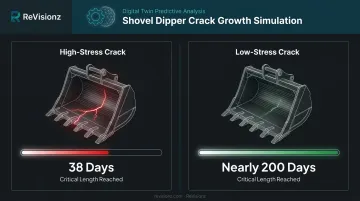
A separate study modeled crack growth in a shovel dipper: a high-stress crack reached critical length in roughly 38 days, compared with nearly 200 days for a lower-stress crack. Both studies let engineers test "what-if" scenarios that would be impossible or dangerous to run on live equipment.
Here's the catch most vendors don't advertise: a digital twin is only as good as the asset data feeding it. Raw sensor noise without structured, lifecycle-ready context produces unreliable simulations.
This is where firms like ReVisionz come in. The company has built digital twin and Asset Information Management (AIM) programs for over two decades, turning fragmented engineering and maintenance records into the structured foundation a twin needs to be predictive rather than decorative.
Cloud and Remote Monitoring Platforms
Cloud-based dashboards let a central engineering team monitor equipment health across multiple remote or underground sites from one interface. That matters enormously in mining, where the nearest qualified technician might be hours away.
Sandvik's Remote Monitoring Service now covers more than 200 connected trucks, loaders, and drills at Barrick's operations, following implementation at the Loulo-Gounkoto underground complex. Haile Gold Mine and Magris Performance Materials' Niobec mine use similar setups.
But centralization isn't automatic success. McKinsey has documented cases where remote operating centers failed because the technology was deployed without redesigning who owns the alert and what happens next. As mining pushes into deeper, harder-to-access deposits, the platforms will keep expanding. The operating model has to expand with them.
Integration of PM with Asset Information Management (AIM) and Data Quality
PM tools are only as accurate as the equipment records behind them. Inconsistent tagging, duplicate records, and fragmented data silos across ERP and EAM systems undermine even the best AI model.
This is a strategic governance problem. The question shifts from "which sensor should we buy" to "how do we build a governed data foundation that every future tool can trust."
AI-powered services designed to clean, structure, and enrich asset data, such as ReVisionz's MIC+ (Main Information Contractor+) managed service, address exactly this gap: turning inconsistent legacy records into structured, analytics-ready information rather than leaving PM teams to work around bad data.
What's Driving These Predictive Maintenance Trends
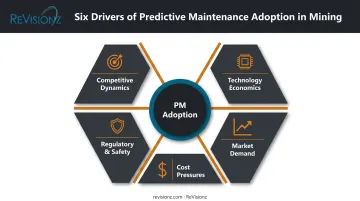
Mining-specific pressures, not generic tech hype, are pushing PM adoption forward.
- Technology economics: Falling costs for IoT sensors, cloud computing, and accessible AI/ML platforms have made PM viable for mid-size operators, not just majors with deep capital budgets.
- Market demand: Global mineral demand is climbing fast. ICMM projects copper demand will roughly double by 2050, pushing miners toward deeper, harder-to-reach ore bodies that need resilient uptime.
- Ore body difficulty: Average copper grades have fallen roughly 40% since 1991, per Deloitte, meaning more material has to move through the same equipment to hit the same output.
- Cost pressures: Capital-intensive equipment and a persistent talent shortage make unplanned downtime increasingly unaffordable. A 2022 survey found 71% of mining leaders cite talent as a constraint on production targets.
- Regulatory and safety influences: Stricter safety standards, including MSHA's rules on surface mobile equipment and conveyor maintenance, turn equipment failure into a liability risk, not just an efficiency loss.
- Competitive dynamics: Early movers gain efficiency and stronger ESG reporting positions. That's pressure competitors can't ignore for long.
How These Trends Are Impacting the Mining Industry
These aren't pilot projects anymore. PM is showing up in operational metrics, capital budgets, and org charts.
Operational Impact
Calendar-based maintenance schedules are giving way to condition-based interventions. That reduces two costly extremes at once: over-maintaining equipment that's still fine and getting blindsided by failures that a fixed schedule missed entirely.
Sites with strong Wi-Fi and connected infrastructure, like Dundee Precious Metals' Chelopech mine, are positioned to track real underground equipment data continuously rather than relying on periodic manual inspection. The metric that matters most is asset-level availability, mean time between failures, and mean time to repair, tracked consistently over time, rather than a single industry-wide percentage.
Business Impact
Capital allocation is shifting. Instead of pouring every dollar into new equipment, more budget is going toward data infrastructure and analytics platforms that extend the life and reliability of existing assets.
PM outcomes are also surfacing in ESG and investor conversations. Uptime and safety metrics increasingly feed sustainability disclosures, even if standardized PM-specific ESG reporting is still maturing across the sector.
Workforce Impact
The skills mix on site is changing:
- Maintenance technicians now need to interpret AI-generated insights, not just execute work orders
- Data analysts need enough mining domain knowledge to know when a model's flag makes operational sense
- Remote monitoring roles are growing, reducing the need for constant on-site inspection in hazardous zones
That last point has a real safety upside. Vale's inspection robots, for instance, remove workers entirely from exposure to rotating equipment, dust, and noise in hard-to-access areas.
Future Signals for Predictive Maintenance in Mining
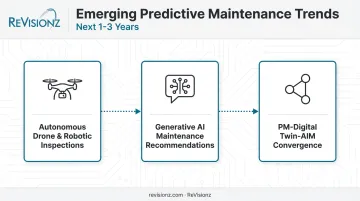
PM technology isn't done evolving. Here's what's worth watching over the next one to three years:
- Autonomous drone and robotic inspections will complement fixed sensors, especially for structures and equipment that are physically hard or dangerous to reach.
- Teams are layering generative AI onto predictive models to turn raw sensor flags into natural-language maintenance recommendations technicians can act on immediately.
- Deeper convergence of PM with digital twin and AIM platforms will make asset data a continuously self-updating resource, rather than a static record someone updates once a quarter.
None of these signals work well without the data foundation underneath them. A generative AI recommendation is only as trustworthy as the maintenance history and asset hierarchy it's drawing from.
Conclusion
AI-driven predictive maintenance is moving from a competitive edge to a baseline expectation across mining. The technology itself (sensors, ML models, digital twins) isn't the hard part anymore. Most of it is commercially available today.
The differentiator is the data foundation underneath it. Companies pairing sensors and AI with structured, lifecycle-ready asset data through AIM and digital twin programs are the ones seeing durable gains in uptime and safety. These gains hold up long-term, unlike a good pilot result that fades after year one.
Strategic foresight—paired with the right digital transformation partner like ReVisionz—will determine who leads this shift and who spends the next decade playing catch-up.
Frequently Asked Questions
What is predictive maintenance in mining?
Predictive maintenance uses sensor data, IoT, and AI to forecast equipment issues before failure occurs. Unlike reactive maintenance, which responds after a breakdown, PM catches warning signs early and schedules repairs proactively.
How does AI improve predictive maintenance in mining operations?
AI and machine learning analyze sensor data patterns to detect anomalies and predict specific failure modes, such as bearing wear or belt degradation. This delivers far more precision than manual monitoring or fixed inspection schedules can achieve.
What is the difference between predictive and preventive maintenance in mining?
Preventive maintenance follows a fixed calendar schedule regardless of equipment condition. Predictive maintenance responds to real-time condition data, triggering interventions only when sensors indicate an actual developing issue.
What are the biggest challenges to implementing predictive maintenance in mining?
The most common barriers are fragmented or inconsistent equipment data, upfront technology investment, and a shortage of workers who can bridge maintenance expertise with data analytics skills.
How much can predictive maintenance reduce downtime in mining operations?
Case studies show PM and remote condition monitoring meaningfully reduce unplanned downtime, though results vary by site, baseline, and asset type. Measure results per asset and mine rather than relying on a single industry-wide figure.
What technologies are used in mining predictive maintenance systems?
The core stack includes IoT sensors for condition monitoring, cloud platforms for centralized dashboards, machine learning models for failure prediction, and digital twins for simulating asset behavior and remaining useful life.