Introduction
Walk into any refinery, chemical plant, or mining operation and you'll find filing cabinets and shared drives packed with scanned PDFs holding decades of engineering drawings, datasheets, specs, and compliance records. Many of these documents still get processed by hand.
The scale is staggering. Crossrail's construction program alone generated 500,000 drawings and 5 million documents across its lifecycle. NIST has estimated that inadequate data interoperability costs the U.S. capital-facilities industry roughly $15.8 billion a year, with owners and operators absorbing the majority of that burden.
Intelligent document processing (IDP) is the AI-powered technology built to fix this. It reads and classifies documents, then extracts the data inside and makes it usable across ERP, EAM, and engineering systems.
This article breaks down how IDP works, what it delivers, where it's already in use, and how to evaluate a solution, including for engineering and asset data environments.
Key Takeaways
- IDP combines AI, OCR, NLP, and machine learning to structure unstructured documents
- It understands document context, going beyond basic OCR or rule-based processing
- Benefits include higher accuracy, lower costs, faster processing, and stronger compliance for regulated industries
- The right approach depends on document complexity, integration needs, and formats like P&IDs
What Is Intelligent Document Processing?
Intelligent document processing is AI-driven technology that extracts, classifies, and structures information from PDFs, scanned images, emails, forms, and technical documents, including P&IDs and equipment datasheets. It reads a document, figures out what type it is, and pulls out the specific data points that matter.
What sets IDP apart is its ability to handle three data categories:
- Structured data: forms and templated fields with predictable layouts
- Semi-structured data: invoices, inspection reports, and datasheets with variable formats
- Unstructured data: free-text contracts, emails, and legacy engineering drawings with no fixed template
Older systems could only manage the first category. IDP handles all three, which is exactly why it matters for industries drowning in decades of inconsistent paper and scanned records.
What Is the Difference Between OCR and Intelligent Document Processing?
Optical character recognition (OCR) converts printed or handwritten text into machine-readable characters. That's it. It doesn't understand what the document says or what to do with the information.
IDP layers AI, natural language processing, and machine learning on top of OCR. It classifies the document, extracts meaning from context, and validates the data before passing it downstream. OCR is one component inside a broader IDP pipeline, not a substitute for it.
Intelligent vs. Automated Document Processing
Automated document processing (ADP) relies on rule-based templates to digitize and index documents. It works well when formats are predictable, such as standardized forms with fields in the same place every time.
IDP adapts to new formats, handles exceptions, and feeds insights directly into business workflows. That flexibility is non-negotiable when you're dealing with:
- Technical drawings drafted decades ago in inconsistent styles
- Contracts with varying clause structures and language
- Legacy engineering records scanned at different resolutions and quality levels
How Does Intelligent Document Processing Work?
IDP follows a controlled sequence of stages, moving a raw document from ingestion to a usable, governed data record.
- Ingestion and classification: Documents enter from scans, emails, and uploads. AI models identify the type, whether it's an invoice, contract, P&ID, or inspection report, and route it accordingly.
- Data extraction: OCR, computer vision, and NLP work together to pull key fields such as names, dates, equipment tags, or amounts from both structured and unstructured content.
- Data validation: Extracted values get checked against business rules or reference datasets. Anything with low confidence gets flagged for a human reviewer.
- Data structuring and integration: Validated data converts into structured formats and routes into ERP, EAM, CMMS, or engineering data management systems.
- Continuous learning: Every correction a reviewer makes feeds back into the model, improving accuracy on future documents and new layouts.
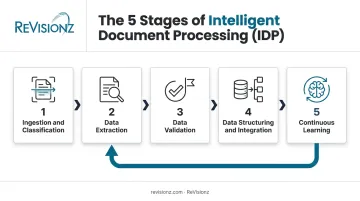
Established cloud and enterprise IDP frameworks consistently point to this feedback loop between automated extraction and human quality review as the key differentiator. Accuracy compounds over time, improving steadily as the system processes more documents and layouts.
Key Technologies Behind IDP
Three technologies do most of the heavy lifting:
- OCR, ICR, and IWR: OCR reads printed text, while ICR and IWR extend that capability to handwriting, useful for scanned field reports and inspection logs.
- NLP: Natural language processing interprets context and meaning in text-heavy documents, distinguishing a contract clause from a datasheet line item.
- RPA: Robotic process automation takes the validated data and moves it into business systems, triggering downstream workflows like approvals or maintenance work orders.
What Are the Benefits of Intelligent Document Processing?
The value of IDP shows up across accuracy, cost, scale, compliance, and speed. Here's how each plays out.
Increased accuracy. Manual data entry is prone to typos, transposed digits, and missed fields, especially at high volume. IDP's automated validation checks extracted values against rules and reference data before they ever reach a downstream system, cutting the number of errors that slip through.
Reduced operational costs. A Forrester-commissioned study modeled a composite organization processing 10 million documents a month and found a 73% ROI with payback in under six months. The same model estimated a 50% drop in manual correction and review time. That's a modeled scenario, not a universal guarantee, but it illustrates the direction of the return.

Greater scalability. Document volume doesn't need to translate into headcount growth. Whether you're processing hundreds of invoices or thousands of technical drawings, IDP scales the workload without proportionally scaling the team.
Improved safety and regulatory compliance. Permits, inspection reports, and safety documentation need to be traceable and retrievable on demand. Faster, more accurate extraction strengthens audit readiness and reduces compliance risk, supporting asset performance across the entire lifecycle rather than just at a single checkpoint.
Faster project handover and digital twin readiness. Converting unstructured legacy documents into structured, lifecycle-ready data accelerates the handover from EPC to operations. This is core to asset information management (AIM) programs. ReVisionz delivers this value directly through its data migration and enrichment methodology, refined over 25 years of bridging project delivery and operational readiness.
Increased employee productivity. Automation frees engineers and administrative staff from repetitive data entry. That time gets redirected toward analysis, decision-making, and work that actually needs a human brain.
Industry Use Cases for Intelligent Document Processing
IDP looks different depending on the industry, but the underlying pattern, extract, validate, integrate, holds steady across sectors.
Healthcare
Healthcare organizations use IDP to process patient records, lab reports, and insurance claims. This reduces administrative workload and speeds up access to patient data when clinicians need it most.
Finance, Legal, and Insurance
- Finance teams automate invoice and expense processing, cutting turnaround time on accounts payable
- Legal teams extract clauses and obligations from contracts, a task detailed enough that CUAD, a benchmark dataset, catalogs over 13,000 expert-labeled clauses across 510 contracts
- Insurers speed up claims validation and fraud detection by classifying and extracting form data before investigators or fraud models review it
Engineering and Asset-Intensive Industries
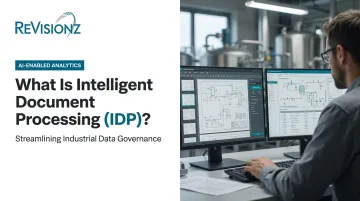
Oil & gas, chemicals, and manufacturing organizations use IDP to digitize and extract data from P&IDs, equipment datasheets, inspection reports, and legacy asset documentation. Researchers have built end-to-end pipelines that extract pipeline codes, symbols, and connections directly from real-world oil-company P&IDs, turning static drawings into structured, searchable data.
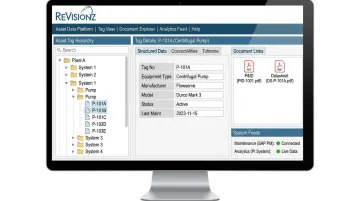
This is where the technology earns its keep for asset-heavy operators. ReVisionz, for instance, applies IDP within its legacy information modernization work, converting decades of scanned drawings and datasheets into tag-centric records that feed predictive maintenance programs and asset analytics platforms.
How to Choose the Right Intelligent Document Processing Solution
Not every IDP platform handles the same document complexity, and picking the wrong one wastes time and budget. Evaluate against four criteria:
- Document compatibility — Test the solution against your actual documents: complex technical drawings, scanned legacy records, and multi-format files. No single platform handles every use case equally well.
- Extraction accuracy and continuous learning — Run field-level accuracy tests on real documents, not vendor demos, and confirm the system improves from corrections over time.
- Integration and scalability — Confirm the platform connects with your existing ERP, EAM, or engineering data systems and can handle peak document volume without breaking down.
- Governance and security — Check for encryption, access controls, and compliance support relevant to your regulatory environment.

How ReVisionz Approaches IDP for Asset-Intensive Industries
ReVisionz applies AI-powered document and data processing through its Main Information Contractor+ (MIC+) service, purpose-built for engineering and asset information rather than generic office documents. The goal: turn unstructured legacy data into information that's ready for use across the asset lifecycle, not just archived after the fact.
This approach draws on 25 years of data migration and enrichment methodology. The work has touched millions of tags and tens of millions of documents across capital projects in oil & gas, petrochemicals, and manufacturing.
Rather than stopping at project handover, MIC+ stays engaged through operations, helping owner-operators close the gap between EPC delivery and day-to-day asset management. You can review examples of this work in ReVisionz's success stories.
Frequently Asked Questions
What is intelligent document processing?
IDP is AI-driven technology that extracts, classifies, and structures data from documents like PDFs, scans, and forms. It makes that data usable across ERP, EAM, and other business systems.
What is the difference between OCR and intelligent document processing?
OCR converts printed or handwritten text into machine-readable characters. IDP adds AI-driven classification, extraction, and validation on top of that OCR output.
How is intelligent document processing used in materials management?
Materials management teams use IDP to extract data from vendor catalogs, datasheets, and purchase orders when building materials catalogs. This reduces duplicate SKUs and speeds up procurement decisions across ERP systems.
What is the best intelligent document processing solution?
The "best" solution depends on your document complexity, integration needs, and industry. Use the evaluation framework above, testing accuracy, compatibility, and scalability with your actual documents.
Can IDP process engineering drawings and technical documents?
Yes. Advanced IDP platforms can extract data from P&IDs, datasheets, and other technical formats. This capability is central to asset information management programs in capital-intensive industries.
Is intelligent document processing the same as robotic process automation (RPA)?
No. RPA automates repetitive tasks using data that's already extracted. IDP focuses on reading and understanding document content, and the two technologies often work together.