Consider the scale: Rio Tinto's Pilbara network reportedly generated 2.4 terabytes of data per minute in 2018 across 16 mines, 1,500 km of rail, and three ports. That's one operator, one region.
Mining has historically lagged other asset-intensive industries when it comes to unifying this data. The result? Safety risks that go undetected until it's too late. Compliance gaps that surface during audits instead of before them. Unplanned downtime that traces back to disconnected legacy systems and siloed data across sites.
This article breaks down the core information systems used in mining today, ERP, GIS, LMS, BIM, and more, along with their measurable benefits, the adoption challenges companies actually face, and best practices for getting implementation right.
Key Takeaways
- ERP, GIS, LMS, and BIM each solve a specific mining data challenge, from planning to compliance.
- Unifying disparate systems reduces downtime, strengthens safety, and enables real-time decision-making.
- Legacy infrastructure, skill gaps, and cultural resistance remain the biggest adoption barriers.
- Digital transformation partners can turn engineering data into lifecycle-ready information faster than internal teams.
What Is a Mining Information System?
A mining information system is any software platform or integrated technology that collects, stores, processes, and shares data across exploration, extraction, processing, and logistics functions. Its purpose is simple: support better operational and strategic decisions with accurate, timely information.
These platforms generally fall into four categories:
| Category | Primary Function | Mining Application |
|---|---|---|
| ERP | Finance, procurement, supply chain integration | Pit-to-port logistics, maintenance coordination |
| GIS | Spatial and geological data management | Ore body mapping, exploration risk reduction |
| LMS | Workforce training and compliance | Safety certification, regulatory documentation |
| BIM/AIM | Asset and engineering lifecycle data | Infrastructure design, handover readiness |
ERP in Mining
Enterprise Resource Planning systems integrate finance, procurement, maintenance, and supply chain data onto a single platform. This gives site managers and executives coordinated planning across multiple mine locations instead of relying on spreadsheets that don't talk to each other.
ERP is often paired with automation software specifically to reduce unplanned downtime. When maintenance schedules, spare parts inventory, and production plans live in one system, a bottleneck at one site becomes visible before it becomes a crisis.
GIS and BIM in Mining
Geographic Information Systems map mineral deposits, build geological models, and reduce exploration risk through remote sensing and spatial analysis. Esri notes that mining-specific GIS applications range from drill-hole record management to blasthole planning, haul-road monitoring, and tailings-facility oversight.
While GIS handles spatial and geological data, Building Information Modeling, adapted from the construction sector, is increasingly used for mine infrastructure design and asset lifecycle data. BIM in mining overlaps closely with Asset Information Management (AIM) practices.
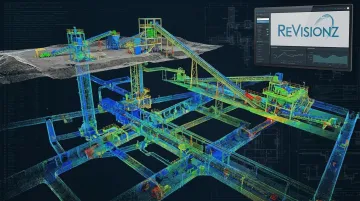
A 2024 case study at Vietnam's Nui Beo underground coal mine combined BIM with terrestrial laser-scanning point clouds to build and evaluate a 3D mine information model. ReVisionz has applied a similar approach, using laser-scanned facility models to support asset information management in mining environments.
LMS in Mining
Learning Management Systems support workforce training delivery, safety certification tracking, and regulatory compliance documentation. Given how hazardous mining work is, this isn't optional infrastructure. In the US, MSHA's Part 46 and Part 48 requirements mean training plans need to be documented, submitted, and tracked, not just delivered once and forgotten.
Key Benefits of Leveraging Information Systems in Mining
Improved safety and regulatory compliance. Real-time monitoring, automated reporting, and audit trails flag risks before they escalate. MSHA has noted that proximity-detection systems could have prevented dozens of fatalities historically tied to pinning, crushing, and striking incidents around continuous mining machines. This finding underscores why monitoring needs to function as part of a broader control system, not a standalone device.
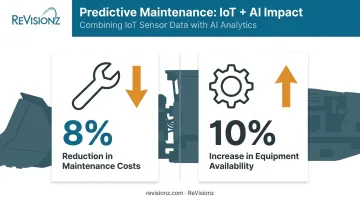
Reduced downtime and lower total cost of ownership. Predictive maintenance driven by IoT sensor data is one of the clearest wins available. A 2025 peer-reviewed study on underground mining equipment found that combining IoT data with AI-based predictive maintenance produced an 8% reduction in maintenance costs and a 10% increase in equipment availability. Results will vary by site, sensor coverage, and baseline maintenance practices, but the direction is consistent.
Enhanced decision-making. Integrated dashboards combine production, financial, and geological data into a single source of truth. Instead of pulling numbers from four different systems before a Monday meeting, managers see it all in one place.
Increased productivity and resource optimization. AI and machine learning models refine drilling patterns, improve ore-waste identification, and optimize pit-to-port logistics. A mine using grade-control algorithms, for instance, can redirect trucks in real time, cutting dilution and boosting recovered tonnage without adding equipment.
Greater ESG traceability. GRI 14: Mining Sector reporting standards now call for granular disclosure on emissions, biodiversity, tailings, and human rights. Connecting operational data to these disclosure requirements isn't optional for companies with public sustainability commitments anymore.
Integrating It All: Data, Digital Twins & Asset Information Management
Here's the friction point most mining companies run into: operational technology (OT) data from equipment and sensors lives in a different world than IT data from ERP and finance systems. Siloed OT and IT create blind spots, and blind spots cost money.
A unified data repository, or a digital twin approach, resolves that friction. Digital twins let mining companies run "what-if" scenarios for pit design, throughput planning, and equipment reliability before committing capital.
Boliden and ABB, for example, built a digital twin of the Aitik mine's comminution process to test advanced process-control strategies. The simulation modeled throughput improvements of 1% to 3%—promising results worth validating against real production data once deployed.
This is where Asset Information Management (AIM) comes in. AIM is the discipline of transforming unstructured engineering, geological, and operational data into governed, lifecycle-ready information. It's less glamorous than a digital twin demo, but it's the foundation that makes the twin trustworthy in the first place.
Bridging Project Delivery and Day-to-Day Operations
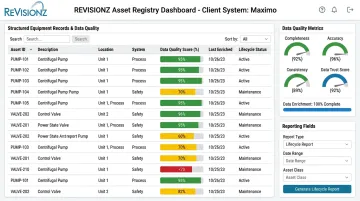
This is precisely the gap ReVisionz works in. Asset-intensive owner-operators often inherit messy handover data from EPC contractors, data that limits trust in downstream reporting systems. In one engagement, ReVisionz encountered a client whose low-quality asset data blocked reliable reporting entirely. Rather than a disruptive overhaul, the team:
- Used the client's existing Maximo system innovatively to auto-generate asset registry reports
- Executed data improvements offline to avoid burdening an already-stretched operations team
- Delivered trusted records with a 0% rework requirement
That result built enough trust that the client invited ReVisionz to replicate the approach on a new greenfield project. ReVisionz takes a technology-agnostic approach, working across Hexagon, AVEVA, Cognite, OpenText, and VEERUM environments. Its AI-powered Main Information Contractor+ (MIC+) service is built specifically to enrich and structure asset data so it's usable long after project handover, not just at commissioning.
Beyond structuring the data itself, getting it to the right people matters just as much. Cloud-based industrial data platforms are playing a growing role here, securely sharing information between corporate offices, remote site teams, and external stakeholders like equipment OEMs. These stakeholders need visibility into asset performance without requiring full system access.
Common Challenges in Mining Information System Adoption
Mining isn't slow to adopt technology by accident. There are real, structural reasons behind the hesitation.
- Legacy infrastructure: Disconnected point solutions across multiple mine sites make integration slow and expensive to untangle.
- Skill gaps: PwC, citing World Economic Forum research, found that 73% of mining companies identify local skills gaps as the largest barrier to adopting new technology.
- Cultural resistance: Mining has traditionally moved slower than other sectors on operational technology, and that caution isn't irrational.
- 24/7 remote operations: When a mine runs nonstop in a remote location, any system downtime carries real cost, making leadership's caution about new rollouts understandable, not stubborn.
Deloitte's mining maturity research backs this up, finding that strengths were scattered unevenly across strategy, culture, operations, and technology; no single operator led in every category.
Best Practices for Implementation & What's Next
Getting this right depends less on the platform you pick and more on how you sequence the work.
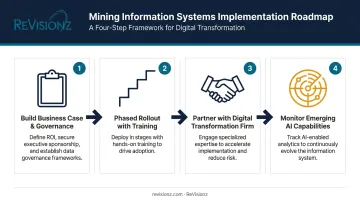
- Build the business case and governance framework first. Selecting software before you've defined data governance is backwards. Establish standards, ownership, and quality metrics before migration begins.
- Roll out in phases, not a big bang. Pair phased deployment with structured LMS-based training. ReVisionz's own engagements favor a value-first approach: prove the concept on one workflow, build trust, then expand, rather than forcing a disruptive full-system cutover.
- Partner with an experienced digital transformation firm. Purely internal, ad-hoc integration efforts tend to stall. ReVisionz's participation in standards bodies like CFIHOS shows this shift toward structured, interoperable data models, not one-off fixes.
- Watch where AI is heading next. Predictive analytics, autonomous equipment, and computer vision for geological modeling, particularly around drill-core imagery, are moving from pilot to mainstream adoption. These tools still depend on clean, governed data underneath them; AI can't fix a broken data foundation.
Frequently Asked Questions
What is a mining information system?
A mining information system is technology infrastructure that collects, integrates, and shares data across mining operations, supporting planning and day-to-day decision-making while strengthening safety across every site.
What is ERP in mining?
ERP is a platform that integrates finance, procurement, maintenance, and supply chain functions across mine sites, replacing disconnected spreadsheets with coordinated, real-time planning.
What is LMS in mining?
An LMS, or Learning Management System, delivers workforce training, tracks safety certifications, and documents regulatory compliance, critical given the hazardous nature of mining work.
What is BIM in mining?
BIM, or Building Information Modeling, is adapted from construction for mine infrastructure design and asset lifecycle data management, often overlapping with broader Asset Information Management practices.
What are the benefits of digital transformation in mining?
Integrated information systems improve safety, reduce unplanned downtime, sharpen decision-making, and strengthen ESG reporting accuracy, gains that compound as systems become more connected.
How do I choose the right information system for my mining operation?
Start with a clear business case, then assess existing infrastructure gaps honestly. Consulting an experienced implementation partner early tends to save far more time than it costs.