Now multiply that volume across every refinery expansion, mining operation, and petrochemical facility running today. Many organizations still treat document control as a back-office filing function. That mindset is falling apart fast.
AI, digital twins, and Asset Information Management (AIM) are pulling document control out of the file cabinet and into the data stack. This article breaks down what document control actually means, how it differs from document management, its full lifecycle, and how the discipline is changing heading into 2026.
Key Takeaways
- Document control governs document approval, version integrity, and access permissions across the project lifecycle
- ISO 9001 Clause 7.5 requires documented controls for creation, review, protection, and disposition
- AI is replacing manual indexing with automated classification and metadata tagging
- Poor document control drives measurable rework costs and safety incidents in capital-intensive industries
- 2026 trends push document control beyond project phases into full asset-lifecycle governance
What Is Document Control?
Document control is the structured process governing how documents are created, reviewed, approved, distributed, revised, and retired. The goal is simple to state and hard to execute: the right people always access the right, current, approved version.
The core objective is trust and traceability, not organization for its own sake. A controlled document can be verified as reviewed, approved, and current, while an uncontrolled one, no matter how neatly it's stored, can't be relied upon for engineering or safety decisions.
That distinction is exactly what ISO 9001:2015 Clause 7.5 addresses. The standard doesn't hand down a tidy dictionary definition of "document control." Instead, it specifies the required control outcomes: appropriate creation and approval, availability, protection against loss, access management, preservation, change control, and retention or disposition.
Document control covers the entire lifecycle:
- Creation and identification: assigning naming conventions and numbers before a document enters circulation
- Review and approval: verifying technical accuracy before release
- Revision control: tracking every change with a clear audit trail
- Distribution and access management: controlling who receives which revision
- Withdrawal and archiving: removing obsolete versions and retaining records per schedule
What Document Control Is Not
A few misconceptions persist, even among experienced project teams. Document control is not:
- Simple filing or storage, which falls under document management instead
- A software tool by itself; a platform enables control, but doesn't create it
- The same as records management, which focuses on retained evidence rather than live, working documents
Who Performs Document Control?
Dedicated document controllers, information management professionals, or trained project staff typically carry out this function. The title varies by organization, but the requirement doesn't: whoever owns document control needs defined responsibilities and real organizational authority.
Without that authority, controls become suggestions. Engineers route around bottlenecks, informal copies circulate, and the "controlled" register stops reflecting reality.
The Document Control Lifecycle: Key Stages
Document control follows a document through its entire life, from creation to retirement, as a continuous cycle rather than a single checkpoint.
- Creation and identification. Standardized naming and numbering conventions, along with templates, set the foundation. Skip this step, and every downstream stage inherits the inconsistency.
- Review and approval. Structured workflows pull in multiple stakeholders to verify technical accuracy, compliance, and spec alignment before release. A workflow engine, the logic that routes tasks through defined stages, handles this automatically.
- Revision and version control. Every change gets tracked with a clear audit trail: who changed what, when, and why. Obsolete versions get pulled from circulation, not just marked "old."
- Distribution and access management. Controlled transmittals and access permissions make sure the right audiences receive the right revisions at the right time, no more and no less.
- Archiving, withdrawal, and handover. Retention schedules and structured handover packages close the loop, mattering most when EPC firms transfer completed project documentation to owner-operators. A messy handover here creates months of cleanup later.
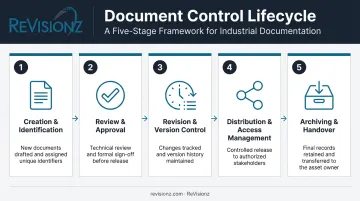
Each stage builds on the last. A weak numbering system at creation will haunt every review cycle that follows.
Document Control vs. Document Management: What's the Difference
These two terms get used interchangeably far too often, and that habit causes real problems.
Document management is the storage, organization, and accessibility of files — AIIM (the Association for Intelligent Information Management) defines this as handling documents through creation, sharing, and storage. Document control adds governance, workflows, and accountability on top of that foundation.
| Aspect | Document Management | Document Control |
|---|---|---|
| Purpose | Store and retrieve files efficiently | Govern approval, revision, and access |
| Scope | Repository structure, search, tagging | Workflows, version integrity, audit trails |
| Compliance focus | Findability and accessibility | Traceability and defensibility |
A well-organized repository doesn't guarantee anyone knows which revision is current. Treating these functions as interchangeable creates predictable failures:
- Rework when teams pull outdated file versions
- Non-compliance when audit trails have gaps
- Disputes over which revision was actually approved
This gap shows up most painfully during capital project handovers, when hundreds of documents move from EPC contractor to owner-operator systems at once.
Document Control in 2026: The Trends Reshaping the Discipline
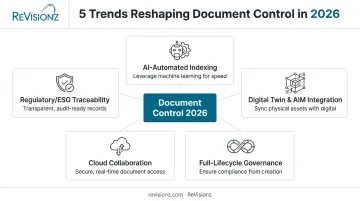
The discipline is shifting from manual gatekeeping to something closer to a data operation. A few forces are driving that change.
AI is replacing manual indexing. Classification, data extraction, and metadata tagging that once required hours of manual review are increasingly automated. Peer-reviewed studies on engineering-drawing extraction report dimension recall above 87% and character error rates under 2%.
Realized labor savings vary by organization and haven't been broadly measured yet. Treat vendor ROI claims with a healthy dose of skepticism.
Documents are feeding digital twins, not standing alone. Document control is integrating with Asset Information Management (AIM), where documents feed structured, lifecycle-ready data models instead of sitting as static PDFs. Standards like CFIHOS, now at version 2.0, give this integration a common structure across operators, contractors, and suppliers.
Project-phase control is expanding into full-lifecycle governance. Document control used to live mainly inside EPC delivery. Now it's stretching across the entire asset lifecycle, supporting operations, maintenance, and predictive analytics long after the ribbon-cutting.
Cloud collaboration is becoming the norm, slowly. Distributed EPC and owner-operator teams increasingly work from cloud platforms rather than on-premise systems. Adoption is real but uneven.
A recent industry survey found roughly half of construction businesses use cloud software, though real-time site access still lags behind that number. Platform adoption and controlled information access aren't the same thing yet.
Regulatory and ESG demands require traceable trails. Sustainability reporting frameworks now require documented evidence supporting assurance conclusions, not just a data point on a dashboard. That pushes document control toward automation rather than manual tracking.
ReVisionz built its Main Information Contractor+ (MIC+) service around this shift. Document control sits alongside functions like API extractions and KPI data quality dashboards. That structure reflects a broader shift: document control now operates as one integrated piece of asset information management, not a standalone filing task.
Why Document Control Matters for Capital-Intensive Industries
Poor document control creates real operational risk on capital projects.
When outdated drawings or unapproved specs reach the field, the consequences compound:
- Rework from building to the wrong revision
- Safety incidents when procedures don't match actual plant conditions
- Compliance failures when audits can't find evidence that controls were followed
The numbers back this up. Autodesk and FMI's construction-industry study estimated bad project data cost the global construction industry $1.85 trillion in 2020, with roughly $88.7 billion (about 14% of total rework) tied directly to bad data.
That's a global, vendor-sponsored estimate, not a guarantee for any single project. Still, it points at the same problem operators see every day: bad information costs real money.
The stakes climb higher in oil & gas, petrochemicals, mining, and manufacturing. EPC handover accuracy and process safety compliance in these sectors depend directly on document reliability.
Federal investigations into refinery incidents have repeatedly found outdated or missing operating procedures among contributing factors. It's a reminder that document control failures rarely stay contained to a filing cabinet.
For owner-operators, the value proposition connects to bigger business outcomes:
- Lower total cost of ownership across the asset lifecycle
- Stronger safety and regulatory compliance posture
- A tighter bridge between project delivery and day-one operational readiness
Document Control Best Practices for 2026
Technology alone won't fix a broken process; governance has to come first.
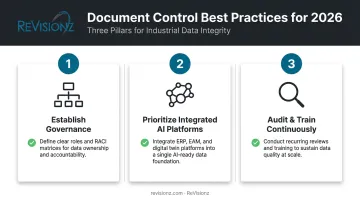
Follow these three practices to keep document control effective in 2026:
Establish governance before scaling any tool: Define roles, build RACI matrices, and standardize numbering conventions early, or risk automating chaos instead of eliminating it.
Prioritize integrated AI platforms: Look for EDMS or AIM platforms that connect with ERP, EAM, and digital twin environments — not siloed solutions that create new data islands.
Audit and train continuously: Regular audits catch workarounds before they become habits, and ongoing training keeps teams aligned as compliance requirements evolve.
Frequently Asked Questions
What is meant by document control?
Document control is the structured process of creating, reviewing, approving, distributing, and retiring documents to ensure only current, approved versions are in use. It's about governance and traceability, not just storage.
What is the difference between document control and document management?
Document management handles storage, organization, and access to files. Document control adds governance, workflows, and compliance oversight on top of that foundation, ensuring version integrity and accountability.
Who is responsible for document control in an organization?
Dedicated document controllers, information management professionals, or trained project staff typically own this function. Effectiveness depends on defined responsibilities backed by real organizational authority.
Is document control required for ISO 9001 certification?
Yes. ISO 9001 Clause 7.5 mandates documented procedures for approving, reviewing, and controlling documents to ensure information stays reliable and traceable throughout its lifecycle.
How is AI changing document control in 2026?
AI is automating classification, data extraction, and metadata tagging, tasks that used to require manual indexing. It's also enabling tighter integration between document control and digital twin or Asset Information Management (AIM) platforms.
Which industries rely most heavily on document control?
Oil & gas, petrochemicals, mining, and manufacturing depend most heavily on document control, since EPC handover accuracy and process safety compliance in these sectors hinge on reliable, current documentation.