Everyone talks about digitization as the next big thing. But the real payoff isn't the software — it's fewer unplanned shutdowns, faster decisions on the plant floor, and operators who catch problems before they become incidents.
This article breaks down what plant digitization actually delivers operationally, backed by data, not buzzwords.
Key Takeaways
- Plant digitization creates one real-time source of truth from sensors, systems, and manual data
- Core benefits: faster decisions, predictive maintenance, and stronger safety/compliance outcomes
- 57% of manufacturing executives use analytics at the facility or network level, per Deloitte's 2025 Smart Manufacturing and Operations Survey
- Delaying digitization means rising costs and reactive firefighting that compounds year over year
- Value requires governed data and organizational ownership, not just new dashboards
What Is Plant Digitization?
Plant digitization is the process of converting analog plant data, such as dial readings, manual logs, and paper-based inspections, into digital signals that can be captured, networked, and analyzed.
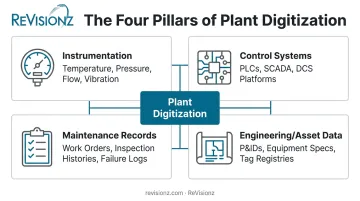
It typically applies across four areas:
- Instrumentation: sensors measuring temperature, pressure, flow, vibration
- Control systems: PLCs, SCADA, and DCS platforms
- Maintenance records: work orders, inspection histories, failure logs
- Engineering/asset data: P&IDs, equipment specs, tag registries
One distinction matters here: digitization is the conversion step. Digitalization is what happens next: using that data to drive decisions. Digitization without digitalization just produces more data sitting in a system nobody uses.
Key Advantages of Plant Digitization
The advantages below aren't abstract technology claims. They map directly to metrics plant leaders already track: cost, uptime, safety, and compliance, which makes building an internal business case far easier than pitching "innovation" for its own sake.
Real-Time Visibility and Faster Decision-Making
Digitized sensors and networked systems replace the old walk-the-line model with centralized, at-a-glance monitoring across an entire facility. That matters because the gap between when an issue occurs and when someone notices it is often where the real damage happens.
A well-documented example: continuous personal dust monitors in underground coal mining shifted exposure feedback from weeks to minutes, compared to lab analysis of traditional filter samples, according to NIOSH research. Workers could adjust practices mid-shift instead of learning about a problem after the fact.
That same principle scales across any large or distributed facility:
- Faster detection means faster corrective action
- Fewer surprises translate into lower downtime costs
- Operators make decisions with confidence instead of guesswork
KPIs impacted:
| Metric | What Improves |
|---|---|
| MTTD (Mean Time to Detect) | Drops sharply with continuous monitoring |
| MTTR (Mean Time to Repair) | Shrinks as root cause is identified faster |
| OEE (Overall Equipment Effectiveness) | Rises as unplanned stoppages decline |
This advantage matters most in large, multi-acre, or multi-site operations, where physically walking every unit isn't feasible and blind spots are the norm rather than the exception.
Predictive Maintenance and Enhanced Asset Performance
Continuous data streams from digitized equipment (vibration, temperature, cycle counts) let teams spot developing failures long before they cause a shutdown. That's a fundamental shift from calendar-based or breakdown-based maintenance to condition-based scheduling.
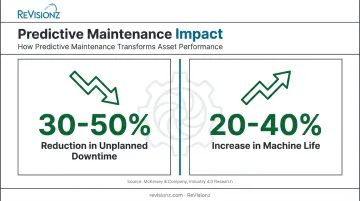
The financial case is strong. According to McKinsey's Industry 4.0 research, predictive maintenance programs typically produce a 30% to 50% reduction in unplanned machine downtime and a 20% to 40% increase in machine life.
Catching a bearing failure early avoids not just repair costs, but the cascading damage that follows when one component takes down a connected system.
KPIs impacted:
- Unplanned downtime hours
- Maintenance cost per asset
- Asset reliability and availability rates
This matters most for high-value, capital-intensive equipment where failure carries real safety or production risk: compressors, turbines, reactors, and similar critical assets.
One caveat worth stating plainly: predictive analytics are only as good as the data feeding them. Structured, lifecycle-ready asset data (the kind ReVisionz builds through its asset information management practice) is what makes those analytics reliable in the first place. Without a governed data foundation, predictive maintenance models produce noise, not insight.
Improved Safety, Risk Reduction, and Regulatory Compliance
Digitized monitoring turns periodic manual safety checks into continuous, auditable records. That distinction matters during an audit: "we checked it last Tuesday" is a much weaker position than a timestamped data trail showing continuous compliance.
Real-time alerts shrink the window where a hazardous condition goes unnoticed. In a NIOSH before-and-after study of respirable dust monitoring, operator samples exceeding the applicable standard fell from 4.2% to 0.7% (an 83% reduction) across a combined dataset of more than 259,000 samples, according to a CDC-published analysis of that data.
KPIs impacted:
- Incident and near-miss rates
- Audit findings and corrective action counts
- Time-to-compliance-reporting
This is most critical in heavily regulated sectors: oil & gas, chemicals, and mining, where non-compliance carries steep financial and legal penalties, not just reputational risk.
What Happens When Plant Digitization Is Missing or Ignored
Facilities relying on manual monitoring and disconnected systems tend to hit the same wall repeatedly. This pattern shows up again and again:
- Inconsistent results across shifts and sites, since outcomes depend on individual operator judgment rather than shared data
- Higher error rates from manual data entry and delayed reporting
- A reactive firefighting culture, where issues get addressed only after failure
- Rising maintenance and downtime costs that compound year after year
- Difficulty scaling or standardizing practices across multiple plants
The cost gap here is measurable. NIST's analysis of manufacturing machinery maintenance found that establishments in the highest quartile of reactive-maintenance reliance reported downtime equal to 13.0% of planned production time. Facilities in the lowest-reactive quartile reported just 4.0%. That's 3.3 times more downtime based on how proactive an operation's maintenance approach is.
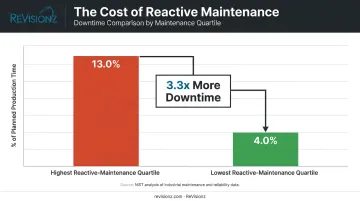
Multiply that gap across a multi-site portfolio, and the case for digitization stops being theoretical.
How to Get the Most Value from Plant Digitization
Digitization only pays off when it's applied consistently across a plant, not piloted in one unit and left to stall. A single successful sensor rollout in one process area doesn't move the needle if it never scales.
A few non-negotiables:
- Assign clear ownership. Raw data is worthless without someone accountable for reviewing and acting on it.
- Build review cycles into daily workflows. Dashboards nobody checks become expensive wallpaper.
- Tie alerts to accountability. An alert that doesn't trigger a defined action gets ignored within weeks.
- Govern the data, not just the sensors. Inconsistent tagging or duplicate records undermine every downstream analytics effort.
This is where the gap between collecting data and using data typically shows up. ReVisionz closes that gap, turning unstructured plant data into structured, lifecycle-ready information. The approach relies on proven data migration and enrichment methodologies built for long-term adoption, not one-off rollouts.
Conclusion
The real value of plant digitization comes from the control and consistency it brings to daily operations, not from the sensors or software themselves.
Visibility and predictive maintenance gains compound over time, as does stronger safety and compliance performance. None of it happens overnight, though — it only materializes when the underlying data is governed and someone acts on it.
Treat plant digitization as an ongoing operational discipline, not a one-time software rollout. That means choosing the right strategy and partner, then building a culture that holds people accountable for what the data shows.
Frequently Asked Questions
What is plant digitalization?
Plant digitalization is the practice of networking digitized plant assets and connecting the resulting data streams to actual decision-making processes. It goes beyond replacing analog dials. It's about using that data to change what operators and managers do.
What are the three types of digitization?
The common categories are process digitization, data digitization, and asset/equipment digitization. In a plant setting, this covers workflow automation, converting records into structured data, and instrumenting physical equipment for continuous monitoring.
What is the difference between plant digitization and digitalization?
Digitization is converting analog signals into digital ones, so a dial reading becomes a data point. Digitalization is using that digital data to actively drive operational decisions, like triggering maintenance based on a sensor threshold.
How long does it take to see ROI from plant digitization?
Timelines vary by scope. McKinsey notes that initial use cases can launch in 6-8 weeks, though full transformation takes two to three years for complete financial impact. Phased rollouts capture value faster.
Which industries benefit most from plant digitization?
Asset-intensive sectors benefit most: oil & gas, chemicals, mining, and manufacturing. These industries face high costs from equipment failure and severe penalties for compliance gaps, making the ROI case for digitization especially strong.
What is the biggest challenge companies face when digitizing plant operations?
The biggest hurdles are usually organizational: resistance to change, unclear data ownership, and misalignment between IT and OT teams. Technology rollouts fail more often from lack of adoption than from lack of capability.