Introduction
Asset-intensive industries have run on spreadsheets, tribal knowledge, and reactive maintenance schedules for decades. That approach is breaking down fast.
Aging infrastructure and tightening compliance requirements are colliding with shrinking teams, exposing the limits of manual asset tracking. Most organizations sit on mountains of asset data that never gets used.
According to Seagate's Rethink Data report, produced with IDC, only 32% of enterprise data gets put to work. The remaining 68% sits fragmented, unstructured, or siloed across disconnected systems.
That gap prevents real-time, risk-based decisions when they matter most.
This article breaks down what intelligent asset management actually means, the benefits it delivers, and a practical framework for building a strategy that works. It also covers the best practices that separate successful rollouts from expensive shelf-ware.
Key Takeaways
- IAM combines IoT, AI, and governed data to create lifecycle-ready asset insight
- Without IAM, expect fragmented data, compliance risk, and rising total cost of ownership
- A working IAM strategy runs six phases: assess, plan, govern, implement, adopt, improve
- Business-first, technology-agnostic approaches beat tool-first deployments on ROI
What Is Intelligent Asset Management?
Intelligent asset management fuses engineering, operations, and maintenance data with AI and real-time analytics to optimize how a physical asset performs across its entire lifecycle. This discipline turns raw signals into decisions about when to intervene and where to invest.
What are intelligent assets? The Ellen MacArthur Foundation and World Economic Forum define them as physical objects that can sense, record, and communicate information about themselves and their surroundings. Think rotating equipment and piping systems instrumented well enough to report their own condition. An asset doesn't need continuous wireless connectivity to qualify: periodic, structured documentation counts too.
What does asset mean in intelligence? The word "asset" stops meaning a static tag number in a register. It becomes a dynamic node generating a continuous stream of intelligence: pressure readings, vibration trends, inspection history, all feeding into decisions about when to intervene and where to spend budget.
This is where intelligent asset management diverges sharply from traditional EAM or CMMS record-keeping. Those systems track what an asset is and when it was last serviced. IAM layers AI, digital twins, and predictive analytics on top of structured, governed data to forecast what an asset will do next.
Core Components of an Intelligent Asset Management System
A functioning IAM system typically includes:
- Sensors and IoT devices that capture temperature, vibration, pressure, and flow data in real time
- Digital twin or 3D models that mirror physical assets virtually, layering live data onto engineering geometry
- Centralized information platforms that consolidate engineering, maintenance, and operational records into one accessible source
- AI-driven predictive analytics that flag anomalies and forecast failure before it happens
- Data governance frameworks that keep all of the above trustworthy, consistent, and audit-ready
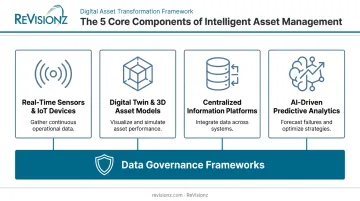
Skip the governance piece, and everything built on top of it inherits bad data.
Key Benefits of Intelligent Asset Management
Organizations that adopt intelligent asset management see returns compound across cost, safety, and data quality. The core benefits break down as follows:
- Reduced total cost of ownership. Predictive maintenance and condition monitoring catch failures before they cascade, cutting unplanned downtime and repair spend. PwC's Predictive Maintenance 4.0 survey of 268 companies found a 9% average uptime gain, and McKinsey documented an even bigger swing: an offshore operator achieved a 20% reduction in downtime and production gains topping 500,000 barrels annually after digitizing its maintenance and reliability program.
- Improved safety and regulatory compliance. Real-time monitoring and structured process safety data help teams stay ahead of risk instead of reacting to it. OSHA's Process Safety Management standard requires documented inspection records retrievable for the life of the process, plus compliance certification every three years, requirements that structured, centralized asset data makes far easier to satisfy.
- Enhanced asset performance across the full lifecycle. Most data loss happens at the handoff between EPC project delivery and day-to-day operations. Bridging that gap keeps asset intelligence flowing from commissioning through decommissioning, so engineering data never gets orphaned once a facility goes live.
- Increased user adoption and ROI on technology investments. An EAM or APM platform is only as valuable as the people using it. Governance and usability, not feature lists, determine whether a six-figure software investment actually gets adopted on the plant floor.
- Data-driven decision-making at scale. Converting unstructured asset data into lifecycle-ready information unlocks benchmarking, trend analysis, and continuous improvement loops that manual processes simply can't support.
- Competitive advantage and scalability. Organizations with mature IAM strategies flex resources faster, track sustainability metrics more accurately, and outpace competitors still running on spreadsheets.
Common Challenges Without an Intelligent Asset Management Strategy
Fragmented data across IT, OT, and engineering systems. Forrester estimates that 60% to 73% of enterprise data goes unused for analytics, largely because it's trapped in incompatible systems that don't talk to each other. Accenture's 2023 research adds a sharper detail: 55% of surveyed executives couldn't consistently trace their own data from source to point of use.
Legacy, siloed tools and manual audits. Paper-based inventory checks and disconnected point solutions increase operational risk, financial loss, and compliance exposure — especially when multiple teams keep their own version of "the truth."
Lack of governance and change management. Software rollouts rarely fail due to bad technology. They fail when nobody builds the habits and accountability needed to sustain adoption. The result: expensive EAM or APM platforms that half the workforce avoids using entirely.
Building an Intelligent Asset Management Strategy: A Step-by-Step Framework
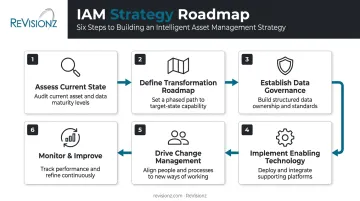
Strategies built around technology selection often stall before they scale. The ones that succeed start with business outcomes and choose technology to serve them. Use the framework below to build yours in six steps:
- Assess current state. Audit your data quality and systems landscape, then benchmark governance maturity against industry norms before committing to anything. You can't fix what you haven't measured.
- Define a transformation roadmap. Anchor the roadmap to specific outcomes (safety performance, cost avoidance, compliance rate) rather than starting with a software shortlist.
- Establish data governance and information standards. Implement master data management and consistent taxonomies, then build an integration architecture that finally connects engineering, operations, and maintenance data.
- Implement enabling technology. Select AI and analytics platforms, along with digital twin tools, based on business fit evaluated on a technology-agnostic basis rather than vendor preference.
- Drive change management and adoption. Build training and communication plans so frontline teams actually use the new systems, not just log into them once during onboarding.
- Monitor, measure, and continuously improve. Define KPIs and feedback loops so the strategy evolves as new data sources and business needs emerge.
Best Practices for Successful Implementation
- Build an outcome-based business case. Tie it to measurable metrics — cost avoidance, compliance rate, uptime — instead of pitching technology for its own sake.
- Prioritize data quality before analytics. McKinsey research shows missing data, broken sensors, and incompatible systems are the top reasons AI projects stall — clean data has to come first, since algorithms can't fix bad inputs.
- Foster cross-functional collaboration. Engineering, IT, and operations teams need shared ownership of governance, or data silos creep right back after go-live.
How ReVisionz Supports Intelligent Asset Management Transformation
ReVisionz has spent over two decades helping asset-intensive organizations close the gap between what a project team hands over and what an operations team actually needs to run a facility safely. Intelligent asset management exists to solve exactly that problem, the same one ReVisionz was founded to address in 2001.
As a technology-agnostic digital transformation consultancy, ReVisionz doesn't sell software licenses. Instead, the firm advises on strategy, implements the platforms that fit a client's specific operations, and stays engaged to sustain data quality long after go-live.
The firm's AI-powered Main Information Contractor+ (MIC+) service, launched in late 2025, is purpose-built for this challenge. MIC+ takes unstructured engineering and asset data (the kind typically buried in disconnected documents and legacy formats) and transforms it into lifecycle-ready information that operations teams can actually trust and use.
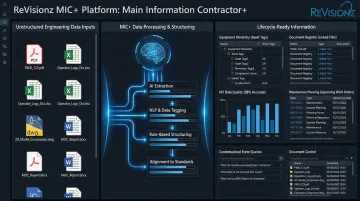
ReVisionz's approach is grounded in:
- A 25-year track record working with owner-operators across energy, chemicals, mining, and manufacturing
- Strategic alliances with AVEVA, Hexagon, Cognite, VEERUM, and OpenText
- Offices in Houston, Texas, and Calgary, Alberta, serving clients throughout North America
Organizations exploring where their own asset data stands today can review ReVisionz's success stories for examples of how this plays out in practice.
Frequently Asked Questions
What are intelligent assets?
Intelligent assets are physical objects capable of sensing, recording, and communicating data about themselves or their surroundings. Pumps, rotating equipment, and piping systems fitted with condition sensors are common industrial examples.
What does asset mean in intelligence?
In this context, an asset is treated as a continuous data source, generating intelligence that feeds directly into operational decisions rather than sitting as a static record with a tag number.
What is the difference between asset management and intelligent asset management?
Traditional EAM or CMMS systems focus on record-keeping: tracking what an asset is and when it was serviced. Intelligent asset management layers AI, digital twins, and predictive analytics on top of that data to forecast performance and risk.
What technologies are used in intelligent asset management?
IAM typically relies on IoT sensors, digital twin models, AI and machine learning analytics platforms, and centralized data governance tools that keep everything connected and trustworthy.
How long does it take to implement an intelligent asset management strategy?
Timelines vary widely based on organizational maturity and scope. A focused pilot can take a few months, while an enterprise-wide rollout typically spans multiple years.
Which industries benefit most from intelligent asset management?
Capital-intensive, asset-heavy industries, including oil and gas, chemicals, mining, and manufacturing, see the biggest returns since downtime and compliance failures carry outsized costs in these sectors.