For engineering, EPC, and owner-operator teams in energy, chemicals, mining, and manufacturing, understanding this framework matters far beyond software selection. It affects compliance, safe handover, and long-term asset performance.
Most teams know the acronyms (EIR, BEP, CDE) but not the underlying process they're meant to support. This article breaks down what ISO 19650 actually is, how the information management process works step-by-step, where it applies across the asset lifecycle, and where the standard commonly gets misapplied.
Key Takeaways
- ISO 19650 governs information management, not just BIM, across the full asset lifecycle.
- It defines specific roles, key documents (EIR, BEP, TIDP/MIDP), and a Common Data Environment for exchange.
- Poor project information drives an estimated $14.3 billion in annual US rework costs
- Owner-operators use it to underpin digital twins and Asset Information Management programs
- Treating it as a BIM checkbox instead of a governance process is the most common failure
What Is ISO 19650?
ISO 19650 is the international standard for organizing and digitizing information about buildings and civil engineering works, including building information modeling (BIM) concepts. Published in 2018 and evolved directly from the UK's PAS 1192 series, it now serves as the global reference point for information management on capital projects.
The goal is straightforward: create a single source of truth: structured information that both people and machines can use reliably throughout an asset's life, not just during design and construction.
BIM vs. ISO 19650: Related, But Not the Same
- BIM is the modeling and technology layer, covering the 3D models, tags, and datasets
- ISO 19650 is the management framework governing how that information (graphical and non-graphical) gets created, verified, and exchanged
- Together, they keep model data structured, verified, and usable long after project handover
The Standard's Parts
| Part | Focus | Published |
|---|---|---|
| Part 1 | Concepts and principles | 2018 |
| Part 2 | Delivery phase of assets | 2018 |
| Part 3 | Operational phase of assets | 2020 |
| Part 5 | Security-minded approach | 2020 |
Parts 1 and 2 remain the most widely referenced today, since they govern the design and construction delivery process most teams encounter first.
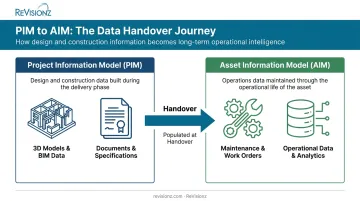
Within that delivery process, two outputs anchor the whole framework. The Project Information Model (PIM) is built during delivery: it's the working model and dataset used by the design and construction teams.
The Asset Information Model (AIM) carries forward into operations. It's populated from the PIM at handover and maintained throughout the asset's operational life.
Why ISO 19650 Matters for Asset-Intensive Industries
Process, energy, and EPC organizations don't adopt ISO 19650 for compliance theater. They adopt it because fragmented information handover is expensive, and it directly threatens safety and regulatory standing.
The cost of getting it wrong is well documented. Poor project information has been attributed to 22% of construction rework, translating to an estimated $14.3 billion in annual US costs, according to a Construction Dive analysis. Combined with miscommunication-driven rework, information failures account for nearly half of all reported rework industry-wide.
Without a structured framework like ISO 19650, teams typically encounter:
- Fragmented spreadsheets that never sync with the master dataset
- Incompatible file formats between EPC deliverables and owner systems
- Asset data that's simply lost at handover, forcing costly re-collection
- Duplicated effort as owner-operator teams rebuild what the EPC already produced
These gaps explain why adoption drivers vary so much by region:
- UK: Information management is mandated on many centrally procured public projects.
- Elsewhere: It's increasingly a contractual requirement written into owner-operator appointments rather than a legal mandate.
- North America: It functions largely as best practice, adopted by organizations that have already felt the cost of bad handovers firsthand.
A structured Asset Information Management approach built on ISO 19650 principles lowers total cost of ownership and improves asset performance over the operational life of a facility. This is exactly the gap ReVisionz works to close for owner-operators — translating the standard's roles and documents into a functioning AIM program rather than a binder that sits on a shelf after commissioning.
How ISO 19650 Works: The Information Management Process
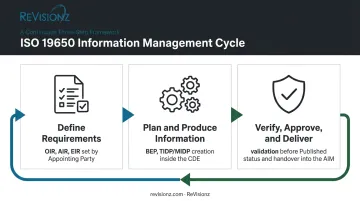
ISO 19650 runs as a continuous cycle: set requirements, appoint parties, produce and verify information, exchange it through a Common Data Environment (CDE). This cycle repeats throughout delivery and operations rather than functioning as a one-time gate.
What feeds the process: Organizational and Asset Information Requirements (OIR/AIR) cascade down into project-specific Exchange Information Requirements (EIR). These define what information is needed, in what format, and by when.
What happens during delivery: Appointed teams respond with a BIM Execution Plan (BEP), then build Task and Master Information Delivery Plans (TIDP/MIDP) to schedule their deliverables against the EIR.
How it's controlled: The CDE manages information through defined states, each with its own approval workflow.
| CDE State | Function |
|---|---|
| Work in Progress | Information under development, not yet shared |
| Shared | Approved for coordination between task teams |
| Published | Authorized for construction or asset management use |
| Archive | Audit trail of all transactions and superseded versions |
Step 1: Define Requirements
The Appointing Party (the client or owner) sets out the OIR, AIR, and EIR. This step answers the fundamental questions: what information does the organization actually need, in what format, and on what timeline? Skipping or rushing this step is where most information management programs fail before they start.
Step 2: Plan and Produce Information
Lead Appointed Parties and their task teams respond through the BEP, then build out TIDPs and an aggregated MIDP. Teams generate information collaboratively inside the CDE, moving it from work-in-progress toward shared status as they coordinate.
Step 3: Verify, Approve, and Deliver
Before anything reaches "published" status, information passes through verification and validation checks. Once approved, it's incorporated into the Asset Information Model at handover, the point where project data officially becomes operational data.
Where and When ISO 19650 Is Applied
ISO 19650 applies across new capital construction, plant refurbishment, EPC-delivered facilities, and ongoing operations and maintenance. It's not exclusive to greenfield builds.
Key lifecycle touchpoints:
- Project mobilization — the EIR gets issued at the tender stage, and prospective delivery teams respond with pre-appointment BEPs
- Design and construction — continuous CDE exchanges coordinate information between task teams
- Handover into operations — relevant information from the PIM transfers into or updates the AIM
These touchpoints trace one project's timeline. What triggers ISO 19650 in the first place varies by organization and asset type.
Common triggers for adoption include:
- A new capital project kickoff requiring formal information requirements from day one
- A contractual or regulatory requirement written into the appointment
- Operational trigger events, such as maintenance, inspection, or a change of ownership, that create new information needs under Part 3
ISO 19650 functions as a continuous, embedded process that governs information through post-handover changes, turnarounds, and the asset's entire operational life. This is precisely where many organizations lose momentum after the initial project closes out.
Common Misconceptions and Where ISO 19650 May Fall Short
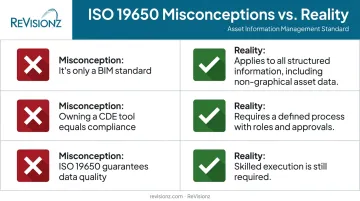
Misconception 1: It's only a BIM/construction standard. ISO 19650 applies to any structured information management process, including the non-graphical asset data process industries rely on daily: tag data, maintenance records, and specification documents included.
Misconception 2: Owning a CDE tool equals compliance. A CDE platform is infrastructure. Running an actual information management process (with defined roles, approval workflows, and quality checks) is what makes the standard functional. Technology alone doesn't get you there.
Misconception 3: ISO 19650 guarantees data quality. It provides the framework and the rules of engagement. Skilled information management resources still have to execute it well; the standard won't catch bad data on its own.
Full formal adoption can also be excessive for very small or short-duration projects, or for organizations without an ongoing asset base to manage long-term.
Perhaps the most common gap: many owner-operators adopt ISO 19650 terminology (EIRs, MIDPs, CDEs) without a supporting AIM strategy behind it. Interest in the standard is growing quickly; NBS reported that nearly one in three industry professionals now associate BIM with ISO 19650 standards, up from one in five just two years earlier.
But familiarity with vocabulary isn't the same as a working program. Partnering with an experienced digital asset consultancy like ReVisionz helps ensure the standard delivers real operational value rather than becoming another compliance checkbox filed away after project closeout.
Frequently Asked Questions
What are information management protocols?
These are the rules, roles, and processes that govern how information is created, shared, and controlled throughout a project or asset lifecycle. Standards like ISO 19650 define these requirements in detail.
What is a BIM protocol?
A BIM protocol is the contractual document referenced under ISO 19650 that sets out information production obligations and intellectual property terms between appointing and appointed parties.
What is the ISO standard for information management?
ISO 19650 is the primary international standard for built-environment information management. Related standards, such as ISO 15489, cover broader records management outside the built asset context.
Is ISO 19650 mandatory for construction and capital projects?
It's mandated through procurement rules on many UK public infrastructure projects and increasingly required contractually by owner-operators globally. Adoption still varies by region and project type.
How is ISO 19650 different from BIM Level 2 or PAS 1192?
ISO 19650 is the international evolution of the UK's PAS 1192 series. It retains the same core principles but uses standardized global terminology and roles instead of UK-specific labels.
Does ISO 19650 apply beyond construction, to asset owner-operators?
Yes. Its Asset Information Management principles extend directly into operations, maintenance, and digital twin programs across oil & gas, chemicals, mining, and manufacturing sectors.