Here's the part most companies miss: reliability programs rarely fail because of weak maintenance tactics. They fail because fragmented, low-quality asset data feeds disconnected EAM and CMMS systems that can't tell maintenance teams what's actually happening in the field.
This guide breaks down what asset reliability management actually means, the frameworks that structure it (including the widely referenced "5 P's"), the metrics that matter, a practical roadmap for building a program, and the challenges that trip up most organizations along the way.
Key Takeaways
- Asset reliability management blends maintenance, reliability engineering, and data governance to prevent failures
- Reliability and availability differ: planned maintenance can lower availability even for reliable assets
- MTBF, MTTR, and OEE give teams a common language for tracking performance
- EAM, CMMS, and AI-driven tools only work as well as the data feeding them
- Programs mature faster when data readiness is addressed early, often with outside expertise
What Is Asset Reliability Management?
Asset reliability management (ARM) is the organizational discipline of ensuring physical and digital assets consistently perform their intended function, within specified conditions, over their entire operating life. It combines three things: reliability engineering, maintenance strategy, and information governance.
That's a mouthful, so here's the simpler distinction. Asset reliability is a performance characteristic: how likely an asset is to run without unexpected failure. Asset reliability management is the ongoing process an organization uses to achieve and sustain that characteristic. One describes a state; the other describes the work.
Asset Reliability vs. Asset Availability
These two terms get used interchangeably, and that's a mistake. Reliability measures an asset's ability to function without unexpected failure over a given period. Availability measures the percentage of time an asset is actually operational and ready to run.
A pump can be extremely reliable and still have modest availability. Say it never fails unexpectedly, but the maintenance team takes it offline every quarter for scheduled inspections. That planned downtime lowers availability while preserving high reliability. The asset didn't break; it was intentionally paused.
Key Metrics: MTBF and MTTR
Two metrics anchor most reliability conversations:
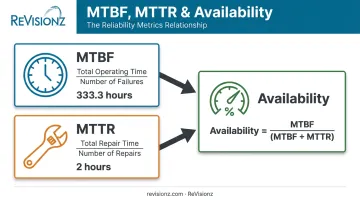
Mean Time Between Failures (MTBF) measures average operating time between successive failures of a repairable asset.
MTBF = Total operating time / Number of failures
Example: an asset runs for 1,000 hours and experiences 3 failures. MTBF = 1,000 / 3 = 333.3 hours.
Mean Time to Repair (MTTR) measures the average time needed to diagnose, fix, and restore a failed asset.
MTTR = Total repair time / Number of repairs
Example: a maintenance team logs 10 total repair hours across 5 repairs. MTTR = 10 / 5 = 2 hours.
Together, these numbers tell a fuller story than either does alone. High MTBF paired with high MTTR still means long, costly outages when failures do occur. NASA's inherent availability formula ties the two together: Availability = MTBF / (MTBF + MTTR). Track both, not just one.
Why Asset Reliability Management Matters
The financial case for reliability isn't theoretical. The U.S. Department of Energy's Federal Energy Management Program estimates that preventive maintenance programs save 12% to 18% compared to a purely reactive approach. Moving further up the maturity curve into predictive maintenance compounds those savings, according to DOE's Operations & Maintenance Best Practices Guide:
- Predictive maintenance lowers maintenance costs by 25% to 30%
- Predictive maintenance reduces downtime by 35% to 45%
Those are estimates and industrial averages, not guarantees. But they establish a clear directional truth: proactive reliability work costs less than firefighting.
There's also a safety dimension that doesn't get discussed enough. According to the Bureau of Labor Statistics' 2024 fatal occupational injury data, 213 workers died in incidents classified as "struck, caught, or compressed by running powered equipment." That accounts for over a quarter of the 756 total contact-related fatalities recorded that year, per BLS Table A-9.
This is a machinery-contact classification, not direct proof that equipment failure caused every incident. Still, it's a stark reminder that equipment condition and worker safety are connected.
Beyond the safety case, reliability also underpins something less quantifiable but equally important for EPCs and owner-operators in regulated, capital-intensive industries: trust. Regulators, insurers, and customers all expect consistent operational performance. A plant with a documented reliability program has an easier time demonstrating compliance and maintaining the confidence of everyone who depends on it running safely.
Building Blocks of an Effective ARM Program
The 5 P's of Asset Management
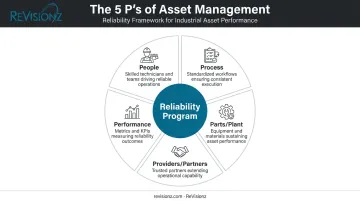
No single ISO or industry standard defines an official "5 P's" of asset management. That said, the mnemonic is widely used across the field as a practical way to organize a reliability program. Most versions cover:
- People – Skilled technicians, reliability engineers, and leadership commitment
- Process – Documented workflows for maintenance, inspection, and failure response
- Parts/Plant – Physical equipment, spares, and materials availability
- Providers/Partners – Vendors, contractors, and consultancies supporting the program
- Performance – The KPIs and data used to measure whether everything above is working
Here's why this framework holds up in practice: a gap in just one "P" can undermine the whole program. A plant might have excellent EAM software and a clean spare parts inventory, but if there's a skills shortage on the maintenance floor, technicians misdiagnose issues, delay repairs, and erode reliability gains. Technology and process alone don't fix a people problem.
Core Maintenance Strategies
Maintenance strategy sits on a maturity curve, and where an organization lands says a lot about how sophisticated its reliability program is.
| Strategy | Approach | Maturity Level |
|---|---|---|
| Preventive | Scheduled by time, usage, or cycle | Foundational |
| Predictive | Based on observed condition data (vibration, temperature, noise) | Intermediate |
| Prescriptive | Uses sensor data and analytics to identify root cause and prescribe corrective action | Advanced |
Preventive maintenance is interval-based; you service the asset on a schedule regardless of actual condition. Predictive maintenance flips that, using real condition data to decide when service is actually needed. Prescriptive maintenance goes further, pinpointing why a failure is likely and recommending a specific fix, not just flagging that something's off.
Reliability-Centered Maintenance (RCM) sits above all three as a structured methodology for deciding which strategy fits which asset. Rather than applying one blanket approach across an entire facility, RCM prioritizes maintenance effort based on criticality.
SAE JA1011 provides the evaluation criteria for what qualifies as a genuine RCM process, tracing back to Nowlan and Heap's 1978 work for the airline industry. Not every preventive maintenance program can call itself RCM; the standard exists precisely to prevent that mislabeling.
Reliability KPIs Beyond MTBF/MTTR
A few additional metrics round out the picture:
- Overall Equipment Effectiveness (OEE) – Combines Availability × Performance × Quality into a single score
- Failure rate – The conditional probability an asset fails within a given time window, given it hasn't failed yet
- Preventive maintenance compliance – The percentage of scheduled PM tasks completed on time (organizations typically define this locally, since no single universal formula exists)
An OEE score of 85% or higher is often treated as a top-tier benchmark in manufacturing, though the right target varies significantly by industry and asset type.
Technology Enablers: EAM, CMMS, Digital Twins & AI
EAM and CMMS platforms centralize asset data, generate work orders, and track maintenance history in one place. Digital twins and AI-driven analytics build on that foundation, using real-time sensor data to predict failures before they happen rather than just recording them after the fact.
But here's the catch nobody likes to hear: none of this technology works if the underlying data is bad. Feed a predictive maintenance model inconsistent tag numbers or incomplete asset hierarchies, and it will produce unreliable predictions, or none at all.
This is where specialized data migration and enrichment work earns its keep. ReVisionz has spent more than two decades helping owner-operators in oil & gas, chemicals, and manufacturing untangle exactly this kind of data mess, working across platforms like Maximo, SAP, Oracle, and VEERUM to build asset records that technology can actually use.
In one engagement, ReVisionz validated and enriched asset and location records with a 0% rework requirement, a level of precision that only comes from disciplined data governance, not just software deployment.
How to Build an Asset Reliability Management Program
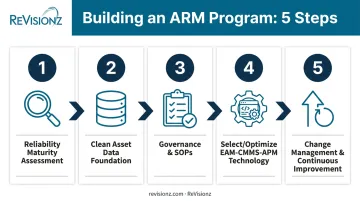
Building an ARM program follows a sequence of deliberate, interconnected steps.
Conduct a reliability maturity assessment. Evaluate people, process, data, and technology to identify where the biggest gaps actually are. Many organizations assume they have a technology problem when the real issue is inconsistent data or an undertrained maintenance team.
Establish a clean, lifecycle-ready asset data foundation. Inconsistent tag numbers, fragmented hierarchies, and missing records can undermine even the best predictive maintenance tools. ReVisionz's MIC+ service, launched in late 2025, helps owner-operators consolidate this data into one trustworthy source.
Define governance and standard operating procedures. Someone needs to own how asset information gets updated, who approves changes, and how maintenance workflows stay aligned with field conditions. Without clear ownership, data quality degrades within a year or two.
Select or optimize EAM/CMMS/APM technology. Approach this with a technology-agnostic mindset, prioritizing what the business actually needs over vendor loyalty. Whether that's Maximo, SAP, or a specialized APM layer depends on existing infrastructure and the specific reliability gaps identified in Step 1.
Drive change management and continuous improvement. Training, KPI tracking, and iterative refinement keep the program from stalling once the initial rollout excitement fades. Reliability programs need ongoing attention long after rollout to stay effective.
Common Challenges in Asset Reliability Management
Even well-intentioned programs hit predictable obstacles:
- Aging infrastructure. Legacy assets that were never connected to IoT sensors force teams back onto manual condition monitoring, which is slower and less consistent.
- Data silos. Disconnected systems scatter asset data and block predictive maintenance before it starts. One LNG operator engagement required consolidating over 300,000 tags and 800,000 documents just to establish a usable baseline.
- Resource constraints and skills gaps. Workforce turnover and a retiring reliability workforce across process industries mean fewer experienced hands available to run these programs day-to-day.
None of these are quick fixes. But organizations that tackle the data and governance piece first tend to have an easier time addressing the other two.
Frequently Asked Questions
What is asset reliability management?
Asset reliability management is the discipline of ensuring assets consistently perform their intended function through maintenance strategy, data governance, and continuous monitoring. It blends reliability engineering with day-to-day operational execution.
What are the 5 P's of asset management?
A widely used industry mnemonic covering People, Process, Parts/Plant, Providers/Partners, and Performance. It's a practical, industry-derived framework for organizing a reliability program rather than a formal ISO standard.
What is ARP certification?
ARP stands for Asset Reliability Practitioner, a credential issued by the Mobius Institute Board of Certification (MIBoC). It's designed for professionals at various levels, from reliability advocates to program leaders, and is valid for three years.
What's the difference between asset reliability and asset availability?
Reliability measures an asset's ability to run without unexpected failure. Availability measures the percentage of time it's actually operational. A pump can be highly reliable yet show lower availability due to scheduled maintenance downtime.
What KPIs matter most for measuring asset reliability?
MTBF, MTTR, and OEE are the three most commonly tracked metrics. MTBF and MTTR focus on failure and repair timing, while OEE combines availability, performance, and quality into one score.
How does asset information management improve reliability outcomes?
Accurate, structured asset data is the foundation that makes predictive maintenance, digital twins, and EAM/CMMS systems effective. Without it, even the most advanced technology produces unreliable or incomplete results.