Many engineering teams still rely on shared drives and spreadsheets to manage this volume. That approach works until it doesn't. Version confusion creeps in, compliance gaps widen, and rework costs pile up fast.
This guide breaks down what an engineering document management system (EDMS) actually is, how it differs from generic document tools, the features that matter most, and how owner-operators select and roll out the right platform.
Key Takeaways
- An EDMS tracks document revisions by equipment tag and WBS code, not file version
- Poor document control drives measurable rework and safety exposure on capital projects
- True EDMS platforms combine CAD/BIM integration, workflow automation, and metadata-driven search
- Deployment choice—cloud, on-premise, or hybrid—depends on data residency and long-term operating needs
- EDMS success depends on change management and adoption, not just software configuration
What Is an Engineering Document Management System?
An engineering document management system (EDMS) is specialized software built to organize, control, search, approve, and securely share engineering-specific documents throughout their entire lifecycle. It functions as an active control mechanism, not a static storage tool.
Typical document types managed inside an EDMS include:
- CAD models and 3D design files
- P&IDs (piping and instrumentation diagrams)
- Equipment datasheets and specifications
- RFIs (requests for information) and transmittals
- MOC (management of change) records
- As-built drawings and construction records
Each of these documents needs to stay linked to the physical asset it describes, sometimes for 20, 30, or 40 years.
EDMS vs. General Document Management System (DMS)
A generic DMS handles everyday business files: contracts, HR records, invoices. It's built for file-level version control and general search.
An EDMS goes further. It ties documents to equipment tags, systems, and work breakdown codes, then manages revision history at a granular level. A P&ID's rev C connects not just to its previous version, but to the specific equipment, discipline, and project phase it belongs to.
Most EDMS platforms also integrate natively with CAD tools. OpenText's engineering-specific content management supports direct connections to AutoCAD, SOLIDWORKS, and SAP.
EDMS vs. Enterprise Content Management (ECM)
ECM is a broader, enterprise-wide strategy for managing all organizational content, spanning HR, legal, finance, and every other department. A DMS or EDMS is narrower by design, focused specifically on document lifecycle control.
ECM is the umbrella strategy, while EDMS is one specialized tool underneath it, purpose-built for engineering and asset-heavy operations. Most owner-operators run an EDMS as a component of a larger ECM or Asset Information Management program, not as a standalone replacement for it.
Why Engineering Document Management Matters
Poor document control creates measurable financial and safety risks, from costly rework to preventable incidents.
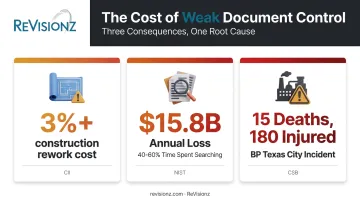
Rework is the most immediate cost: CII (Construction Industry Institute) benchmarking across more than 150 industrial projects found mean field rework exceeding 3% of construction-phase cost for heavy-industrial projects, with roots often traced back to design coordination failures.
Interoperability gaps compound the problem: NIST estimated that inadequate interoperability costs the U.S. capital-facilities industry $15.8 billion annually, with owner-operators absorbing the largest share. The same study found engineers spend 40% to 60% of their time simply locating and validating information before they can even use it.
Safety incidents can trace back to outdated documents: The CSB investigation into the 2005 BP Texas City explosion found operators had followed an outdated startup procedure that was incorrectly marked as current. The explosion killed 15 people and injured 180.
Strong document control delivers measurable value in return:
- Faster search and retrieval across disciplines and contractors
- Stronger collaboration between engineering, construction, and operations teams
- Audit-ready trails that hold up during regulatory review or litigation
- Fewer safety incidents tied to document currency errors
Key Features to Look For in an EDMS
Not all document platforms qualify as a true EDMS. Here's what separates a purpose-built system from generic file storage:
- Metadata-driven repository: Every document links to equipment tags, systems, and project phases, creating a single source of truth instead of scattered folders
- Revision-level version control: Full registered revision history with complete audit trails, not just "file version 2" labels
- Native CAD/BIM integration: Direct connections to tools like AutoCAD, SmartPlant, and SOLIDWORKS, including markup, annotation, and format conversion
- Configurable workflow automation: Role-based task assignment, automated notifications, and structured review/approval cycles
- Advanced metadata search: Teams locate documents by discipline, tag, or work package in seconds, not hours
- Security and compliance controls: Granular permissions, encryption, and alignment with standards relevant to regulated sectors like process safety management
Genuine revision-level control looks very different from a simple file overwrite. Bentley's ProjectWise, for example, defines a version as a read-only snapshot with version-level deletion security, locking in the audit trail rather than just replacing a file.
Cloud vs. On-Premise vs. Hybrid EDMS Deployment
Deployment model shapes everything from IT overhead to long-term flexibility. There's no universal right answer here.
| Model | Best fit | Trade-off |
|---|---|---|
| Cloud | Distributed teams, contractors, growing document volumes | Requires reliable connectivity; data sovereignty questions in regulated regions |
| On-premise | Strict data residency rules, air-gapped networks | Full infrastructure control, but heavier IT burden |
| Hybrid | Long-term owner-operators balancing flexibility and compliance | More complex identity and governance management |
Choosing between these models comes down to a few practical factors:
- Team distribution and how often contractors need remote access
- Data residency or air-gapped requirements tied to your operating regions
- Available IT capacity to manage full on-premise infrastructure
- Identity and access management maturity needed for a hybrid split
Many asset-intensive owner-operators land on hybrid, keeping sensitive operational records local while opening cloud access for contractors and distributed teams during active projects. This flexibility adds complexity, though: hybrid setups require tighter governance to keep identity, permissions, and document versions synced across environments.
How to Choose and Implement the Right EDMS
Selecting an EDMS platform without a plan is how projects end up with expensive, half-adopted software. Start with criteria, not vendor demos.
Define selection criteria first:
- Integration with existing engineering tools (CAD, ERP, EAM systems)
- Scalability as document volumes grow into the millions
- Compliance features aligned to your industry's regulatory requirements
- Ease of adoption for engineering, construction, and field teams
Establish document control standards before evaluating software. Numbering conventions, classification schemes, and metadata taxonomy should exist before you sit through a single vendor pitch. The tool should reinforce your process, not dictate a new one.
Follow a structured implementation path:
- Migrate legacy data and clean up metadata inconsistencies
- Configure workflows, permissions, and integrations
- Run integration testing against CAD and ERP systems
- Roll out in phases, starting with a pilot group
- Train users continuously, not just at go-live

Many owner-operators and EPCs work with technology-agnostic consultancies to navigate this. ReVisionz, for instance, guides platform selection across ecosystems like Hexagon, AVEVA, and OpenText, ensuring the decision is driven by business capability rather than vendor preference. That matters because each ecosystem handles CAD integration, workflow configuration, and metadata structure differently.
The most underestimated factor in EDMS success is change management, which determines whether the system delivers ROI. A perfectly configured system that engineers avoid using because it's clunky or unfamiliar delivers zero value. Adoption planning deserves the same attention as technical configuration.
Beyond the Project: Connecting EDMS to Asset Information Management
For owner-operators, document management can't stop when construction wraps up. Engineering documents created during design and construction need to transition into lifecycle-ready asset information that operations and maintenance teams can use for decades. This is the gap most generic EDMS guides skip entirely.
This "digital handover" matters because it:
- Reduces total cost of ownership by eliminating post-handover data rework
- Strengthens regulatory compliance by keeping operating records current and traceable
- Enables predictive maintenance and digital twin initiatives that depend on accurate, structured asset data
Handing over a folder of PDFs isn't the same as handing over usable, structured data. Operations teams need documents linked to tags, systems, and maintenance schedules from day one, not months into commissioning.
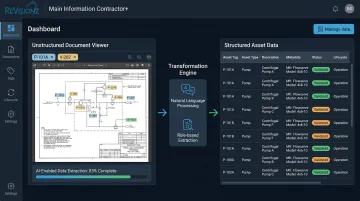
ReVisionz's Asset Information Management (AIM) practice focuses specifically on this transition. Its AI-powered Main Information Contractor+ (MIC+) service transforms unstructured engineering documents and data into lifecycle-ready information. The result is a foundation for long-term asset performance, not a pile of disconnected files inherited from construction.
Frequently Asked Questions
What is an engineering document management system?
An EDMS is specialized software that organizes, controls, and secures engineering-specific documents like drawings, P&IDs, and specifications throughout their lifecycle. It ties every document to equipment tags and revision history, not just file versions.
What is the difference between ECM and DMS?
ECM is a broad, enterprise-wide strategy managing all organizational content across departments. A DMS (or EDMS) is a narrower tool focused specifically on document lifecycle control, often operating as one piece within a larger ECM strategy.
Is an EDMS only for large enterprises?
No. Small and mid-sized engineering firms benefit just as much, especially once document volume grows past what spreadsheets and shared drives can handle reliably. Deployment options range from single-site installs to multi-facility rollouts, scaling with the firm.
Can an EDMS integrate with CAD software like AutoCAD or SOLIDWORKS?
Yes. Native CAD/BIM integration is one of the key differentiators separating true EDMS platforms from generic document storage tools. Most leading platforms support direct connections to AutoCAD, SOLIDWORKS, and similar design software.
How does an EDMS improve regulatory compliance?
An EDMS maintains complete audit trails, role-based access controls, and version histories that regulators and auditors can review directly. That traceability makes it straightforward to prove during an audit that operating procedures and safety documents reflect the current, approved revision.
How much does it cost to implement an EDMS?
Cost depends on deployment model, user count, document volume, and feature set. Cloud subscriptions, on-premise licensing, and hybrid setups all carry different cost structures, with entry-level packages built for smaller teams and tiered pricing for larger, multi-site deployments.