This isn't rare. It's Tuesday.
Poor data quality costs organizations at least $12.9 million a year on average, according to Gartner. For asset-intensive industries, that figure understates the real exposure. Bad asset data doesn't just slow down reporting; it puts safety, compliance, and uptime at risk.
Most companies respond by launching a cleanup project. They scrub a database, fix the obvious errors, and move on. Six months later, the same problems resurface, because data quality was never treated as an ongoing discipline.
This article covers what a real data quality strategy looks like, the pillars that define good data, a step-by-step framework for building one, the metrics worth tracking, and the mistakes that quietly sink most efforts.
Key Takeaways
- A data quality strategy is a sustained framework, not a one-time cleanup project.
- Six core dimensions, plus lineage for asset data, define what "good data" actually means.
- Leadership buy-in, clear ownership, and automated monitoring make the strategy stick.
- Lack of accountability breaks more programs than lack of technology ever does.
- Asset-heavy sectors need data that stays trustworthy for decades, not just at launch.
What Is a Data Quality Strategy?
A data quality strategy is a structured roadmap for keeping data accurate, complete, and trustworthy over time. It combines defined standards, assigned ownership, and systematic monitoring instead of relying on ad hoc fixes whenever something breaks.
The shift matters more than the definition. Reactive organizations fix bad data after it causes a problem: a failed audit, a missed maintenance job, a safety incident traced back to an incorrect equipment spec. Proactive organizations catch the error before it spreads.
For asset-intensive companies, there's an added layer. Data has to stay reliable as it moves from engineering and construction into long-term operations and maintenance. A tag that's accurate on day one of commissioning needs to still be accurate ten years later, after multiple modifications, turnarounds, and system migrations.
The Core Pillars of Data Quality
DAMA UK identifies six primary dimensions for assessing data quality: accuracy, completeness, consistency, timeliness, validity, and uniqueness. These form the baseline for any data quality program.
- Accuracy: Data reflects real-world conditions. An equipment tag in the CMMS matches the physical asset in the field.
- Completeness: Required fields and attributes are populated. A pump record isn't missing its criticality rating or maintenance strategy.
- Consistency: The same data reads the same way across systems, without duplicate or conflicting records between the ERP and the engineering data management system.
- Timeliness: Data is refreshed on the schedule the business actually needs, not whenever someone gets around to it.
- Validity: Values fall within acceptable business rules and defined formats.
- Uniqueness: Each asset exists as a single, non-duplicated record across systems.
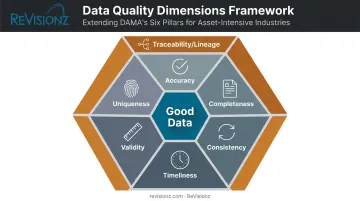
For asset data specifically, there's a seventh consideration: traceability, or lineage. This is the ability to trace a data point back through design, procurement, and construction to its current operational state.
Industry frameworks like CFIHOS support this by defining unique identifiers and standardized relationships between data objects. Individual owner-operators still have to manage the mapping between their own systems and those standards.
How to Build a Data Quality Strategy: A Step-by-Step Framework
A data quality strategy that survives past the first year follows a deliberate sequence, with each step building on the one before it.
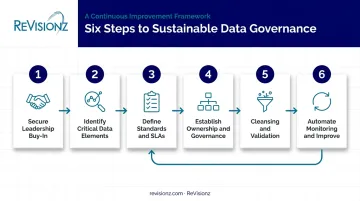
Step 1: Secure Leadership Buy-In and Assess the Current State
Start by documenting current pain points honestly. How many hours per week does your team spend firefighting bad data? How often does a maintenance job get delayed because equipment records were wrong?
Connect those numbers to outcomes executives already care about: safety incidents, compliance findings, unplanned downtime, and audit exposure. Then identify a small group of stakeholders early:
- Data owners from the business
- IT and systems representatives
- Operations leadership who feel the pain directly
Build the business case around cost savings and risk reduction, not abstract data hygiene.
Step 2: Identify Critical Data Domains and Elements
Not all data deserves equal attention. Catalog your Critical Data Elements (CDEs) — the fields that actually drive operations and compliance. In asset-heavy environments, that typically means:
- Equipment tags and asset hierarchy structure
- P&ID revisions and single-line diagrams
- Master asset records in systems like Maximo, SAP, or Oracle
- Criticality assessments and process safety information
Map where each data source originates and how it flows from engineering handover into daily operations. You can't fix what you haven't traced.
Step 3: Define Data Quality Standards, Metrics, and SLAs
Set measurable thresholds for each dimension. What percentage of mandatory fields must be populated before a record is considered usable?
SLAs shouldn't be uniform across the data lifecycle. Raw ingestion data can tolerate more variance than data feeding into compliance reports or safety cases. A field that's still being verified during construction doesn't need the same rigor as a record used for a regulatory submission.
Step 4: Establish Ownership, Stewardship, and Governance
Assign data owners who are accountable at the business-unit level, and data stewards who handle day-to-day enforcement. Without both roles filled, quality issues fall through the cracks by default.
Governance typically follows one of three models:
- Centralized: One team controls standards across the organization. Fast to enforce, slow to scale.
- Decentralized: Each business unit sets its own rules. Flexible, but inconsistent across sites.
- Federated: A central council sets standards; business units apply them locally. This works best for large, multi-site industrial organizations balancing consistency with local operational reality.
Step 5: Implement Cleansing, Validation, and Enrichment Processes
Schedule automated validation checks within your data pipelines so errors get caught at ingestion, not three systems downstream. Catching a bad tag entry at the point of data entry is far cheaper than fixing it after it's propagated into a maintenance plan.
For asset organizations specifically, this step is critical at handover: validating engineering handover packages and reconciling 3D model and tag data against as-built records before operational go-live. Skipping this reconciliation is how sparse, unreliable data ends up baked into the EAM system from day one.
Step 6: Automate Monitoring and Build a Continuous Improvement Loop
Implement anomaly detection and alerting tied directly to accountable stewards, not a generic inbox nobody checks. Then close the loop:
- Regular reporting to stakeholders and leadership
- A feedback channel for teams to flag recurring issues
- Periodic audits to adapt standards as operations evolve
Projects wrap up once the initial cleanup is done. This loop doesn't, because new data sources, systems, and regulations keep entering the picture long after go-live.
Key Data Quality Metrics and SLAs to Track
Track metrics tied to business impact, not vanity scores that look good in a dashboard but don't change behavior.
- Accuracy: Percentage of tags matching a validated source-of-truth system, for example, the share of pump records confirmed against the current P&ID revision.
- Completeness: Proportion of required values or records actually present, measured against your CDE list, not a generic industry benchmark.
- Consistency: Rate of duplicate or conflicting records between systems, such as ERP versus engineering data management platforms.
- Timeliness: Data freshness and lag, which becomes critical when a real-time operational decision depends on current information.
SLA targets should shift depending on where the data sits in the lifecycle:
| Data Stage | Example SLA Target | Tolerance for Variance |
|---|---|---|
| Engineering / raw ingestion | 80–85% field completeness | Higher (data still evolving) |
| Construction handover | 95%+ tag-to-as-built match | Moderate |
| Operational / compliance reporting | 99%+ accuracy on CDEs | Low (feeds safety and audits) |
Common Mistakes to Avoid — and How Automation Helps Prevent Them
Data quality strategies tend to fail in the same predictable spots. Here's where organizations lose ground, and how automation closes each gap:
- Treating data quality as a one-time cleanup. A scrubbed database degrades again within months without ongoing monitoring. Automated data observability tools catch drift as it happens instead of waiting for the next audit to expose it.
- Failing to assign clear ownership. This is the single biggest failure point, ahead of any technology gap. Governance tooling with role-based accountability makes sure an issue lands on someone's desk instead of disappearing into a shared folder.
- Overlooking checks at lifecycle transition points. Project handover from EPC to operations is where organizations lose the most value, leaving sparse asset data in the EAM system while richer detail stays locked in engineering documents. Validating data before go-live, not after, is the fix.
- Focusing only on technical fixes. Metrics that never connect to business KPIs lose leadership support fast. Tie every quality metric back to safety, uptime, or compliance, or expect budget conversations to get harder each year.

ReliabilityWeb has documented how plants routinely start operations this way, with engineering detail nobody migrated over. This is exactly the gap ReVisionz's Main Information Contractor+ (MIC+) service was built to close: it applies AI to validate and enrich unstructured asset data at the handover moment, so operations doesn't inherit a data problem disguised as a completed project.
Conclusion
A data quality strategy works when three things happen together: leadership buy-in, clear ownership, and measurable standards. Miss any one of those, and the program stalls regardless of how good the technology is.
Most failures trace back to the same root cause: a missing owner, not a missing tool. Treating data quality as a project with an end date, rather than a capability the organization sustains, guarantees the same problems resurface.
For asset-intensive organizations, sustaining data quality across design, construction, and decades of operations takes internal governance built on people, process, and technology. It also requires partners who understand engineering and operational data as deeply as the systems that hold it.
ReVisionz has built its practice around that combination, helping organizations manage this challenge at scale.
Frequently Asked Questions
What is a data quality strategy?
A data quality strategy is a structured, ongoing framework of standards, ownership, and monitoring that keeps data accurate and trustworthy over time, not a one-time cleanup effort.
What are the main components (pillars) of data quality?
Accuracy, completeness, consistency, timeliness, validity, and uniqueness form the core dimensions organizations use to define "good data." Asset-intensive industries often add traceability as a seventh.
How long does it take to implement a data quality strategy?
It typically unfolds in phases — assessment, tooling, governance, and monitoring — over several months. Initial wins show up early, while full maturity builds over a year or more.
Who should own data quality in an organization?
Business units generally own their domain data, while a central governance function or council ensures consistency and compliance across the organization.
What tools are used for data quality management?
Common categories include data catalogs, automated monitoring and observability platforms, and governance tools. Many now use AI to speed up validation and enrichment work.
How is data quality different for engineering and asset data compared to typical business data?
Asset and engineering data must stay accurate and traceable across design, construction, and decades of operations. Lineage and handover validation matter far more here than in typical CRM or transactional data.