Introduction
A reliability engineer pulls up a corrosion reading to justify delaying a pressure vessel inspection. The number looks fine.
But nobody on the team can say where it came from, whether it was manually entered, auto-synced from a sensor, or corrected after a calibration error. That gap between "the data says so" and "we can prove it" is where compliance failures and safety incidents start.
As owner-operators and EPCs digitize engineering, operational, and enterprise data across P&IDs, CMMS platforms, ERP systems, and cloud tools, this traceability problem multiplies. Harvard Business Review has found that leaders often treat internal data as either infallible or worthless, with little middle ground for actually verifying it.
This guide defines data lineage, clarifies its role inside data governance, breaks down the five pillars of governance, and explains why lineage is mission-critical for capital-intensive industries.
Key Takeaways
- Data lineage tracks data's complete journey and every transformation from origin to final destination
- Lineage is the operational mechanism that makes governance enforceable and auditable
- The five pillars of governance depend on lineage to prove they're working, not just documented
- In asset-intensive industries, lineage supports process safety and lifecycle visibility from EPC handover onward
- Successful implementation starts with clear objectives and prioritizing high-impact data flows first
What Is Data Lineage?
Data lineage is the process of tracking, recording, and visualizing how data moves from its origin through every enrichment, filter, join, and transformation until it reaches its final destination. The record captures how and why the data changed at every step, not just where it currently sits.
That distinction matters because three related terms are often used interchangeably and incorrectly:
- Data lineage: the dynamic, ongoing record of how data actually flows and transforms across systems
- Data mapping: a static structural exercise showing how source fields correspond to target fields
- Data provenance: narrower still, referring only to a data point's original source, not what happened to it afterward
Mapping and provenance can feed into a lineage record, but neither replaces it.
Types of Data Lineage
Most lineage practices operate at three levels of detail:
- Table-level lineage: tracks how entire datasets move and transform across ETL/ELT pipelines and databases
- Column-level lineage: traces individual field-level transformations, essential for governing sensitive or safety-critical values like pressure thresholds or PII
- Business/report-level lineage: connects technical data flows to the dashboards and KPIs that operations teams and executives actually rely on
A Practical Example
Consider inspection data from a field sensor on a pressure vessel. The reading enters a CMMS or EAM system, where it's validated against expected ranges and timestamped. From there, it feeds a reliability dashboard used to schedule maintenance.
At each hop, something changes: the pipeline converts units, flags outliers, and recalculates aggregations. Without lineage, nobody can tell whether the number on the dashboard reflects reality or a transformation error three steps back.
Is Data Lineage Part of Data Governance?
Yes. Data lineage is a foundational, embedded component of data governance, not a standalone discipline that operates on its own timeline.
Think of it in layers. Governance defines the policies, ownership, and rules for managing data. Lineage is the mechanism that shows whether those policies are actually being followed in practice.
Gartner advises data and analytics leaders to use lineage practices specifically to improve governance, sharpen decision-making, and support regulatory compliance. Gartner also warns that failing to understand how data flows through an organization can have lasting operational consequences.
Here's the functional split:
| Function | Data Governance | Data Lineage |
|---|---|---|
| Defines | Policies, ownership, rules | Actual data movement and change |
| Answers | Who is accountable? | What happened to the data, and when? |
| Format | Documented framework | Auditable, verifiable trail |
Without lineage, governance frameworks exist only on paper. When a compliance issue surfaces, there's no way to trace accountability back to its source. That gap determines whether a governance program actually works or just looks good in a slide deck.
The 5 Pillars of Data Governance (and Where Lineage Fits)
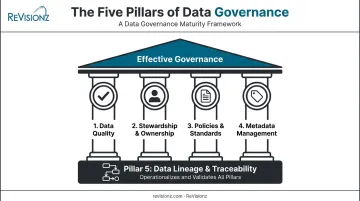
Effective data governance frameworks rest on five interconnected pillars. Each one covers a distinct function, but none of them can be verified without the last.
Pillar 1 – Data Quality
This pillar ensures data is accurate, complete, and consistent across every system it touches. It's the baseline: nothing downstream matters if the source data is wrong.
Pillar 2 – Data Stewardship & Ownership
Stewardship assigns clear accountability for specific datasets and decision rights. Someone has to own the answer when a field is wrong, and this pillar makes sure that person exists.
Pillar 3 – Policies & Standards
This pillar establishes the rules for data access, security, and usage across the organization — who can see what, and under what conditions.
Pillar 4 – Metadata Management & Architecture
Metadata provides the structural context, definitions, classifications, and relationships that make data understandable and searchable rather than just a pile of numbers.
Pillar 5 – Data Lineage & Traceability
This is where the other four get tested. Lineage operationalizes and validates quality, stewardship, policy, and metadata by showing measurable proof that each is functioning, not just documented. A governance program can claim excellent data quality standards; lineage is what confirms whether that claim holds up when data actually moves.
Why Data Lineage Matters for Asset-Intensive Industries
Oil & gas, chemicals, mining, and manufacturing organizations face a lineage challenge that most SaaS-native companies never encounter. Their data spans decades and multiple disconnected systems, including P&IDs, 3D models, CMMS, EAM platforms, and legacy document repositories that predate modern data architecture entirely.
Safety and Regulatory Compliance
OSHA's Process Safety Management standard requires employers to compile written Process Safety Information covering chemical hazards, process technology, and equipment before conducting a process hazard analysis. That includes P&IDs, safe operating limits, and materials of construction.
When a change happens, related PSI and operating procedures must be updated to match. Inspection records, in turn, need to identify the date, inspector, equipment identifier, and results.
None of that works without traceable data. If a safety-critical value on a dashboard can't be traced back to its inspection record, mechanical integrity programs collapse under audit scrutiny.
Where ReVisionz Fits
This is the exact problem ReVisionz's Asset Information Management practice is built around. ReVisionz's internal data shows that 70 to 80% of asset data in enterprise systems is incomplete or inaccurate at facility startup. Fixing it after commissioning costs three to ten times more than addressing it during project delivery.
ReVisionz's AI-powered Main Information Contractor+ (MIC+) service tackles this earlier in the lifecycle by:
- Embedding data requirements into EPC contracts before construction starts
- Running progressive data quality audits throughout the project, rather than waiting for a single handover event
- Using NLP and AI-enabled extraction to convert unstructured vendor manuals and engineering documents into structured, traceable data
- Applying CFIHOS and ISO-aligned rules to measure completeness before and after handover
- Maintaining a KPI data quality dashboard that gives teams an auditable record of data condition at every stage
The goal is lifecycle-ready asset data that stays traceable from EPC handover through years of operations, not just at the moment of transfer.
How to Implement Data Lineage
Rolling out lineage tracking across a hybrid, decades-old asset environment isn't a one-shot project. It works best as a phased effort with clear priorities.
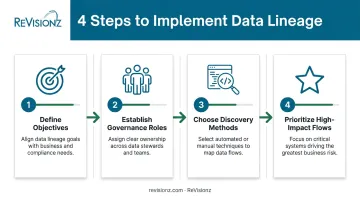
- Define objectives first. Separate compliance-driven priorities, such as column-level lineage for safety-critical fields, from efficiency-driven ones, like eliminating duplicate reporting workflows.
- Establish governance roles. Data stewards maintain lineage accuracy and add the business context that automation alone can't capture, like knowing why a field was manually overridden.
- Choose discovery methods that fit the environment. Automated parsing works well for modern systems, while manual documentation fills gaps left by legacy code or access restrictions. Most mature programs blend both, and a technology-agnostic evaluation prevents vendor lock-in.
- Prioritize high-impact flows first. Map the data that feeds safety decisions and regulatory reporting before attempting full-scale coverage across every system.
Common Implementation Challenges
Two obstacles show up repeatedly:
- Hybrid environment gaps: decades-old engineering systems mixed with modern cloud platforms create coverage blind spots that automated tools alone can't close
- Resource intensity and buy-in: lineage accuracy degrades quickly if stakeholders don't keep it updated as systems and processes evolve; it's not a set-it-and-forget-it exercise
Frequently Asked Questions
Is data lineage part of data governance?
Yes. Data lineage is a foundational component of data governance, providing the traceability needed to enforce and verify that organizations actually follow governance policies, not just document them.
What are the 5 pillars of data governance?
Data quality, stewardship and ownership, policies and standards, metadata management, and lineage and traceability. Each pillar depends on the others, and lineage is what proves the rest are working.
What's the difference between data lineage and data provenance?
Provenance refers only to a data point's original source. Lineage tracks the entire journey afterward, including every transformation, join, and destination the data passes through.
How does data lineage help with regulatory compliance?
Lineage creates an auditable trail organizations can use to demonstrate compliance with regulations like GDPR, HIPAA, or industry-specific safety standards such as OSHA's PSM requirements.
What tools or techniques are used to track data lineage?
Automated parsing handles consistent, well-structured systems efficiently. Manual or descriptive documentation fills gaps where automation fails, such as legacy code or restricted access. Most modern platforms combine both approaches.
How is data lineage different for physical asset data versus purely digital systems?
Asset-intensive industries must trace data across engineering documents, 3D models, and operational systems spanning decades. That complexity requires specialized asset information management approaches, like ReVisionz's Intelligent Asset Management practice, that go beyond typical IT lineage tools.