
Introduction
Most guides to master data management focus on customer records: CRM systems, retail catalogs, loyalty programs. That's fine if you sell shoes online.
But if you run a refinery, a chemical plant, or a mine, your biggest data problem isn't customers. It's equipment tags, engineering drawings, spare parts, and vendor records scattered across a dozen disconnected systems.
The financial stakes are real. NIST estimated that inadequate data interoperability across U.S. capital facilities costs the industry $15.8 billion annually, with owners and operators absorbing roughly $10.6 billion of that burden through rework, manual re-entry, and project delays.
This guide breaks down what an MDM strategy means for asset-intensive industries, its core components, and how owner-operators and EPCs can build one that protects safety, compliance, and performance.
We're drawing on lessons from ReVisionz's 25 years guiding digital asset transformation across energy, chemicals, and manufacturing.
Key Takeaways
- Treat equipment, materials, and engineering data as critical business assets
- Poor handover data between EPCs and operators costs billions in rework annually
- Governance, data quality, and technology must work as one integrated system
- Architecture should match organizational complexity, not a generic template
- AI-readiness depends on governed, structured asset data
What Is a Master Data Management Strategy?
An MDM strategy is the structured approach an organization uses to manage its most critical, shared data as a single source of truth. It covers governance, quality standards, integration methods, and technology choices, all aimed at producing what practitioners call a "golden record."
In plain terms: MDM is the discipline of consolidating core business entities, such as customers, products, assets, suppliers, and locations, into one trusted, consistently maintained dataset used across every system in the organization.
Master Data in Asset-Intensive Industries
For owner-operators and EPCs, master data looks different than it does in retail. It typically includes:
- Equipment and asset tags
- Engineering documents and drawings
- Materials and spare parts records
- Plant and location hierarchies
- Vendor and supplier records
Here's the distinction that trips people up: master data isn't the same as transactional data. A pump's tag number, manufacturer, and nameplate specifications are master data. The maintenance work order logged against that pump last Tuesday is transactional data. Reference data (like unit-of-measure codes) and unstructured data (like a PDF datasheet) round out the full picture.
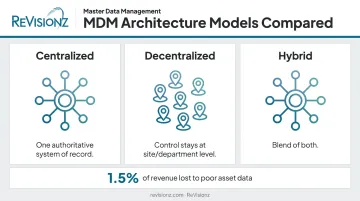
Architecture matters too. Organizations generally choose between three foundational models:
- Centralized: one authoritative system of record
- Decentralized: control stays at the site or department level
- Hybrid: a blend of both
The right choice depends on your organizational structure and how many sites you're running (more on this below).
Getting that architecture right isn't just an IT decision—it carries real financial stakes. Poor asset data isn't a minor inconvenience. AVEVA's industry data puts the cost of poor asset information at 1.5% of annual sales revenue for engineering-heavy operations, spanning fabrication, maintenance, and daily operations. That's a direct hit to margin, driven largely by duplicate records and manual reconciliation.
Why Asset-Intensive Industries Need a Strong MDM Strategy
A well-built MDM strategy pays off in ways that go well beyond tidier spreadsheets.
It lowers total cost of ownership. When equipment records are duplicated across engineering, procurement, and maintenance systems, teams waste hours reconciling conflicting information instead of doing actual work. Clean master data eliminates that redundancy at the source.
Safety and compliance depend on it too. Inspectors and process safety engineers rely on trusted equipment data. If a pressure vessel's inspection history or material specification is wrong in the system, it creates a compliance and safety exposure that inspectors can't overlook.
The strategy also bridges project delivery and operations. One of the most persistent gaps in capital projects is what happens at EPC handover. Data captured during construction often isn't usable on day one of operations because it was never structured for the operating systems that need it. A solid MDM strategy closes that gap before the ribbon gets cut.
Predictive maintenance and digital twins depend on it, too. Analytics models and digital twin initiatives are only as good as the data feeding them. Garbage in, garbage out still applies, no matter how sophisticated the algorithm.
The cost of ignoring this adds up fast. Gartner research puts the average annual cost of poor data quality at $12.9 million per organization — and that's an enterprise-wide figure, before isolating the engineering and equipment records unique to asset-intensive operations.
Key Components of an Effective MDM Strategy
A comprehensive MDM strategy rests on a few interconnected pillars:
- Data governance and stewardship
- Data quality and integration
- Technology selection and AI-readiness
Skip any one of these, and the whole structure gets shaky. The following breakdown explains what each pillar actually involves.
Data Governance and Stewardship
Governance is the framework of policies, ownership, and accountability that determines who manages data quality standards and how conflicts get resolved. Without it, everyone assumes someone else owns the data, and nobody actually does.
Organizations typically choose from three stewardship models:
- Centralized — one team owns data quality decisions enterprise-wide
- Federated — stewardship is distributed across business units or sites
- Hybrid — central standards, local execution
Data stewards act as the bridge between engineering and operations teams on one side and IT systems on the other. Without that translation layer, technical fixes rarely stick.
Data Quality and Integration
Trustworthy golden records depend on four measurable dimensions, drawn from the UK Government's Data Quality Framework:
| Dimension | What It Means |
|---|---|
| Accuracy | Data matches reality |
| Completeness | Required fields are populated |
| Consistency | Values don't contradict each other across systems |
| Timeliness | Data reflects the current state |
Getting these right for equipment and materials records requires integration between engineering tools (like Hexagon or AVEVA), ERP, and EAM systems. Batch, real-time, and API-based methods each have a place, depending on how quickly downstream systems need updated information. The goal is the same regardless of method: no silos, no manual re-keying.

Technology Selection and AI-Readiness
A common mistake: organizations select software first, then attempt to force their data strategy around it. That approach is backwards.
Technology choice should be business-capability-led, not software-led. A technology-agnostic approach, evaluating what the organization actually needs before choosing a platform, tends to produce better long-term fit than starting with a vendor demo.
AI-readiness follows the same logic. It does not mean buying an AI tool. It means structuring and governing asset data so it can reliably support predictive maintenance, analytics, and digital twin models down the road. Models built on ungoverned data produce unreliable predictions, no matter how advanced the algorithm.
MDM Architecture and Implementation Approaches
Choosing an architecture means weighing consistency against flexibility.
- Centralized gives you one system of record, ideal for consistency but harder to implement across established local systems
- Decentralized preserves site-level control, but duplicate or conflicting records tend to persist
- Hybrid balances the two, letting local systems function while a central hub governs shared standards
Beyond architecture type, there are four common implementation styles:
- Registry: local systems stay authoritative; a central hub links records without full consolidation
- Consolidation: records flow into a central repository for reporting, though source systems stay independent
- Coexistence: hub and source systems both hold master data, synchronized through governed processes
- Centralized/transactional: the MDM hub becomes the single authoritative source, with the strongest control but the highest disruption
For complex, multi-site owner-operators in industries like oil & gas, petrochemicals, and mining, coexistence or hybrid models often strike the best balance. They improve shared data without requiring a wholesale rip-and-replace of established site systems.
Architecture choice should align with organizational maturity, the number of operating sites, and your existing engineering and IT landscape. There's no universal template. What works for a single-site chemical plant won't necessarily fit a mining operation running a dozen sites across two continents.
How to Build and Implement Your MDM Strategy: Key Steps
Building an MDM strategy means working through a sequence of decisions that build on each other over time.
Define objectives and scope. Identify which data domains matter most, whether that's equipment, materials, documents, or vendors, and set measurable goals tied to safety, compliance, or cost savings.
Establish governance and stewardship roles. Assign clear accountability for data ownership before selecting any technology. Skipping this step is why so many MDM projects stall after the software gets installed.
Assess current data state and select technology. Evaluate existing ERP, EAM, and engineering platforms, then choose an architecture and platform that fits your data volume, complexity, and growth plans.
Migrate, cleanse, and enrich data. This step converts legacy, unstructured asset data into lifecycle-ready information, and it's the most labor-intensive, most underestimated part of the process. Specialized services, like ReVisionz's MIC+, use AI to accelerate this work for engineering and asset data, since most providers stop at handover while the real work begins once operations start.
Drive adoption and continuous improvement. Implement change management, role-based training, and feedback loops so the strategy evolves alongside new regulations, technologies, and business needs.
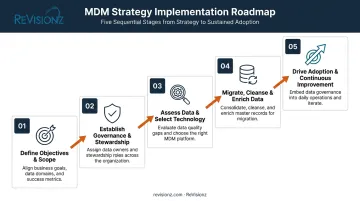
Each step depends on the one before it. Jumping to technology before governance is the most common shortcut we see, and it's usually the one that costs organizations the most time to unwind later.
Common Challenges in MDM Strategy and How to Overcome Them
Even well-planned MDM strategies run into friction. Here's what typically causes it.
Change management resistance. Engineering and operations teams unfamiliar with new data processes often push back, not out of stubbornness, but because nobody explained why the change matters to their daily work. Transparent communication and role-based training go further than any mandate.
Data silos from legacy tools. Disconnected EPC handover packages and outdated engineering platforms create silos that resist quick fixes. A phased integration approach, tackling one data domain or system connection at a time, works better than attempting a single big-bang migration.
Cost and timeline concerns. MDM programs require real investment, and results don't always show up in month one. Treat it as a long-term capability, not a one-off project:
- Enterprise MDM implementations often stretch from several months to well over a year, depending on organizational complexity
- Vendor-reported ROI figures, like a Forrester-commissioned study citing 315% three-year ROI, offer directional signals rather than universal benchmarks
- Actual payback timelines vary by industry, data maturity, and the number of systems requiring integration
Set realistic expectations upfront, and the budget conversation gets a lot easier.
Frequently Asked Questions
What does MDM mean in business?
MDM is the business discipline of managing an organization's most critical shared data, such as customers, products, assets, and suppliers. It maintains that data as a single trusted source of truth used across all systems and departments.
What is the difference between an MDM strategy and MDM implementation?
Strategy defines the what and how: governance, goals, and architecture. Implementation is the actual execution, deploying the platform and migrating data according to that strategy.
What are the main types of MDM architecture?
Centralized architecture uses one system of record; decentralized keeps control at the site level; hybrid blends both. Multi-site operators typically lean toward hybrid or coexistence models for flexibility.
How long does it take to implement an MDM strategy?
Timelines vary by organizational complexity and data volume. Enterprise-wide, multi-site programs typically range from a few months to well over a year.
What industries benefit most from master data management?
MDM began in customer-data-heavy sectors like retail and finance, but asset-intensive industries such as energy, chemicals, and manufacturing gain significant value from managing engineering and equipment master data.
How often should an MDM strategy be reviewed and updated?
At minimum, review your MDM strategy annually. Add ad hoc reviews after major events like mergers, new regulations, or large capital projects that introduce new data domains.