Manufacturers in asset-intensive sectors, including oil & gas, chemicals, and discrete manufacturing, face pressure from three directions at once. Labor shortages are draining experienced talent off the floor. Aging infrastructure is becoming harder and costlier to maintain. Supply chain volatility keeps punishing anyone without real-time visibility.
Combined, these forces make a clear digital transformation roadmap essential for 2026, not optional. This guide breaks down the technology trends reshaping manufacturing, the forces driving them, their operational and business impact, and what to watch for next.
Key Takeaways
- AI/ML, digital twins, IIoT, automation, and AR/VR each solve a distinct efficiency, safety, or quality problem
- Clean asset data, not flashy tools, determines whether these technologies deliver ROI
- Cost, workforce skill gaps, and legacy system integration remain the top adoption barriers
- Structured transformations succeed 80% of the time versus 30% for unstructured efforts, per BCG's 825-executive study
Key Technology Trends Shaping Manufacturing in 2026
Five technology areas form the backbone of most manufacturing digital transformation programs today. Each tackles a distinct operational challenge, from unplanned downtime to skills shortages on the floor.
Artificial Intelligence and Machine Learning
AI/ML analyze sensor and production data in real time to power predictive maintenance, computer-vision quality inspection, and demand forecasting. Instead of waiting for a machine to fail, algorithms flag anomalies before they cause downtime.
Adoption is already happening at scale. Bosch now uses generative AI to create synthetic training images for optical inspection in stator production, turning a handful of real images into more than 15,000 synthetic ones. Deloitte's 2025 survey found 29% of large US manufacturers had already deployed AI/ML at the facility or network level, with another 23% still piloting it.
This trend is accelerating because generative AI has moved past back-office analytics. Manufacturers are now applying it to product design iteration and shop-floor troubleshooting, giving line workers a tool that answers questions in plain language instead of forcing them to dig through manuals.
Digital Twin Technology
A digital twin is a virtual replica of a physical asset or process, used to simulate performance and catch maintenance issues before they cause downtime.
Rolls-Royce has run engine digital twins for years, testing performance under extreme conditions and extending time between overhauls. Airbus takes this further: sensor data from more than 12,000 connected aircraft feeds virtual models used by over 50,000 Skywise users to predict wear and optimize maintenance schedules.
Here's the part most manufacturers underestimate: a digital twin is only as reliable as the asset data behind it. Feed it incomplete tag data or outdated engineering drawings, and the simulation will be wrong, no matter how good the software is.
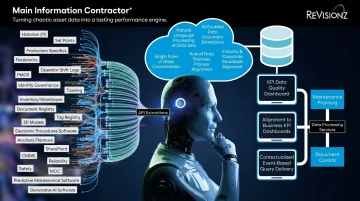
This is where a partner like ReVisionz fits in. With 25 years of digital twin and Asset Information Management experience, ReVisionz's AI-powered Main Information Contractor+ (MIC+) service turns raw, fragmented engineering data into a lifecycle-ready foundation.
That's the structured, accurate information a digital twin actually needs to produce trustworthy simulations. Skip that groundwork, and digital twins tend to underdeliver on ROI, no matter how sophisticated the platform behind them is.
Industrial IoT (IIoT) and Connected Asset Data
IIoT sensors capture real-time data on equipment performance, energy use, and environmental conditions across the plant floor, turning previously invisible machine behavior into a continuous stream of usable information.
Siemens' Insights Hub platform illustrates the scale involved. At Vorwerk Elektrowerke, the platform connects 500 machines and processes 7,500 data points every 15 seconds, contributing to a 3-5% improvement in overall equipment effectiveness (OEE).
This trend keeps growing because siloed systems can't support predictive analytics across a full asset lifecycle. Manufacturers need centralized, structured data environments where sensor readings, maintenance records, and engineering documentation speak the same language before analytics tools find patterns worth acting on.
Automation and Robotics
Robotic process automation and industrial robots handle repetitive, hazardous, or precision tasks (welding, packaging, assembly) that used to depend entirely on manual labor.
ABB's own study found robotic automation for electronics surface-treatment machining increased productivity by 33% or more, with ROI exceeding 1,200% in some applications. Tesla's Gigafactories run some of the industry's most automated production lines, relying on robotics for battery assembly and material handling alike.
Growth here is tied directly to labor economics. Automation isn't replacing workers so much as filling gaps manufacturers can't hire their way out of, while delivering the consistent, high-speed output that quality standards now demand.
Augmented and Virtual Reality
AR/VR support technician training and remote maintenance guidance in manufacturing environments too complex or too risky to learn through trial and error.
Airbus's Getafe plant has used mixed reality since 2019 for A330 MRTT conversions. By 2023, operators completed 70% of relevant work orders using it. GlobalFoundries reported sharper results still: standardized AR work instructions cut training on-ramp time by 40% and reduced scrap and rework by 25%.
Immersive tech keeps gaining ground because it shortens the distance between reading a manual and doing the job correctly. In high-risk, high-complexity environments, that gap is exactly where costly errors happen.
| Technology | Core Mechanism | Proof Point |
|---|---|---|
| AI/ML | Prediction, inspection, forecasting | 29% facility-level deployment (Deloitte) |
| Digital Twins | Lifecycle simulation + live feedback | 12,000+ connected aircraft (Airbus) |
| IIoT | Asset connectivity, contextualized data | 3-5% OEE gain (Siemens) |
| Robotics | Repeatable physical execution | 33%+ productivity gain (ABB) |
| AR/VR | In-context guidance, training | 40% faster training on-ramp (GlobalFoundries) |
What's Driving These Digital Transformation Trends
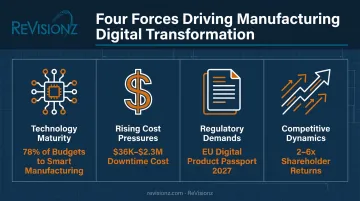
A mix of technological, economic, and competitive forces is accelerating manufacturing's digital shift. Here's what's actually pushing budgets toward these investments in 2026:
- Technology maturity: AI, IIoT, and cloud computing are now affordable enough for mainstream adoption, with 78% of manufacturers allocating over 20% of improvement budgets to smart manufacturing, per Deloitte.
- Rising cost pressures: Unplanned downtime is brutally expensive, costing $36,000 per hour in FMCG and up to $2.3 million in automotive, according to Siemens.
- Regulatory and sustainability demands: The EU's Digital Product Passport will require traceable sustainability data for industrial and EV batteries by February 2027, pushing manufacturers toward auditable systems well ahead of the deadline.
- Competitive dynamics: McKinsey found digital and AI leaders generate 2 to 6 times the shareholder returns of laggards, meaning faster digitizers pull further ahead while others fall behind.
How These Trends Are Impacting the Manufacturing Industry
These trends are reshaping how manufacturers operate, invest, and staff their organizations. The shift shows up in maintenance schedules, capital budgets, hiring plans, and job descriptions alike.
Operational Impact
Real-time data and predictive maintenance are changing daily workflows on the floor. Instead of technicians reacting to breakdowns, maintenance teams now get alerts before failures happen.
Industry 4.0 transformations reduce machine downtime by 30-50% and extend machine life by 20-40%, according to McKinsey's analysis of manufacturing analytics deployments. That shift, from reactive to proactive maintenance, changes how plant managers schedule shifts and plan shutdowns.
Business Impact
Capital budgets are moving. Deloitte's 2025 survey found 78% of manufacturers now put more than 20% of improvement spend toward smart manufacturing, pulling dollars away from traditional capex like standalone equipment upgrades.
Leadership now favors data infrastructure, digital twin platforms, and AI tools over one-off hardware purchases. It's a real change in how leadership measures value: not just units produced, but decisions made faster and problems caught earlier.
Workforce Impact
Roles are shifting toward data literacy and digital tool fluency. A technician who can read a dashboard and interpret an anomaly alert is now more valuable than one who can only follow a maintenance checklist.
The gap is real. US manufacturing may need as many as 3.8 million new workers through 2033, with 1.9 million of those positions potentially going unfilled. This talent gap pushes upskilling and change management to the center of HR strategy, not an afterthought bolted onto IT rollouts.
Challenges to Overcome and Future Signals to Watch
Even well-funded transformation programs hit friction. Here's what typically slows manufacturers down, and where the industry is headed next.
Common Implementation Challenges
- High upfront costs: Technology investment and system integration remain the top-cited headwind among manufacturing executives, per Deloitte's smart manufacturing research
- Workforce skill gaps: 46% of manufacturers surveyed by Rockwell Automation said they lack the skilled workforce needed to outpace competitors
- Legacy infrastructure and data silos: Decades-old systems and disconnected data sources slow integration, forcing manufacturers to clean up historical data before new tools can function properly
These upfront costs, skill shortages, and legacy data gaps aren't disappearing anytime soon, but they're already shaping where manufacturers are placing their next round of bets.
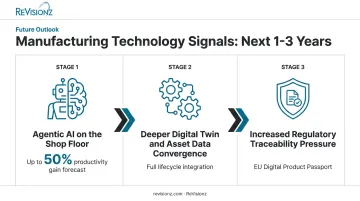
Future Signals to Watch (Next 1-3 Years)
- Agentic AI on the shop floor: Siemens has introduced industrial AI agents for autonomous decision-making, projecting productivity gains of up to 50%, though that figure is a forecast, not a confirmed result
- Deeper convergence of asset information and digital twins: Platforms increasingly link design, operations, and maintenance data across the full asset lifecycle, following the model Airbus uses across its fleet
- Increased regulatory pressure on traceability: EU Digital Product Passport requirements are pushing manufacturers toward real-time, auditable asset data well ahead of any US equivalent
Conclusion
Digital transformation in manufacturing isn't optional anymore. AI, digital twins, IIoT, automation, and immersive tech are reshaping how assets get designed, operated, and maintained. Manufacturers moving fastest on these fronts are pulling ahead of those still waiting to see how it plays out.
The ones gaining lasting advantage share a common foundation: clean data and a clear strategy, built before they scale any single technology. Skip that step, and even the best AI model or digital twin platform will underdeliver.
That's the gap ReVisionz exists to close. With 25 years of experience turning fragmented engineering and asset data into a lifecycle-ready foundation, ReVisionz helps manufacturers build the data backbone these technologies need. The result is measurable ROI, not another pilot project that never scales.
Frequently Asked Questions
What are the four types of digital transformation in manufacturing?
They generally cover process transformation (streamlining operations), product/service transformation (adding digital features), business model transformation (new revenue models), and cultural/organizational transformation (mindset and workflow shifts).
What is Industry 4.0 digital transformation in manufacturing?
Industry 4.0 refers to advanced manufacturing that automates traditional processes using IIoT, AI, robotics, big data, and cloud computing, creating connected, data-driven smart factories, per NIST's definition.
What are the four pillars of successful digital transformation in manufacturing?
Most frameworks point to strategy and leadership alignment, data and technology infrastructure, workforce readiness, and continuous ROI measurement as the pillars that separate scaled programs from stalled pilots.
What are the biggest challenges manufacturers face in digital transformation?
High upfront costs, workforce skill gaps, legacy system integration, and cultural resistance to new workflows top the list. Data quality issues compound all four.
How long does a digital transformation initiative typically take in manufacturing?
Timelines vary by scope. Phased rollouts starting with pilot projects can show measurable results within months, while full-scale, enterprise-wide transformation typically spans several years.
What kind of ROI can manufacturers expect from digital transformation?
ROI varies by initiative, but McKinsey found Industry 4.0 programs can increase throughput 10-30%, improve labor productivity 15-30%, and boost forecast accuracy by up to 85%.