
A bad customer record might mean a misdirected email. A bad tag number or an outdated P&ID can mean a technician working on the wrong valve, a missed inspection, or a failed audit. For capital-intensive, asset-heavy industries, data quality isn't an analytics nice-to-have — it's tied directly to safety, regulatory compliance, and asset uptime.
This article breaks down the eight core dimensions of data quality, the major standards that formalize them (including ISO), and how these concepts play out in real engineering and operations environments.
Key Takeaways
- Poor data quality costs organizations millions annually, with amplified risk in asset-intensive industries
- Eight core dimensions form a practical framework for diagnosing data quality issues
- ISO 8000, DAMA-DMBOK, DMAIC, and ISO/IEC 25012 each formalize a different aspect of data quality
- Incomplete engineering data at project handover creates operational readiness gaps that persist for years
- Sustained data quality requires ownership, measurable metrics, and continuous monitoring, not one-time cleanup
What Is Data Quality and Why It Matters for Asset-Intensive Industries
Data quality is the degree to which data is accurate, complete, consistent, timely, and fit for its intended use. That last part matters most: quality is contextual. A spreadsheet good enough for a quarterly report might be dangerously inadequate for a process hazard analysis.
Generic business data quality problems (a mistyped email address, a duplicate CRM contact) are annoying. Engineering and asset data problems are different in kind:
- Tag numbers that don't match between design and operations systems
- P&IDs missing revision updates after a plant modification
- Equipment master data with conflicting nameplate values
- Maintenance records that don't reflect actual repair history
These aren't abstract concerns. Reliabilityweb reports that 68% of organizations are dissatisfied with their CMMS data quality, a gap that directly undermines confident operational decisions on the plant floor.
In process and manufacturing environments, that dissatisfaction shows up as unplanned downtime, safety incidents, failed audits, and delayed project handovers. These are real financial and human consequences, not just messy dashboards.
The 8 Key Dimensions of Data Quality
These eight dimensions give data teams and asset managers a practical framework for diagnosing where data is breaking down and prioritizing what to fix first.
Accuracy
Accuracy means data correctly reflects the real-world entity or event it represents. An incorrect equipment nameplate value, or a tag classified under the wrong asset type, is an accuracy failure. In regulated industries, accuracy is a documented compliance requirement tied to process safety information.
Completeness
Completeness means all required fields and records are populated. An incomplete P&ID, or a maintenance history record missing a repair date, blocks downstream analysis entirely. Reliability engineers can't trend failure patterns on data that was never captured in the first place.
Consistency
Consistency means data matches across systems. If an asset ID reads one way in the CMMS and differently in the EAM or ERP system, reconciling work orders becomes a manual, error-prone exercise every single time.
Uniqueness
Uniqueness means no duplicate records exist. Duplicate equipment entries in a materials or equipment master create real confusion: technicians pull the wrong part, and inventory counts never quite add up.
Timeliness
Timeliness means data is available when it's needed. Delayed sensor or IoT feeds into a predictive maintenance model don't just slow reporting; they can mean a failure signature gets caught after the equipment has already gone down.
Validity
Validity means data conforms to defined formats and business rules. A tag number that skips the organization's naming convention, or doesn't follow the relevant ISO format, breaks automated validation and search across systems.
Currency
Currency measures how current data is relative to the real-world state it describes. Outdated equipment location or ownership records after a plant modification create a currency problem: the data was accurate once, but reality has since moved on.
Integrity
Integrity refers to preserving relationships between data entities across systems. A broken link between an engineering document and its physical asset record during a data migration is an integrity failure. It's exactly the kind of gap that undermines digital twin accuracy downstream.

Understanding Data Quality Standards & Frameworks (Including ISO)
Several international standards and methodologies exist to formalize how organizations define, measure, and govern data quality, rather than leaving it to ad hoc cleanup projects.
ISO 8000: The International Standard for Data Quality
ISO 8000 is the standard family dedicated specifically to data quality, and it treats quality as context-dependent , not absolute. ISO 8000-61 provides a process reference model for data quality management — defining the processes, purposes, and outcomes organizations need to assess and improve data quality maturity. It's broadly applicable to asset and product master data in engineering environments, though it functions as a management-process standard, not a master-data-only specification.
DAMA DMBOK
The DAMA Data Management Body of Knowledge, published by DAMA International, organizes data management into eleven knowledge areas, including data governance, stewardship, and quality management. Organizations adapt DMBOK's dimensions and practices to their own maturity level rather than applying it as a rigid checklist.
Six Sigma (DMAIC)
Define-Measure-Analyze-Improve-Control gives teams a structured cycle for tackling chronic data quality issues at their root cause instead of patching symptoms repeatedly. DMAIC's popularity in regulated, safety-critical industries stems from its emphasis on trustworthy baseline measurement and standardized control procedures, both essential when data errors carry compliance consequences.
ISO/IEC 25012
This standard defines a general data quality model for structured data held within computer systems, breaking quality into 15 characteristics. These characteristics fall into two categories: inherent quality (belonging to the data itself) and system-dependent quality (how well that quality is preserved as data moves through a system). Engineering and software teams use it to define data requirements for information systems from the ground up.
Real-World Applications: Data Quality in Asset-Intensive Industries
Data quality failures in engineering and operations create risks that generic business examples simply don't capture: safety incidents, stalled digital transformation programs, and audit failures among them.
Closing the Handover Gap
Consider a large petrochemical facility expanding with a new storage tank. The engineering team finished on time and on budget, but as the tank neared completion, the capital projects team hadn't prepared the documentation operations needed.
The O&M team ended up searching through hundreds of files and datasheets just to close information gaps, delaying the tank's digitalization and its connected assets.
As ReVisionz Partner Jason Drews puts it: "The gaps that surface in commissioning are almost never a surprise to the people closest to the work — they're there because the project team treated information as a burden to be handed off, not as an asset operations will actually depend on."
This is the exact gap an Asset Information Management approach targets. ReVisionz's data migration and enrichment methodology, along with its Main Information Contractor+ (MIC+) AI-powered service, catches these gaps during delivery instead of at startup.
In one enterprise engagement, updating AIM standards and master data templates addressed safety and cost concerns flagged in internal audits, with a projected $60 million in annual value over a five-year ramp-up.
Predictive Maintenance and Compliance
Handover gaps aren't the only place trusted data pays off. Validated, current sensor and maintenance data is the foundation predictive maintenance programs run on.
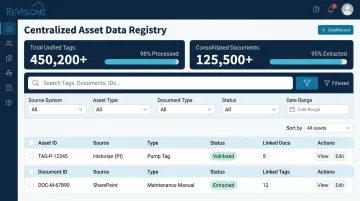
In one LNG operator engagement, ReVisionz consolidated more than 300,000 tags and 800,000 documents into a centralized registry: the kind of consolidation that makes reliable failure trending possible in the first place.
Compliance depends on the same foundation. OSHA's Process Safety Management standard requires covered employers to:
- Maintain accurate P&IDs and equipment specifications
- Keep inspection records current and accessible
- Audit compliance at least every three years
ReVisionz has implemented digital shift-handover workflows for a client operating roughly 30 facilities around the clock, replacing handwritten logs with auditable digital records after a safety concern surfaced in an insurance audit.
Digital Twins Built on Trusted Data
Beyond compliance and maintenance, that same trusted data underpins digital twins as well. A digital twin is only as reliable as the data feeding it.
Industry groups focused on digital twin implementation are explicit that a twin must be built on data of appropriate quality, with clear ownership and governance behind it. Without that foundation, advanced analytics and long-term asset performance modeling are built on sand.
Building a Data Quality Program: Best Practices
Sustaining data quality takes more than a cleanup sprint. It requires structure that survives staff turnover and system changes.
- Assign clear ownership. Data quality isn't solely IT's job. Engineering, operations, and IT each hold a piece, and stewardship roles should reflect that shared accountability.
- Define measurable metrics and SLAs. Completeness percentage, error rate, and time-to-resolution are good starting points — but tailor thresholds to your most critical data elements.
- Invest in continuous monitoring. Gartner reports that 59% of organizations don't measure data quality at all, so treat governance and automation as ongoing capabilities, not one-time projects.
Frequently Asked Questions
What are the data quality standards?
Data quality standards are defined criteria, including accuracy, completeness, consistency, timeliness, and validity, that data must meet to be considered fit for use. Frameworks like ISO 8000 and DAMA-DMBOK formalize these criteria into repeatable processes.
What is the ISO standard for data quality?
ISO 8000 is the primary international standard family for data quality, with ISO 8000-61 addressing data quality management processes. ISO/IEC 25012 covers technical data quality characteristics for structured data in computer systems.
What are the 8 dimensions of data quality?
The eight core dimensions are accuracy, completeness, consistency, uniqueness, timeliness, validity, currency, and integrity. Together they give teams a practical framework for diagnosing and prioritizing data issues.
Why is data quality especially important for asset-intensive industries?
In asset-intensive industries, poor data quality can lead to safety incidents, failed compliance audits, and unplanned downtime, not just flawed reports. Engineering and maintenance data errors carry operational and regulatory consequences that generic business data errors don't.
How is data quality typically measured?
Common measurements include error rates, completeness percentages, duplicate record counts, and time-to-resolution for identified issues. Organizations tailor these metrics to their most critical data elements rather than applying them uniformly.
What is the difference between data quality and data integrity?
Data quality is a broad usability measure covering accuracy, completeness, timeliness, and more. Data integrity specifically concerns preserving relationships and consistency of data across systems, which is one dimension within the larger data quality picture.