
Introduction
Asset-intensive industries like oil & gas, chemicals, mining, and manufacturing routinely manage millions of dollars in materials across project lifecycles that span years.
When that material data lives in disconnected spreadsheets, shared drives, and legacy tools, the results are predictable: stalled procurement, duplicate orders, and compliance gaps that surface at the worst possible time.
Materials management accounts for 50%-60% of total project cost and drives roughly 80% of the project schedule, according to the Construction Industry Institute. Get materials tracking wrong, and everything downstream slows down.
A Materials Management Information System (MMIS) is the digital backbone that consolidates procurement, inventory, and material tracking into one connected source. This article breaks down what MMIS actually is, its core components, the types available, and why the distinction between MMIS and ERP matters for owner-operators running capital projects.
Key Takeaways
- Centralizes and tracks material data across procurement, storage, use, and final disposition
- Core components include item master data, procurement modules, inventory modules, and reporting dashboards
- MMIS types range from standalone systems to ERP-embedded modules and AI-powered cloud platforms
- A well-implemented MMIS reduces project delays, controls costs, and speeds handover to operations
What Is a Materials Management Information System (MMIS)?
An MMIS is a software platform that compiles and integrates information about an organization's materials across purchasing, storage, delivery, and use. It tracks movement, stock levels, and requirements so procurement, warehouse, and project teams work from the same numbers.
Two terms often get used interchangeably, but they describe different things:
- Materials management is the organizational process: planning, sourcing, storing, and issuing materials.
- MMIS is the technology that enables and automates that process.
Why MMIS Scope Runs Deeper on Capital Projects
In typical retail or manufacturing settings, an inventory tool might just track stock in and stock out. On engineering, procurement, and construction (EPC) projects and in owner-operator environments, MMIS scope stretches much further. It spans:
- Engineering material take-offs (MTOs) generated during design
- Procurement and vendor management
- Warehousing and yard logistics
- Field installation tracking
- Handover of material records to operations and maintenance teams
That last step matters more than most people realize. For asset-heavy organizations, material data has to be lifecycle-ready: accurate, structured, and usable long after installation, not just during construction.
Reliable material data improves purchasing decisions and gives maintenance teams confidence in the systems they depend on daily. ReVisionz has seen this firsthand, helping an energy infrastructure client rebuild data trust across its supply chain through stronger materials management practices.
The stakes here are real. The Construction Industry Institute (CII) surveyed 218 industry respondents and found 27% rated onsite materials visibility as less than adequate, with visibility dropping even further upstream, to 62% at tier-2 suppliers and 58% at ports and barge sites. The top barriers cited were materials data sitting outside IT systems (72%), incompatible IT systems (71%), and organizational silos (63%).
Key Components of an MMIS
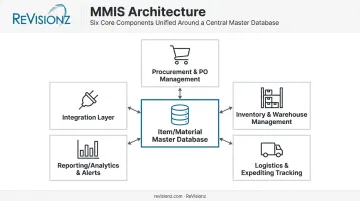
A functioning MMIS combines several connected components that share a common data foundation.
| Component | What It Does |
|---|---|
| Item/Material Master Database | The single source of truth for material specs, tags, and classifications used across engineering, procurement, and maintenance |
| Procurement & PO Management | Manages requisitions, purchase orders, supplier records, and contract terms |
| Inventory & Warehouse Management | Tracks stock levels, storage locations, receiving, and issuing to job sites or production lines |
| Logistics & Expediting Tracking | Monitors shipment status, delivery timelines, and material readiness against schedules |
| Reporting, Analytics & Alerts | Delivers dashboards and automated alerts for reorder points, shortages, and compliance exceptions |
| Integration Layer | APIs and connectors linking MMIS to ERP, engineering systems, and field execution tools |
The Material Master Is Non-Negotiable
The item or material master database deserves special attention. SAP describes the material master as the central repository for materials an enterprise procures, produces, and stocks — with fields supporting purchasing, engineering specs, planning, and accounting simultaneously.
Without a clean material master, every other component inherits bad data. Duplicate part numbers, inconsistent classifications, and missing specs cascade into procurement delays and warehouse confusion.
The integration layer carries its own weight too. Process and energy industries often run complex tech stacks, combining SAP or Oracle ERP with engineering platforms like Hexagon or AVEVA. An MMIS that can't communicate with these adjacent systems becomes just another data silo.
Types of Materials Management Information Systems
Not every organization needs the same MMIS setup. Three general categories dominate the market today.
Standalone/Best-of-Breed MMIS Dedicated materials management software not tied to a broader ERP. Organizations choose this route when they need specialized, engineering-grade tracking — particularly on complex capital projects where requisition-line-item detail matters more than financial reporting depth.
ERP-Embedded MMIS Modules Materials functionality built directly into ERP suites like SAP S/4HANA or Oracle Cloud. These offer tight financial integration since inventory, purchasing, and accounting share the same database. The tradeoff is often reduced depth for engineering-specific data like MTOs or component-level traceability.
Cloud-Based & AI-Powered MMIS Modern SaaS platforms delivering real-time visibility, predictive analytics, and remote access. Multi-site owner-operators managing distributed assets increasingly favor these platforms, and the shift is already visible in the market.
ENR reported that DPR Construction began enterprise-wide deployment of an AI-driven procurement and material-tracking platform in early 2025. The platform connects directly to ERP data, estimating systems, and project schedules rather than replacing them.
None of these types is universally "better." The right choice depends on project complexity, existing systems, and how much engineering-grade granularity your operations actually require.
Primary Functions of an MMIS
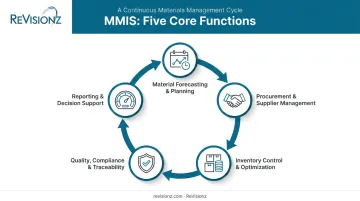
Strip away the software labels, and every MMIS exists to perform five core functions.
- Material Forecasting & Planning: Predicts future material needs using project schedules, maintenance plans, or historical usage patterns.
- Procurement & Supplier Management: Automates purchase orders, tracks supplier performance, and manages lead times to prevent delays.
- Inventory Control & Optimization: Maintains stock levels that avoid both shortages (which halt operations) and excess inventory (which ties up capital).
- Quality, Compliance & Traceability: Tracks certifications, material test reports (MTRs), and regulatory documentation.
- Reporting & Decision Support: Generates dashboards that inform planning, budgeting, and audit readiness.
Traceability Isn't Optional in Regulated Sectors
Function four deserves extra weight in regulated industries. ASME and National Board certification guidance checks whether material identification stays visible on pressure-retaining parts, whether MTRs link back to the job and purchase order, and whether quality records get retained for at least five years.
Food and beverage manufacturers face a parallel requirement: FDA's Food Traceability Rule mandates that companies handling listed foods maintain Key Data Elements for specified Critical Tracking Events and produce those records on request.
An MMIS that can't produce this chain of custody on demand exposes the business to real compliance risk.
MMIS vs. ERP: Why the Distinction Matters for Asset-Intensive Industries
Here's a mistake owner-operators make often: assuming ERP alone covers material management needs. It doesn't, at least not fully.
ERP systems manage broad enterprise resources, including finance, HR, and general supply chain. MMIS is purpose-built for granular, engineering-grade material tracking. Together, the two address different needs: enterprise breadth and engineering depth.
| ERP Materials Module | Specialized MMIS | |
|---|---|---|
| Data scope | Enterprise master data shared across purchasing, accounting, planning | Requisition-line-item tracking from takeoff through field installation |
| Primary strength | Financial and organizational integration | Engineering digital thread, schedule alignment, expediting |
| Best fit | Standard purchasing and inventory processes | Complex capital projects with high material specificity |
MMIS typically integrates with or complements ERP rather than replacing it, particularly on capital projects where engineering material volume outpaces what standard ERP fields were designed to capture.
This is where specialized materials management expertise earns its keep. ReVisionz's Materials Management Practice, expanded in late 2024 to meet growing demand, turns raw, unstructured material data into structured, lifecycle-ready information.
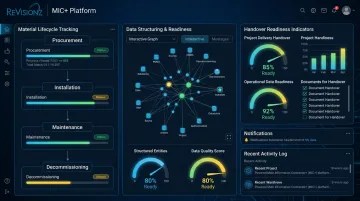
The company's AI-powered Main Information Contractor+ (MIC+) service extends this work, helping organizations bridge the gap between project delivery and operational readiness. That same challenge drives industry standards like CFIHOS, which define standardized data models and spares information requirements for handover.
Before selecting or upgrading an MMIS, though, assess your current data maturity and system landscape first. Integration complexity, not software features, tends to determine whether these projects succeed.
Frequently Asked Questions
What is a materials management information system?
An MMIS is software that integrates procurement, inventory, and usage data to track materials throughout their entire lifecycle. It gives project and operations teams one connected view of material status.
What are the main components of a materials management information system?
Core components include the item/material master database, procurement and inventory modules, logistics tracking, and reporting/integration capabilities. Together, they create a single, reliable source of material data across the project.
What are the types of materials management information systems?
The three main types are standalone/best-of-breed systems, ERP-embedded modules, and cloud/AI-powered platforms. Each fits different levels of project complexity and integration needs.
What are the primary functions of a materials management information system?
Primary functions include forecasting, procurement management, inventory control, and compliance/traceability tracking. A fifth function, reporting, ties these together for decision-making.
How is an MMIS different from an ERP system?
MMIS focuses on granular, engineering-grade material tracking, while ERP manages broader enterprise resources like finance and HR. Most capital projects run both systems together rather than choosing one over the other.
Why is MMIS important for capital-intensive industries like oil & gas and manufacturing?
MMIS reduces project delays, controls material costs, and supports lifecycle-ready data handover from project teams to operations. Without it, organizations risk the visibility gaps and schedule overruns that plague poorly tracked capital projects.