The problem isn't the volume. It's the gap between what's on paper (or in a server folder) and what's actually happening in the field. Fragmented storage, outdated revisions, and documents disconnected from physical assets remain persistent issues, even at companies that already own a document management platform.
This article breaks down what document management actually means in oil & gas, the document types that matter most, proven best practices, common pitfalls, and how asset information strategies are closing the gap between paper and plant.
Key Takeaways
- Poor document control creates rework and downtime, then escalates into real regulatory exposure
- Safety and compliance documents carry higher risk than commercial records, so priorities should differ accordingly
- Centralized systems with version control and built-in workflows outperform siloed folder structures
- Closing the gap between MOC/turnaround events and master documentation is the biggest structural challenge
- AI-enabled data services are starting to automate migration and enrichment at scale
What Is Document Management in Oil & Gas?
Document management in this industry refers to the systems and processes used to capture, store, control, version, and distribute documents tied to physical assets across their lifecycle — from front-end engineering through decommissioning.
That's a broader job than it sounds. A document management system (DMS) has to hold onto not just files, but the context connecting each file to a piece of equipment, a location, or a maintenance event.
Common approaches in practice include:
- Traditional EDMS platforms built for engineering document control, revision tracking, and transmittals
- Cloud-based content management systems offering broader accessibility but often weaker asset context
- Integrated Asset Information Management (AIM) platforms that tie documents directly to structured asset data, tags, and hierarchies
Basic file storage and true document management aren't the same thing. Storing a PDF in a shared drive tells you nothing about which pump it belongs to, whether it's the current revision, or who approved it last.
Leading operators are moving past file-centric thinking entirely. They treat documents as structured data linked to the physical asset, not isolated attachments.
Why Document Management Is Mission-Critical in Oil & Gas
Engineering drawings, HSE records, permits, maintenance logs — the documentation footprint of a single facility spans nearly every discipline on site. Most oil and gas companies sit on vast volumes of semi-structured data, and accessibility, integration, and data quality remain persistent obstacles, according to McKinsey's analysis of oil and gas digitization.
The Operational and Safety Stakes
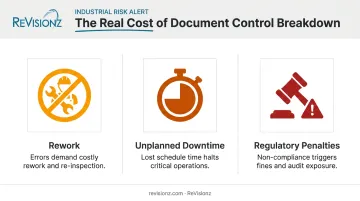
When document control breaks down, the consequences show up fast:
- Rework from technicians acting on outdated drawings or superseded procedures
- Unplanned downtime while teams track down the current revision of a critical document
- Regulatory penalties tied to incomplete or unverifiable records during inspections
The safety consequences can be far more severe. The U.S. Chemical Safety Board's 2024 investigation into the BP-Husky Toledo refinery incident found no written procedures or documented corrective actions for handling a high liquid level in a fuel gas mix drum.
A missing shift log and inadequate handover compounded the problem. The result: a naphtha release, a vapor cloud, a fire, and two workers killed.
The CSB concluded that effective management of change and better abnormal-situation documentation could have interrupted the chain of events before it became fatal.
Document-to-Asset Drift
This is the quieter version of the same problem. MOC events, turnarounds, retrofits, and contractor modifications update the physical asset, but master documentation doesn't always follow. Over years, the gap between what's built and what's documented widens.
Multi-site, multi-contractor operations make this worse. Every onshore/offshore split and every additional contractor is another place where a document can go stale without anyone noticing.
Types of Documents Oil & Gas Companies Must Manage
Documentation in this industry falls into four broad categories, each with its own controls and risk profile:
| Category | Examples |
|---|---|
| Engineering/technical | P&IDs, isometrics, datasheets, material and energy balances |
| Operational | SOPs, permits-to-work, work orders, startup/shutdown procedures |
| Safety/compliance | HSE records, process hazard analyses, inspection reports, training logs |
| Commercial/contractual | Vendor manuals, transmittals, contracts, handover packages |
OSHA's process safety management standard names most of the engineering, operational, and safety categories explicitly: think block flow diagrams, safe operating limits, and mechanical integrity records under 29 CFR 1910.119. Commercial handover, meanwhile, is increasingly governed by CFIHOS, the industry-origin standard for structuring contract and information deliverables.
Turning Unstructured Documents Into Usable Data
A large share of this documentation exists as scanned PDFs, CAD files, and spreadsheets: technically digital, but not searchable or usable without work. Getting there requires OCR, metadata tagging, or manual enrichment before the content becomes queryable.
When planning a digitization initiative, prioritize:
- Safety and compliance documentation first, since it carries the most direct risk
- Engineering/technical records tied to active or high-criticality assets
- Operational documents in daily use by field teams
- Commercial/contractual records last, unless a handover deadline forces the sequence
Core Best Practices for Document Management in Oil & Gas
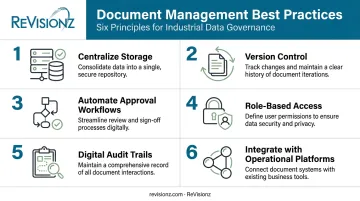
Six practices consistently separate organizations with reliable document control from those firefighting version confusion.
Centralize storage in a single, structured repository. Departmental and site-level silos are where compliance violations and inconsistent handling start. Every authorized stakeholder should be pulling from the same source, not five different shared drives with five different "latest" versions.
Implement rigorous version control. Check-in/check-out, revision history, and superseded-document handling ensure field personnel always work from the current approved revision — not last year's copy someone printed and never replaced.
Automate approval workflows. Manual routing creates bottlenecks in MOC and permit-to-work packages precisely when speed matters most. Workflow automation removes the guesswork about who needs to sign off next.
Enforce role-based access permissions. Sensitive documents need governed access, including temporary, controlled access for contractors and regulators who need visibility without full editing rights.
Maintain digital audit trails. Effective dates, approval lineage, and retention policies support ISO certifications and make regulatory inspections dramatically less painful. ISO 9001:2015 explicitly requires control of documented information as part of a functioning quality management system.
Integrate with operational platforms. When a document system connects to CMMS/EAM and asset hierarchy tools, technicians can pull the right document directly from a work order instead of hunting through a separate system.
That last point matters more than it might seem. Consolidating documents without connecting them to operational context just creates a bigger silo. On one LNG operator engagement, ReVisionz helped consolidate more than 800,000 documents and 300,000 tags into a structured, accessible system. That scale makes clear why manual reconciliation stops working somewhere around a few thousand records.
Overcoming Common Document Management Challenges
Even organizations that adopt these six practices run into recurring friction points.
Folder Structures Don't Match How Field Teams Think
Office-style nested directories organize documents by department or date. Field teams think in terms of physical location and asset. Organizing documentation around asset context (this pump, this unit, this line) rather than a folder tree closes that gap and cuts search time.
Legacy Paper Archives
Decades of paper records sitting in filing cabinets or scanned-but-unindexed PDFs are common in mature facilities. Digitizing with OCR and metadata tagging turns these archives into searchable, usable records instead of dead weight.
The MOC-to-Documentation Gap
This is the challenge that connects back to document-to-asset drift. Closing it requires a closed-loop process:
- Trigger a documentation update task automatically when MOC and turnaround events occur, not as an afterthought
- Verify updates against as-built conditions before marking the record current
- Retire superseded versions formally instead of leaving them in a folder to confuse the next person
Without that loop, master records slowly diverge from reality until an inspection or an incident exposes the gap.
Building a Future-Ready Document Management Strategy
The industry is shifting from siloed file storage toward a holistic Asset Information Management approach that treats documents as structured, lifecycle-ready data tied directly to physical assets, rather than files managed in isolation.
Technology-Agnostic, Not Platform-Locked
A strategy built around business capabilities and governance (rather than any single software platform) lets organizations work across EDMS, CMMS, and digital twin tools without getting locked into one vendor's roadmap. That flexibility matters over a 20- or 30-year asset lifecycle, when the software landscape will almost certainly change more than once.
Where AI Fits
AI-powered services are starting to automate data migration, enrichment, and quality control at a scale manual teams can't match.
ReVisionz's Main Information Contractor+ (MIC+) service, launched in December 2025, applies AI and natural language processing to detect and correct data gaps. It also aligns records to standards like CFIHOS and prepares load files for systems such as SAP PM and Maximo.
As Kirk Gibson, President of ReVisionz North America, put it at launch: "Most providers stop at handover, but the real challenge begins once a facility moves into operations. With Main Information Contractor+, we stay with clients beyond delivery."
That's the gap that trips up most organizations — not the initial system rollout, but sustaining accuracy years after go-live.
A Phased Roadmap
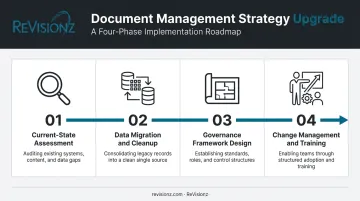
Organizations upgrading their approach tend to follow a similar sequence:
- Current-state assessment: understand what exists, where it lives, and how bad the gaps really are
- Data migration and cleanup: consolidate and correct records before building new workflows on top of bad data
- Governance framework design: define ownership, review cycles, and retention policy
- Change management and training: technology alone doesn't drive adoption; people do
ReVisionz has spent 25 years helping owner-operators bridge exactly this gap between project delivery and operational readiness, across engineering document management, materials governance, and AI-enabled data services.
Frequently Asked Questions
What is a document management system?
A document management system is software and process infrastructure used to capture, store, secure, and control documents throughout their lifecycle. In oil & gas, it directly supports safety and regulatory compliance.
What is an example of a document management system?
Common categories include cloud-based content platforms, engineering-specific EDMS tools, and integrated Asset Information Management platforms that connect documents to structured asset data.
What are the 4 types of documentation?
In oil & gas, documentation typically falls into four categories: engineering/technical, operational, safety/compliance, and commercial/contractual records.
What documents should oil & gas companies prioritize digitizing first?
Safety-critical and compliance documents (P&IDs, SOPs, and inspection records) should come first, given their direct link to operational risk and regulatory exposure.
How does document management support regulatory compliance in oil & gas?
Version control, audit trails, and controlled access let organizations demonstrate compliance quickly during inspections and reduce the risk of penalties tied to incomplete or outdated records.
How often should a document management system be reviewed or updated?
Reviews should be tied to major MOC events, turnarounds, or regulatory changes, plus routine governance audits to keep the system aligned with day-to-day operational needs.