
Fragmented systems, disconnected handover packages, and unreliable asset records don't announce themselves with alarms. They quietly erode safety margins, compliance postures, and profitability, one bad record at a time.
This article defines poor data governance, breaks down its real financial and operational costs, and shows how owner-operators and EPCs can start fixing it before the next capital project or turnaround exposes the gaps.
Key Takeaways
- Poor data quality costs organizations at least $12.9 million per year on average
- Knowledge workers lose up to 50% of their time hunting for or correcting bad data
- Asset-intensive industries face amplified risk because data spans systems, EPCs, and lifecycle stages
- Governance failures directly stall digital twin, AIM, and predictive maintenance ROI
- Fixing it starts with ownership, standardization, and the right enrichment technology
What Is Poor Data Governance?
Data governance is the system of policies, standards, and accountability that determines how data is created, accessed, maintained, and retired across its lifecycle. It answers who owns what data, how quality gets enforced, and what happens when something breaks.
Poor data governance is the absence of that structure. Ownership isn't assigned, standards aren't enforced, and lifecycle discipline doesn't exist. Data exists, but nobody can vouch for it.
Common markers include:
- Disconnected data silos across departments and systems
- Inconsistent definitions — the same asset means something different to engineering than it does to maintenance
- No designated ownership for critical data domains
- Weak compliance controls that don't catch errors before they matter
- No lifecycle management policy to govern data from creation to decommissioning
In engineering and asset environments, this shows up as conflicting equipment tags between the EAM and ERP systems, incomplete P&IDs missing revision history, or the same pump appearing as three different asset records depending on which system you query. For many maintenance planners, that's just another Tuesday.

Signs Your Organization Has a Data Governance Problem
Some signs are obvious, while others hide in workarounds your team has normalized.
Data Inconsistencies Across Systems
Duplicate or conflicting equipment records between engineering, maintenance, and operations systems are the clearest red flag. If your reliability engineer and your project engineer are looking at different "truths" for the same tag, governance has already failed.
Lack of Clear Data Ownership
Without designated stewards for critical asset information, errors go unaddressed for months or years. Nobody feels responsible for fixing what nobody owns.
Inefficient Data Processes
Watch for these operational tells:
- Manual reconciliation between spreadsheets and systems of record
- Slow data retrieval during audits or turnarounds
- Heavy rework at the start of every capital project
- Staff building personal "shadow" trackers because they don't trust the official system
If your team spends more time verifying data than using it, the underlying issue is governance, not efficiency.
The Real Business Impact of Poor Data Governance
The costs of poor governance show up in concrete places: income statements, incident reports, and boardroom slides.
Financial Impact
Poor data quality costs organizations at least $12.9 million per year on average, according to Gartner's research on data quality. IBM's 2023 research adds detail: more than a quarter of organizations estimated annual losses above $5 million, and 7% reported losses of at least $25 million.
For asset-intensive operators, this shows up as missed billing on capital equipment, duplicated procurement spend, and rework during audits, costs that compound across every site and every system.
Operational Inefficiencies and Lost Productivity
Bad data costs time as well as money, the kind that never shows up on a budget line until someone tallies it.
Research cited by Harvard Business Review found that studies showed knowledge workers waste up to 50% of their time locating data, correcting errors, or confirming information they don't trust in the first place.
In an engineering environment, that translates to:
- Planners cross-checking three systems before scheduling a work order
- Engineers rebuilding equipment lists from scratch instead of pulling them from a master register
- Turnaround teams discovering, mid-shutdown, that the P&ID doesn't match the field
Safety Risks and Compliance Violations
This is where poor governance stops being an efficiency issue and becomes a safety issue.
OSHA's Process Safety Management standard requires employers to maintain accurate process-safety information, including P&IDs, materials of construction, and relief-system design data. When that information is incomplete or outdated, compliance gaps follow, and incidents often follow close behind.
The Chevron Richmond refinery fire in August 2012 illustrates the point. A pipe ruptured and released flammable hydrocarbons, engulfing 19 workers and sending roughly 15,000 community members to seek medical treatment.
The U.S. Chemical Safety Board's investigation found that historical inspection data had been collected on higher-silicon fittings, not the low-silicon component that ultimately failed. Management concluded the piping was safe for continued operation based on data that didn't represent the failed component, and recommended 100% inspections were never performed.
The real failure was unrepresentative asset data distorting a mechanical integrity judgment call, with consequences that reached far beyond the fence line.
Reputational Damage and Eroded Trust
Reputational damage is the slow bleed of public and investor trust, and it rarely announces itself.
The UK Post Office Horizon scandal offers a stark example. Fujitsu's Horizon accounting system generated inaccurate shortfall records in branch accounts between 1999 and 2015, and those unreliable records contributed to hundreds of sub-postmasters being wrongfully prosecuted for theft and fraud.
The fallout included a statutory public inquiry, parliamentary scrutiny, and three consecutive days of declines in Fujitsu's share price once the scale of the failure became public. No one hacked the data; it was simply unreliable, and nobody caught the problem in time.
Flawed Decision-Making
Bad data can also steer entire strategic decisions off a cliff, well beyond routine operational friction.
Target's Canadian expansion is a well-documented case. Reuters reported that barcodes on many products entering Target Canada's warehouses didn't match the company's inventory system, contributing to warehouse logjams and poorly stocked shelves.
Target exited Canada after less than two years, closing all 133 stores, with roughly $1.7 billion in operating losses and a $5.4 billion pretax charge tied to the exit. Inexperienced staffing and rapid expansion played a role too, but mismatched system data was a material driver of the collapse.

Why Poor Data Governance Hits Asset-Intensive Industries Harder
Every industry deals with bad data. Asset-intensive industries deal with a different order of magnitude.
Capital Projects Generate Enormous Data Volumes
A single capital project can produce hundreds of thousands of tags and documents (P&IDs, 3D models, equipment specs, and maintenance history) that must transfer cleanly from EPC to operator. NIST estimated the annual cost of inadequate interoperability in the US capital-facilities industry at $15.8 billion, with over $9 billion of that hitting operations and maintenance directly. Information needed for daily operations often gets overlooked simply because it wasn't required to finish construction.
Digital Twins and Multi-System Environments Compound the Problem
A digital twin built on incomplete or duplicated data can't deliver trustworthy decisions. Gartner has noted that many industrial digital twins remain stuck at a "foundational" level, providing situational awareness but never advancing to predictive or prescriptive value, largely because the underlying data infrastructure isn't there yet.
The problem compounds when multiple systems enter the picture. Operators running SAP, Maximo, Hexagon, and AVEVA simultaneously don't have one data governance problem. They have four, and they overlap. Reconciling asset records across engineering, maintenance, and ERP systems is exponentially harder than governing data in a single-platform business.
Poor Governance Raises Costs and Blocks Predictive Maintenance ROI
Every duplicate record, every rework cycle, every failed audit adds to the total cost of ownership for physical assets (the exact metric that governed, lifecycle-ready data is meant to bring down).
That same gap shows up in predictive maintenance ambitions. McKinsey research found that digitally enabled reliability programs can improve asset availability by 5% to 15% and cut maintenance costs by 18% to 25%. Yet only half of maintenance managers said their IT/OT architecture actually supported those processes. Inconsistent asset naming, free-text maintenance logs, and data trapped in spreadsheets are the barriers standing between operators and that ROI.
Building a Data Governance Framework That Actually Works
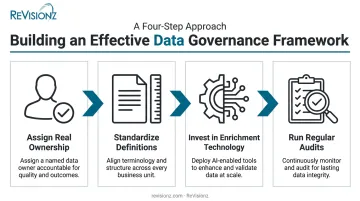
Fixing governance is an ongoing discipline, not a one-time cleanup project. Here's where to start:
- Assign real ownership. Designate data stewards for engineering, maintenance, and operations domains — not IT alone. Domain experts understand what "correct" actually looks like for a given asset class.
- Standardize definitions across the lifecycle. Align data policies to each stage, from design through decommissioning, so a tag means the same thing in every system that touches it.
- Invest in the right enrichment technology. AI-powered tools can identify, cleanse, and enrich legacy engineering data at a scale manual review simply can't match.
- Run regular data audits. Catch inconsistencies before they surface during a compliance audit, a turnaround, or a capital project schedule crunch.
Most organizations don't have the in-house bandwidth to do this work on top of running daily operations. That gap is exactly what ReVisionz's Main Information Contractor+ (MIC+) service was built to close.
MIC+ is a technology-agnostic, AI-powered approach that consolidates data from systems like CMMS, historian/PI, and inventory platforms. It transforms unstructured asset data into lifecycle-ready, governed information without adding to your team's workload.
Frequently Asked Questions
What is poor data governance?
Poor data governance is the absence of consistent policies, ownership, and quality controls for organizational data. It leads to inaccurate, inconsistent, or insecure information across systems and departments.
What are examples of data governance?
Examples include data quality standards, access control policies, defined data stewardship roles, and audit or compliance frameworks such as DAMA-DMBOK. Master data management for equipment and materials is another common example in asset-intensive industries.
What are the warning signs of poor data governance in an organization?
Key indicators include duplicate or conflicting records across systems, no clear data ownership, and reliance on manual workarounds to reconcile information. Slow data retrieval during audits is another common tell.
How does poor data governance impact regulatory compliance in asset-intensive industries?
Inaccurate asset and process safety data increases the risk of failed audits and regulatory fines, sometimes escalating to safety incidents. OSHA's Process Safety Management standard specifically requires accurate, current equipment and process data.
Can poor data governance affect digital transformation and AI initiatives?
Yes. Digital twins, predictive maintenance, and analytics programs depend entirely on clean, governed data. Feed them incomplete or duplicated information and the outputs become unreliable, no matter how sophisticated the algorithm.
How can a company start improving its data governance?
Start by assigning clear data ownership, running a baseline data audit to understand current gaps, and standardizing definitions before scaling to new systems or sites. Governance built on a shaky foundation just multiplies the problem.