
That gap creates a real problem. Without a clear way to measure what data is actually worth, digital transformation budgets become guesswork. Leadership teams struggle to prioritize which data initiatives deserve funding, and IT projects compete for dollars against tangible capital work that's easier to justify.
This guide breaks down what data assets actually are, the proven methods for measuring their value, the factors that make that value rise or fall, and the practical strategies asset-intensive organizations use to protect and grow it.
Key Takeaways
- Data assets are valued using income, cost, and market-based approaches.
- Quality, accessibility, lifecycle context, and governance determine extractable value.
- Poorly managed "data debt" erodes value faster than new data creates it
- Converting legacy engineering data into lifecycle-ready formats is the fastest path to value.
What Are Data Assets—and Why Do They Matter for Asset-Intensive Industries?
A data asset is a structured collection of data elements grouped to support a business function. ISO 55013:2024 defines it more precisely as data that's managed to provide value to an organization and its stakeholders.
In engineering and operational contexts, that definition gets concrete fast. Examples include:
- Piping and instrumentation diagrams (P&IDs)
- Asset registers and equipment tag data
- Inspection and mechanical integrity reports
- Digital twin models and 3D design environments
- Maintenance logs and work order histories
Strategic vs. Operational Data Assets
Not all data assets carry the same weight for decision-makers. It helps to separate them:
| Data Asset Type | Purpose | Examples |
|---|---|---|
| Strategic | Feeds portfolio-level decisions | Asset performance benchmarking across sites, long-term reliability trending for capital planning |
| Operational | Supports day-to-day work | Daily maintenance logs, inspection tickets, shift handover notes |
Executives care about strategic data because it shapes capital allocation. Maintenance and reliability teams care about operational data because it keeps equipment running. Both matter, but for different reasons and different audiences.
Why Quantifying Data Value Matters
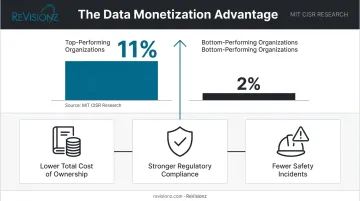
Treating data as a monetized asset produces measurable results. According to MIT CISR's 2024 survey of 349 senior leaders, top-performing organizations attributed 11% of revenue to data monetization, compared with just 2% among bottom performers, a statistically significant gap.
That's a cross-industry finding, not an asset-intensive-sector guarantee. Still, it makes a strong case: organizations that quantify data value get better at prioritizing where to invest.
For capital-intensive industries specifically, better-valued data translates into:
- Lower total cost of ownership across the asset lifecycle
- Stronger regulatory compliance postures
- Fewer safety incidents tied to incomplete or outdated engineering information
How to Measure the Value of Data Assets
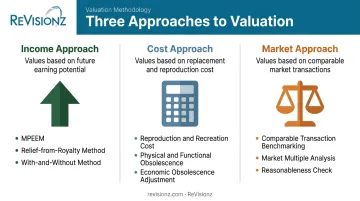
There's no single universal formula for valuing data. Instead, organizations adapt established intangible-asset valuation practices, most of which fall into three categories recognized by the International Valuation Standards (IVS), effective January 2025: income, cost, and market approaches.
None of these methods works in isolation. Each gets layered with qualitative factors, like data quality, completeness, and business relevance, to produce a defensible number.
Income Approach
This method converts the future benefits attributable to a data asset into present value. Three variations show up most often:
- Multi-period excess earnings method (MPEEM): isolates the cash flow attributable to the data asset after accounting for returns owed to other required assets
- Relief-from-royalty method: values the hypothetical royalty payments avoided by owning the data instead of licensing it
- With-and-without method: compares business performance with the asset in place versus without it
A practical example: valuing a digital twin's contribution by comparing operational costs and unplanned downtime at a facility with accurate, current asset data against a comparable facility running on outdated or incomplete records. The delta is the value the data asset is creating.
Cost Approach
This method asks a simpler question: what would it cost to recreate this data asset today? For engineering data, that means pricing out:
- Re-surveying physical assets in the field
- Redrawing P&IDs from scratch
- Re-migrating legacy engineering records into current systems
The result gets adjusted for technological and economic obsolescence, since recreating a 1990s-era paper drawing archive isn't the same as building a modern, tag-linked digital equivalent.
Market Approach
This approach benchmarks against comparable data transactions or licensing deals. It's the weakest of the three for proprietary engineering and asset data, because comparable transactions are rarely observable for highly specific, plant-level datasets. IVS itself notes that intangible assets are heterogeneous, so identical-asset transactions are uncommon.
That doesn't make the market approach useless. It works best as a reasonableness check, a way to sanity-test numbers produced by the income or cost methods rather than a standalone valuation.
Key Factors That Influence Data Asset Value
Five factors consistently determine how much value an organization can actually pull from its data.
Data quality and accuracy. Incomplete or outdated engineering data undermines confidence in safety-critical decisions. A P&ID that doesn't match field conditions becomes a liability waiting to surface during a turnaround or incident investigation.
Accessibility and usability. Data trapped across siloed design tools, maintenance systems, and dusty archive shelves has value on paper but delivers none in practice until it's centralized and retrievable.
Lifecycle stage and context. The same dataset carries different weight depending on where it sits in the asset lifecycle:
- During design and construction, data supports engineering decisions and change control
- At commissioning, it supports startup safety and readiness checks
- In long-term operations, it drives maintenance planning and reliability strategy
Handover readiness between these stages is where a lot of value gets lost or preserved.
Governance, compliance, and risk exposure. Regulatory frameworks like OSHA's process safety management standards require complete and accurate process safety information, including P&IDs and mechanical integrity records. Poor governance here creates a compliance and safety risk with real financial exposure attached.
Scarcity and business relevance. Proprietary operational data, like equipment failure histories or unique performance benchmarks built over years of operation, often carries more strategic value than generic datasets you could simply purchase elsewhere.
Strategies to Maximize Data Asset Value
Knowing how to value data is only half the equation. Protecting and growing that value requires deliberate action across five areas.
Establish strong data governance. Clear ownership, defined data standards, and quality controls prevent slow value erosion. This means assigning accountability so the people creating and relying on asset information also own its accuracy, not treating data quality as a once-a-year cleanup project.
Invest in structured migration and enrichment. Unstructured legacy engineering data (boxes of scanned drawings, disconnected spreadsheets, orphaned files) needs a proven methodology to become lifecycle-ready information.
ReVisionz's data migration and enrichment work demonstrates this at scale:
- Migrated 800,000+ documents with version histories intact for one asset owner
- Consolidated content from dozens of siloed systems into a standardized Asset Information Management architecture for another
- Extended support through the AI-powered Main Information Contractor+ (MIC+) service, which repairs data gaps and keeps information aligned from project delivery into long-term operations
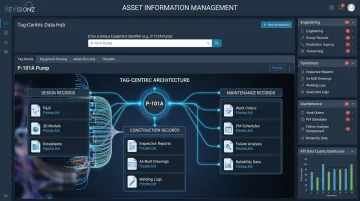
Break down data silos. A tag-centric information architecture anchors design specs, construction records, and maintenance data to unique equipment identifiers. This lets engineering, operations, and maintenance teams pull from the same source instead of hunting across disconnected systems. Standards like CFIHOS support this by giving projects a common structure instead of reinventing an information model each time.
Enable real-time analytics and predictive maintenance. Static, historical records only create value once they inform forward-looking decisions. Organizations that move from reactive maintenance toward condition-based monitoring and predictive analytics convert stagnant data into reduced downtime and lower lifecycle costs.
Build a data-driven culture. Even flawless data delivers limited value if teams don't trust or use it. Change management and user adoption programs matter as much as the technology itself.
Data Debt: The Hidden Cost of Undervalued Data
Data debt is the accumulated cost of poor data lifecycle management: quality issues left unfixed, compliance gaps left unresolved, and security risks left unaddressed. One useful way to track it is a data debt leverage ratio, weighing a data asset's current value against the cost of the debt attached to it.
If the ratio tips toward debt, the asset becomes a liability rather than a resource.
For asset-intensive industries, the stakes are higher than a messy spreadsheet:
- Outdated engineering data can contribute directly to safety incidents during maintenance or turnaround work
- Compliance failures follow when process safety information doesn't match field reality
- Rework costs spike when capital project teams discover gaps mid-execution instead of before
This pattern shows up across the industry, not just in isolated projects. ISO 55013 confirms the directional risk: data-asset value tends to deteriorate with age, often faster than physical assets, because information becomes outdated while the equipment it describes keeps changing.
No universal percentage exists for how fast that decay happens. But the pattern holds across engineering environments: the longer inaccurate data sits unmaintained, the more expensive it becomes to trust or fix later.
Proactive enrichment and governance function as ongoing value protection, not routine maintenance. Skip them, and data debt will outpace the value your data creates.
Frequently Asked Questions
How do you value data assets?
Data assets are typically valued using income, cost, or market-based approaches, often combined with qualitative assessments of quality, completeness, and business relevance. No single method works alone for engineering and operational data.
What is an example of a data asset?
In general business contexts, examples include customer records and transaction histories. In asset-intensive industries, they range from P&IDs and asset registers to digital twin models and maintenance logs.
What is data debt, and how does it affect data value?
Data debt is the accumulated cost of poor data management, unresolved quality issues, and compliance gaps. Left unmanaged, it erodes the net value of a data asset faster than new data can rebuild it.
Why does data valuation matter for digital transformation programs?
Quantifying data value helps organizations prioritize which initiatives deserve investment and gives leadership a business case grounded in numbers rather than assumptions. It turns abstract "digital transformation" into a fundable, measurable program.
What's the difference between data governance and data valuation?
Governance manages how data is controlled, maintained, and kept accurate over time. Valuation quantifies the economic or strategic worth of that data. One protects value; the other measures it.
How can asset-intensive industries maximize the value of their engineering and operational data?
Structured data migration and enrichment, integrated Asset Information Management systems, and predictive analytics are the key levers. Specialized partners like ReVisionz can accelerate this work at scale across complex, multi-site operations.