Introduction
Aging pipelines, retiring engineers, and tightening regulations are colliding at the same time. Many energy operators are stuck running reactive maintenance programs built for a workforce and asset base that no longer exists.
That's beginning to change. Intelligent asset management (IAM) in energy fuses AI, IoT sensors, and unified data platforms to shift operations from "fix it when it breaks" to "predict it before it fails." This applies across oil & gas, power generation, and utilities alike.
The pressure is real. IDC predicts that 40% of utilities will implement generative AI by 2026, improving equipment restoration times by 30%. This guide unpacks where those trends are headed in 2026, giving owner-operators and EPCs concrete ways to cut downtime and make faster, data-backed calls.
Key Takeaways
- AI orchestration layers now enhance, not replace, existing SCADA and EAM systems
- Digital twins are becoming the single source of truth for physical assets
- Agentic AI is stepping into gaps left by retiring subject matter experts
- IoT sensors are replacing static asset scoring with real-time condition data
- Clean, lifecycle-ready data determines whether every other IAM investment pays off
Key Trends Shaping Intelligent Asset Management in Energy (2026)
Trend 1: AI-Driven Predictive Maintenance and Orchestration Layers
Most energy operators already run SCADA, EAM, and GIS systems. Data isn't the problem. The real issue is that it lives in silos that never talk to each other. Orchestration layers solve this by sitting on top of existing infrastructure, pulling fragmented feeds into one operational view without a rip-and-replace project.
Transmission and distribution operators are increasingly layering AI for fault detection and adaptive maintenance planning across their networks, according to ENTSO-E's technology overview. The payoff is measurable:
- Deloitte reports predictive maintenance can deliver 10%-40% lower maintenance costs
- The same programs can cut downtime by 30%-50%
- IDC's forecast ties generative AI adoption directly to 30% faster restoration times
This is orchestration, not replacement. The value lies in connecting what already exists rather than tearing it out.
Trend 2: Digital Twins as the Single Source of Truth
A digital twin combines the 3D engineering model, live telemetry, and maintenance history into one continuously updated view of a physical asset. Instead of a static drawing filed away after commissioning, it becomes a living reference operators actually use.
Equinor's Echo environment illustrates the concept well. It links a 3D representation of offshore assets with ongoing project and operations data, supporting teams through both design and daily work.
At Johan Sverdrup, personnel used the twin in daily operations. Equinor attributed more than NOK 2 billion in first-year additional value to its digital technologies collectively.
Adoption is accelerating fast. IDC projects that 50% of utilities will implement digital twins by 2027, cutting unplanned outages by roughly 30%. That kind of adoption curve doesn't happen without a genuine ROI case behind it.
The catch: a digital twin is only as trustworthy as the data feeding it. Standards like CFIHOS exist specifically to make sure engineering data and documents transfer cleanly from contractor to operator, which is exactly the handover point where most twins either succeed or quietly fall apart.
Trend 3: Agentic AI Augmenting a Retiring Workforce
Energy's skills problem isn't hypothetical. IEA's 2025 World Energy Employment report flags electricians, pipefitters, line workers, plant operators, and nuclear engineers as especially scarce roles. 40% of surveyed employers said they've had to raise salary offers just to fill positions.
AI agent networks are stepping into that gap, not to replace experienced engineers but to compress the manual analysis that used to take weeks into a matter of minutes. Think interpreting siloed sensor data, cross-referencing maintenance history, and recommending a repair window.
Industry conferences are picking up on this shift too. The September 2026 Intelligent Asset Management in Energy Summit lists "Augment your Workforce" as a headline theme, right alongside data-driven decision-making. It reflects a direct response to the retirement wave already underway.
Trend 4: IoT-Enabled Real-Time Condition Monitoring
Traditional asset scoring relies on age and last-inspection date. It's a rough proxy, and it misses a lot. Dynamic health models replace that guesswork with real-time telemetry, environmental data, and actual usage patterns.
The results speak for themselves. Equinor's machine-learning maintenance system detected more than 200 failures on heavy rotating equipment in 2022, saving the company millions of Norwegian kroner. The system draws on data from over 18,000 sensors across more than 30 offshore and onshore installations.
Shell's program offers a similar picture:
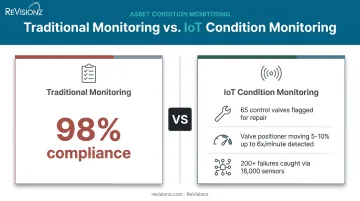
- Flagged 65 control valves for repair at a Netherlands refinery
- Caught a valve positioner moving 5%-10% up to six times per minute on a Gulf of Mexico platform
- The same valve showed 98% compliance under traditional monitoring, proof that condition monitoring catches what static checks miss
Rotating equipment and pumps are where this shift shows up first, largely because failures there are expensive and dangerous.
Trend 5: AI-Powered Asset Information Management for Lifecycle-Ready Data
None of the trends above work without clean data. Feed a predictive model fragmented, inconsistent asset records, and it produces fragmented, inconsistent predictions.
McKinsey's research on industrial AI confirms this: insufficient, inaccessible, or low-quality data is a recurring barrier to scaling these tools. 46% of manufacturing COOs report ongoing limitations in their data or IT/OT systems.
This is where Asset Information Management (AIM) comes in as the foundation layer, not an afterthought. ReVisionz built its Main Information Contractor+ (MIC+) service around exactly this gap. Launched in December 2025, MIC+ uses AI and natural language processing to:
- Extract data from tags, datasheets, and even poor-quality scans
- Repair and enrich incomplete or corrupted engineering records
- Align structured data to standards like CFIHOS and ISO 15926
- Prepare information for predictive maintenance and analytics platforms
Data quality determines the return on a digital asset investment far more than AI sophistication does.
What's Driving These Intelligent Asset Management Trends
A mix of technology maturity, economics, and regulation is converging on energy operators at once. The predictive maintenance market alone is forecast to grow from $13.89 billion in 2026 to $23.79 billion by 2031 — an 11.4% CAGR that spans multiple industrial verticals, energy included.
Several forces are pushing this growth:
- Technology maturity: AI, machine learning, IoT sensors, and cloud platforms have matured enough to make real-time analytics commercially viable, not just experimental
- Workforce pressure is mounting as retiring subject matter experts drive demand for systems that capture institutional knowledge before it walks out the door
- Cost constraints are pushing operators toward tools that extend asset life instead of replacing equipment outright, as maintenance costs rise and capital budgets tighten
- Regulatory demands mean investment decisions increasingly need transparent, data-backed justification amid stricter reporting requirements
- Competitive dynamics are shifting: operators who adopt IAM early are pulling ahead on reliability and uptime, leaving slower-moving competitors exposed

Gartner's numbers reinforce the urgency: 94% of power and utility CIOs planned to increase AI investment in 2025, boosting spending by an average of 38.3%.
How These Trends Are Impacting the Energy Industry
These shifts aren't theoretical. They're already reshaping operations, capital planning, and workforce structure across the sector.
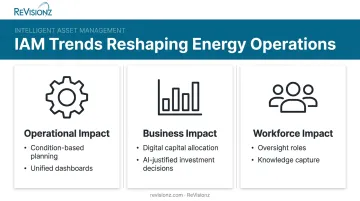
Operational Impact
Maintenance is moving from fixed calendar schedules to adaptive, condition-based planning that flags problems before they become failures. Fragmented data workflows are giving way to unified dashboards, which means engineers spend less time hunting for information and more time acting on it.
Business Impact
These shifts also reshape capital allocation, tilting it toward digital enablement rather than pure physical asset replacement. In one ReVisionz mining engagement, laser-scan reality capture and 3D modeling cut the cost of rebuilding an asset registry well below what traditional physical verification would have required. Investment decisions are also increasingly leaning on AI-generated justification to satisfy regulators and stakeholders.
Workforce Impact
The same forces are reshaping who does the work, moving roles from manual inspection toward oversight of AI-driven recommendations. Automation is designed to augment field staff rather than replace them. People still carry the judgment calls on what an asset is actually telling them. Organizations that get this right are prioritizing knowledge capture and structured change management to offset the loss of experienced personnel.
Future Signals for Intelligent Asset Management in Energy
IAM will keep evolving fast over the next one to three years. A few signals worth watching:
- Executives are focusing on data basics first. Industry summit themes for 2026 increasingly emphasize "getting the basics right" on asset data before layering advanced AI on top. Many operators skipped this sequencing during earlier digital pushes.
- Agentic AI networks are expanding. Expect broader deployment of AI agents capable of end-to-end maintenance planning, plus deeper integration between digital twins and generative AI interfaces.
- Partnerships over DIY. More owner-operators are choosing to partner with specialized digital asset consultancies to build lifecycle-ready data foundations, rather than attempting AI adoption directly on top of fragmented legacy systems.
The common thread: AI tools only perform as well as the data feeding them, a lesson now shaping IAM budgets and vendor selection heading into 2026.
Conclusion
AI orchestration, digital twins, agentic AI, and lifecycle-ready data are converging to reshape how energy assets get designed, operated, and maintained, all at once. Operators who invest early in clean data foundations and predictive capabilities are the ones gaining a durable edge in reliability and safety.
Strategic foresight matters, but so does execution. Pairing that foresight with a technology-agnostic implementation partner turns these trends into operational value instead of another stalled pilot project. The right partner works across SCADA, EAM, and AIM platforms rather than pushing a single vendor stack.
Frequently Asked Questions
What is intelligent asset management in energy?
Intelligent asset management uses AI, IoT sensors, and unified data platforms to optimize energy infrastructure performance and extend equipment lifecycle. The goal is shifting from reactive repairs to predictive, condition-based decisions.
How does AI improve asset management in the energy sector?
AI analyzes real-time and historical asset data to predict failures and recommend maintenance timing, flagging anomalies before they cause downtime. This reduces the manual analysis workload that used to take engineers days or weeks.
What is the difference between traditional and intelligent asset management?
Traditional asset management relies on fixed, calendar-based maintenance schedules regardless of actual equipment condition. Intelligent asset management uses real-time data to trigger maintenance only when it's actually needed.
What technologies are used in intelligent asset management?
Core technologies include digital twins, IoT sensors, AI/ML orchestration layers, and Asset Information Management (AIM) platforms. Together, they turn raw operational data into actionable maintenance decisions.
Do energy companies need to replace existing systems to adopt intelligent asset management?
No. Orchestration and AIM layers are typically built on top of existing SCADA and EAM systems rather than requiring a full replacement. This makes adoption faster and far less disruptive to daily operations.
What are the benefits of intelligent asset management for energy companies?
Benefits include reduced unplanned downtime, lower maintenance costs, stronger regulatory compliance, and extended asset lifespan. Operators also gain faster, better-justified capital investment decisions.