Introduction
A single unplanned shutdown in oil and gas doesn't just cost money. It costs momentum, safety margin, and market position.
A precise industry-wide dollar figure for downtime remains elusive. Still, Siemens' True Cost of Downtime 2024 report confirms downtime costs swing sharply with oil prices, spiking during high-demand periods and falling when markets soften.
That volatility, paired with aging infrastructure and thinning margins, makes reactive maintenance a liability few operators can afford.
Predictive maintenance (PdM) has moved from "nice to have" to survival strategy. This guide covers what PdM actually means for oil and gas, and how it plays out differently across upstream, midstream, and downstream operations. It also covers the data foundation most programs overlook, and how to build a program that works.
Key Takeaways
- PdM uses real-time data, not calendars, to predict failures early
- Upstream, midstream, and downstream operations need different sensors and monitoring
- Clean, structured asset data determines PdM success or failure
- A phased rollout, starting with criticality analysis, cuts risk and cost
What Is Predictive Maintenance in Oil & Gas?
Predictive maintenance (PdM) combines IIoT sensors, condition monitoring, and machine learning to catch equipment anomalies before they turn into failures. In oil and gas, that means adapting the approach to harsh, hazardous, and often remote environments where a technician can't just walk over and check a gauge.
The Maintenance Evolution: Reactive vs. Preventive vs. Predictive
The U.S. Department of Energy's Operations & Maintenance Best Practices Guide draws a clear line between the three models:
| Approach | How it works | Main drawback |
|---|---|---|
| Reactive | Fix it after it breaks | High cost from unplanned outages and safety exposure |
| Preventive | Service on a fixed schedule (time or run-hours) | Over-maintains healthy equipment, misses failures on variable-load assets |
| Predictive | Act based on actual measured condition | Requires reliable sensor data and analytics to work properly |
Preventive maintenance sounds safer than reactive, but fixed schedules ignore how an asset is actually performing. A pump running under variable load might fail well before its scheduled service date, or get serviced needlessly when it's running fine. Predictive maintenance ties the intervention to the equipment's actual condition, not the calendar.
How Predictive Maintenance Works: The Data-to-Action Cycle
PdM runs on a four-stage loop:
- Data collection – Sensors capture vibration, temperature, pressure, and oil condition continuously
- Data analysis – Machine learning models flag deviations from normal operating patterns
- Prediction – Centralized dashboards surface alerts ranked by severity and time-to-failure
- Action – Maintenance teams generate work orders and intervene before failure occurs
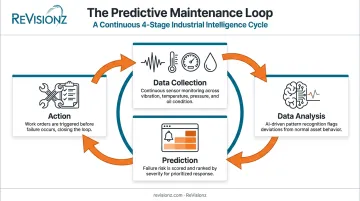
Here's the part most vendors skip: many PdM programs stall between stages three and four. Analytics platforms generate a perfectly good alert, but if it doesn't flow into the CMMS where work orders get created, that insight just sits in a dashboard nobody checks daily.
The technology works. The execution gap is what kills ROI.
Why Predictive Maintenance Matters Across the Oil & Gas Value Chain
Upstream, midstream, and downstream operations don't share the same assets, environments, or failure modes, so a one-size-fits-all PdM strategy rarely works. Each segment needs its own sensor mix and monitoring logic.
Upstream: Protecting Remote and Offshore Assets
Electric submersible pumps (ESPs), rod pumps, and top drives often sit hours from the nearest technician, sometimes on an offshore platform reachable only by helicopter.
A failed ESP in a remote field doesn't just cost repair time. It costs the flight, the crew mobilization, and every barrel that isn't flowing while you wait.
Remote SCADA integration and wireless sensor networks solve this by centralizing fleet monitoring. Engineers watching dozens of wells from a single control room can spot a failing pump days before it stops, and schedule the trip instead of scrambling for one.
Midstream: Safeguarding Pipelines and Compressor Stations
Midstream assets face a different challenge: distance and false alarms. Acoustic leak detection catches pipeline anomalies early, while vibration analysis on compressor stations flags bearing wear or misalignment before a shutdown.
The catch is correlation. Vibration data alone can trigger false positives when a compressor simply changes throughput. Correlating mechanical and process data (pressure, flow rate) filters out normal operational shifts from genuine degradation — a distinction that determines whether your team trusts the system or starts ignoring its alerts.
Downstream: Optimizing Refinery Reliability
Refineries pack thousands of rotating assets into a dense footprint, and much of that equipment predates modern sensor technology by decades. A brownfield refinery running 30-year-old rotating equipment can't justify ripping everything out to install a PdM system.
The practical answer is layering: retrofitting wireless sensors onto existing pumps, compressors, and heat exchangers without touching the underlying process equipment.
The U.S. Chemical Safety Board's investigation into the 2010 Tesoro Anacortes refinery explosion traced the tragedy to a heat exchanger nearing 40 years old that failed catastrophically during a maintenance startup, killing seven workers. Aging equipment doesn't wait for a convenient capital cycle.
The Data Foundation: Why Asset Information Management Determines PdM Success
Here's what most PdM pitches leave out: sensors and machine learning models are only as good as the data feeding them. Deploy an AI model on top of messy, incomplete asset records, and you get false positives, missed failures, and a program nobody trusts after six months.
Common data problems in oil and gas include:
- Unstructured tag data scattered across legacy documents rather than a queryable database
- Inconsistent asset hierarchies where the same equipment is named differently across systems
- Maintenance history disconnected from engineering records, so nobody can see the full picture of an asset's condition over time
Fixing this requires what's often called "lifecycle-ready" data: asset information that's clean, enriched, and structured well enough to feed accurately into analytics engines and digital twin models. Without it, even the best PdM software is guessing.
This is the gap ReVisionz was built to close. Rather than starting with a sensor deployment, ReVisionz's data migration and enrichment methodology focuses on converting unstructured engineering data (think scattered P&IDs, disconnected maintenance logs, inconsistent tag naming) into a trusted, structured foundation.
The company's AI-powered Main Information Contractor+ (MIC+) service extends this work for owner-operators preparing their asset data for predictive maintenance and digital twin programs.
This approach also stays technology-agnostic. Operators can layer any PdM or CMMS platform on top of a clean data foundation without getting locked into one vendor's proprietary structure, which matters if you ever want to switch analytics providers down the road.
Core Technologies Powering Modern PdM Programs
Three condition-monitoring techniques form the backbone of most PdM programs:
- Vibration analysis – Detects misalignment, imbalance, and early-stage bearing wear on rotating equipment
- Tribology (oil analysis) – Identifies contamination, wear metals, and lubricant breakdown before mechanical failure
- Infrared thermography – Spots overheating in electrical connections, bearings, and insulation from a safe distance
These techniques produce continuous data streams that need reliable capture. Industrial Internet of Things (IIoT) sensors paired with edge and cloud computing make continuous monitoring possible even in hazardous or remote locations where a technician visit isn't practical. Edge processing handles time-sensitive alerts on-site, while cloud platforms aggregate data across the fleet for trend analysis.
Digital twins take this further. A digital twin is a virtual replica of a physical asset that mirrors its current state and simulates behavior under different operating conditions. Engineers can test "what if we run this compressor 15% harder" scenarios virtually, refining failure predictions and validating maintenance decisions before touching real equipment.
Key Benefits & ROI of Predictive Maintenance in Oil & Gas
Downtime Reduction and Cost Savings
The U.S. Department of Energy's cross-industry benchmarks for mature predictive maintenance programs are striking:
- Up to 10x return on investment
- 25% to 30% lower maintenance costs
- 70% to 75% fewer equipment breakdowns
- 35% to 45% less downtime
- 20% to 25% higher production output
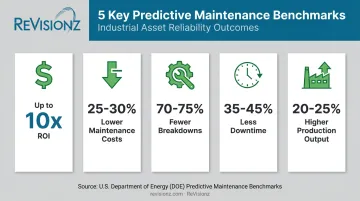
These figures come from the DOE's Operations & Maintenance Best Practices Guide, drawn from independent surveys across heavy industry. They're not oil-and-gas-specific guarantees, but they set a realistic bar for what a well-executed program can deliver.
Extended Asset Life
Those downtime and cost figures don't capture the full value of predictive maintenance. Catching wear, corrosion, and misalignment early doesn't just prevent breakdowns. It stretches the usable life of critical equipment.
A compressor or pump showing healthy vibration and thermal readings can often run well past its scheduled replacement date. Condition-based intervals replace the fixed-schedule approach, servicing assets based on actual wear rather than an arbitrary calendar date.
Improved Safety and Regulatory Compliance
Beyond cost and asset life, API standards like RP 691 (risk-based machinery management) and Standard 670 (machinery protection systems) set the benchmark for monitoring rotating equipment. OSHA's mechanical integrity requirements for refineries go further, mandating written procedures, regular inspection, and documented correction of deficiencies.
Skip this, and the consequences go beyond fines. Cal/OSHA's 2017 settlement with Chevron followed a corroded-pipe refinery fire that cost the company an estimated $15 million in piping replacement.
The company also paid roughly $5 million for new equipment-monitoring procedures, on top of a $1.01 million penalty. PdM helps prevent the kind of equipment failure that triggers this level of regulatory action.
Building a Predictive Maintenance Roadmap: Implementation Best Practices
Rolling out PdM across an entire facility on day one is how programs fail. A phased approach works better:
- Start with criticality analysis. Using a framework like ISO 14224's equipment taxonomy, identify the roughly 20% of assets responsible for 80% of your downtime. These become your pilot candidates, not your entire fleet.
- Take a sensor-agnostic, phased approach. Integrate with existing legacy SCADA and historian systems rather than pursuing a costly rip-and-replace. Most operators can't justify swapping out functioning infrastructure just to add condition monitoring.
- Invest in change management early. PdM asks maintenance teams to shift from reactive firefighting to data-driven decision-making, a cultural shift as much as a technical one. Teams that have spent years fixing what's broken need training and support to trust an alert telling them something will break in three weeks. ReVisionz's sustainment practice, for example, builds this kind of change enablement directly into PdM rollouts.
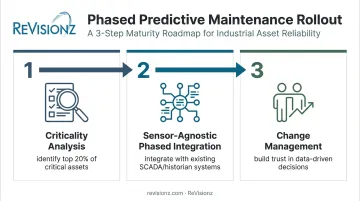
Skip any one of these three, and you'll likely end up with an expensive sensor network that generates alerts nobody acts on.
Frequently Asked Questions
What are the three types of predictive maintenance?
The main techniques are vibration analysis, oil (tribology) analysis, and infrared thermography. Some classifications also group PdM by method, such as time-based, condition-based, and prediction-model-based approaches, and definitions vary by organization.
What are the 4 P's of maintenance?
The 4 P's commonly refer to People, Process, Parts, and Procedures, the core pillars supporting any maintenance strategy. These apply just as much to predictive programs as to traditional preventive maintenance.
What are the 7 elements of preventive maintenance?
Common elements include inspection, cleaning, lubrication, adjustment, calibration, parts replacement, and documentation or scheduling. ISO and SMRP frameworks don't fix this list at exactly seven items, so the breakdown varies by organization.
What is the ROI of predictive maintenance in oil and gas?
Mature predictive maintenance programs can achieve up to 10x ROI through reduced downtime, lower labor costs, and extended asset life, based on cross-industry U.S. Department of Energy research. No verified O&G-specific benchmark exists, and actual timelines depend on asset criticality and program maturity.
How is AI used in predictive maintenance for oil and gas?
Machine learning models analyze sensor and historical data to detect anomalies, estimate failure timelines, and recommend maintenance actions automatically. The accuracy of these predictions depends directly on the quality of the underlying asset data.
Can predictive maintenance work with a company's existing legacy systems?
Yes. Modern PdM approaches are designed to integrate with legacy SCADA and historian systems, provided the underlying asset data has been structured and cleaned first. Without that data foundation, integration attempts tend to produce unreliable results regardless of the platform used.