Introduction
Oil and gas operators, chemical plants, mining companies, and manufacturing plants generate staggering amounts of data every day. Engineering drawings, tag records, P&IDs, maintenance logs, inspection reports — the volume keeps growing, but trust in that data often doesn't keep pace.
Many organizations struggle with information scattered across legacy systems and disconnected operational platforms, compounded by messy EPC handovers. This isn't just an IT headache. It creates real safety risks, compliance exposure, and unplanned costs when engineers and operators can't rely on the data in front of them.
This guide breaks down what data governance actually means, the principles that make it work, and how to build a framework around it. It also covers the best practices that help programs scale, especially for asset-intensive industries where the stakes run higher than a typical enterprise data project.
Key Takeaways
- Data governance sets the rules; data management handles daily execution
- Governed engineering data cuts rework, speeds handovers, and closes compliance gaps
- Successful programs start small, anchor to funded initiatives, and secure sponsorship early
- Clear roles like governance councils, data owners, and stewards prevent accountability gaps
- Industry standards like CFIHOS give capital-intensive organizations a shared data language
What Is Data Governance?
Data governance is the set of policies, processes, roles, and standards an organization uses to make sure its data stays accurate, secure, accessible, and used the right way across its entire lifecycle. It answers questions like: Who owns this data? Who can access it? How do we know it's trustworthy?
Governance often gets mistaken for bureaucratic red tape: another layer of approvals slowing teams down. In practice, good governance does the opposite. It balances security and control with usability, so the right people get the right data at the right time, without needless friction.
This balance matters more than ever at the leadership level. In Gartner's 2024 survey of 479 chief data and analytics officers, 68% named data governance a key responsibility, with 74% pointing to data and analytics strategy overall. For today's data leaders, governance has moved from a side project to a core part of the job description.
Data Governance vs. Data Management
Data governance is a subset of data management, not a replacement for it. DAMA's Data Management Body of Knowledge organizes the discipline into 11 knowledge areas. Governance is one of them, alongside architecture, quality, metadata, integration, and security.
Think of it this way:
- Governance sets the rules, decision rights, and accountability: who owns what, and what "good" looks like
- Management executes those rules: storing, integrating, processing, and moving the data day to day
Without governance, management has no standards to follow. Without management, governance has no way to enforce anything.
Why It Matters Beyond the Data Center
For owner-operators and EPCs, ungoverned engineering and asset data isn't an abstract IT problem. It shows up as rework, delayed startups, and compliance exposure. Drawings that don't match as-built conditions. Tag data duplicated across three systems. Maintenance records nobody trusts enough to act on.
McKinsey's research on capital project delivery found that projects across the value chain averaged 38% longer than scheduled and 40% over budget, with quality running 25% below target. That figure covers many causes beyond data alone. Still, incomplete, paper-based handovers are consistently flagged as a driver of rework and delayed operational readiness.
Kelly Kinghorn, Senior Partner and Director of Delivery Excellence at ReVisionz, has observed a related pattern across capital projects: teams are generating more data than ever, yet handover confidence hasn't improved. The gaps that surface during commissioning and startup are rarely surprises. They exist because nobody was accountable for information quality earlier in the project.
Key Principles of Data Governance
Strong governance programs are built on a handful of consistent principles, regardless of industry:
- Transparency: Know where data lives, how it flows between systems, and who's using it, since auditors in regulated environments ask exactly these questions.
- Accountability: Every data domain needs a named owner. Vague ownership is functionally the same as no ownership.
- Data integrity and quality: Governed data must be accurate, complete, and consistent enough to support decisions and regulatory reporting without a second round of validation.
- Security and compliance: Restrict access to sensitive data based on role and risk, aligned with applicable regulations such as environmental, safety, or privacy standards specific to the industry.
- Engagement and stewardship: None of this works if stakeholders don't understand why it matters or how it fits into their daily workflow. Governance embedded into existing processes survives; governance bolted on as an extra step usually doesn't.
Building a Data Governance Framework
A data governance framework is the structured blueprint that turns these principles into practice: the people, policies, processes, and technology that make governance operational rather than aspirational.
Skip the software search at the start. Begin instead by defining a mission statement and a small set of measurable KPIs tied directly to business priorities: fewer rework hours, quicker handover cycles, and a measurable drop in data-related audit findings. Without that anchor, governance risks becoming a policy document nobody references.
Key Roles and Responsibilities
| Role | Responsibility |
|---|---|
| Data Governance Council | Cross-functional leaders who set strategy and resolve high-level data disputes |
| Data Owners | Accountable for accuracy, integrity, and access decisions within a specific data domain |
| Data Stewards | Manage day-to-day data quality, compliance checks, and issue escalation |
| Data Consumers | Apply governed data in daily operations, reporting, and decision-making |
Each role needs clear boundaries. A common failure point: data stewards get assigned quality responsibilities without the authority to enforce fixes, which leaves problems unresolved and stewards frustrated.
Choosing a Framework Model
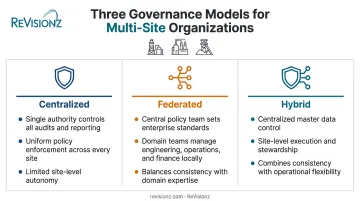
Organizations generally choose between three models:
- Centralized: A single authority controls governance, audits, and reporting across the enterprise
- Federated: A small central team sets core policy while domain teams (engineering, operations, finance) own execution
- Hybrid: Combines centralized policy or master data control with federated execution at the site or business-unit level
Large, multi-site organizations in capital-intensive industries tend to gravitate toward hybrid models. A single refinery or mine site rarely operates the same way as a corporate office three states away, but they still need shared standards for tag data and master asset records.
Data Governance Best Practices
Governance programs that actually stick share a few common traits:
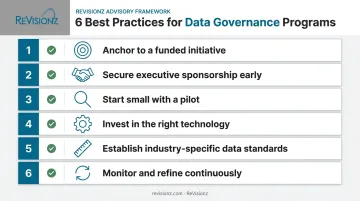
- Anchor to a funded initiative. Pitch governance as a standalone program and it competes for budget every year. Tie it to digital transformation, AI adoption, or a capital project already funded, and it inherits that momentum.
- Secure executive sponsorship early. Without leadership buy-in, policies get written but rarely adopted organization-wide. Sponsorship needs to come from someone who can enforce accountability, not just approve a budget line.
- Start small with a pilot. Pick one high-value data domain, such as critical equipment tags, prove the value, then expand. ReVisionz used this approach on a brownfield asset initiative, building an automated Maximo tag register that delivered enriched records with zero rework at handover. The client later requested the same approach for a new greenfield project.
- Invest in the right technology. Data catalogs, lineage tools, and metadata management platforms automate policy enforcement that would otherwise depend on manual spreadsheet tracking.
- Establish industry-specific data standards. For capital-intensive sectors, this means structured standards for engineering documents, tag data, and asset master data. CFIHOS is one widely referenced example for capital facilities information handover.
- Monitor and refine continuously. Regulations change, systems get replaced, and new data sources appear. A framework frozen in year one becomes irrelevant by year three.
Common Data Governance Challenges
Even well-intentioned programs hit predictable obstacles.
Weak executive sponsorship and fuzzy accountability. When nobody senior owns the outcome, policy adoption stays inconsistent across departments. This connects directly to a broader measurement problem: in a 2024 Gartner survey of 504 data and analytics executives, 30% cited inability to measure data and AI impact as their top challenge. Without measurable value, sponsorship erodes fast.
Data silos across legacy systems. Engineering and operational environments are notorious for this. One pattern shows up repeatedly across multi-site operations running 24/7: facilities relying on informal processes (text messages, handwritten logs) because no standardized system connects them. That gap traces back to governance, not technology.
Balancing access with control. Self-service analytics and AI adoption push teams to want faster, broader data access. Governance has to define who gets what, without turning every request into a bottleneck.
Why Data Governance Is Critical for Asset-Intensive Industries
For oil and gas, chemicals, mining, and manufacturing organizations, governed engineering and asset data isn't a nice-to-have. It directly supports safety, regulatory compliance, and asset performance across the entire lifecycle — from design through decommissioning.
Poor governance at project handover creates a domino effect:
- Incomplete tag data leaves maintenance teams working from guesswork
- Missing document metadata prevents auditors from verifying mechanical integrity records
- Disconnected P&IDs feed predictive analytics models incomplete training data
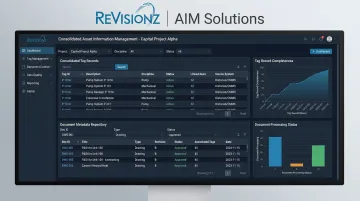
This is exactly the gap ReVisionz's AIM Solutions practice and AI-powered MIC+ (Main Information Contractor+) service are built to close, bridging project delivery and operational readiness by turning unstructured asset data into lifecycle-ready information.
In one engagement with an LNG operator, ReVisionz consolidated over 300,000 tags and 800,000 documents into a unified Asset Information Management program, closing gaps in data, standards, and governance that had accumulated across years of disconnected project delivery.
The lesson holds across industries: embedding governance from the start costs far less than fixing it after handover.
Frequently Asked Questions
What is data governance?
Data governance is the set of policies, roles, and processes that ensure data stays accurate, secure, and usable throughout its lifecycle. It defines who is accountable for data and how it should be handled.
What are the key principles of data governance?
The core principles are transparency, accountability, data integrity and quality, security and compliance, and stakeholder engagement. Together, they turn governance from a policy document into daily practice.
What is a data governance framework?
A framework is the structured blueprint of people, policies, processes, and technology that operationalizes governance principles. It includes defined roles, a chosen governance model, and measurable KPIs.
What is the difference between data governance and data management?
Governance sets the rules, decision rights, and accountability for data, while management executes those rules through storage, integration, and daily processing. Governance is one subset of the broader data management discipline.
Who is responsible for data governance in an organization?
Responsibility spans a governance council that sets strategy, data owners accountable for specific domains, data stewards managing daily quality issues, and business users applying governed data operationally.
How does data governance apply to engineering and asset data?
Governed engineering and asset data — tag records, P&IDs, maintenance logs — ensures safer operations, smoother capital project handovers, and audit-ready compliance across the full asset lifecycle.