For asset-intensive industries like oil & gas, chemicals, mining, and manufacturing, the stakes are higher. Engineering, safety, and operational data often gets governed inconsistently across EPCs, owner-operators, and a patchwork of software platforms. One team trusts the P&ID in the engineering system; another pulls a different version from the EAM. Neither is technically wrong, but neither is fully right either.
Gartner predicts that 80% of data and analytics governance initiatives will fail by 2027, largely because they lack a real business crisis driving urgency (Gartner, 2024). This blueprint covers the pillars, frameworks, organizational structure, and architectural components that make governance work in practice, not just on paper.
Key Takeaways
- Governance sets the rules; architecture enforces them technically, and both must work together
- People, policies, processes, and technology form the four core components of any governance program
- Data catalogs, lineage tools, and RBAC are the technical backbone that turns policy into daily practice
- Asset-intensive organizations must govern engineering and asset data, not just business records
- Successful programs start with a pilot domain and prove value before scaling organization-wide
What Is Data Governance Architecture?
Data governance architecture is the combination of policies, roles, processes, and technology that determines how an organization collects, secures, manages, and uses its data assets. It functions as the operating system connecting policy to execution, not a single tool or policy document.
Governance answers "why": the rules, accountability, and decision rights behind data use. Architecture answers "how": the systems that enforce those rules day to day. According to Gartner, data governance means specifying decision rights and building an accountability framework for how data gets valued, created, consumed, and controlled.
Here's a simple example. A governance policy might mandate encryption and access controls on sensitive engineering data. On its own, that policy is just a sentence in a document. Architecture teams turn it into something real through:
- Role-based access control (RBAC) that restricts who can view or edit specific data classes
- Encryption-in-transit and at-rest for data moving between systems
- Automated classification tags that trigger access rules without manual intervention
Without architecture, that policy stays unenforceable text on a page. Architecture needs policy too, though; lacking clear direction, engineering teams end up building access rules through guesswork rather than requirements.
Why This Matters More for Asset-Intensive Industries
In capital-intensive sectors, ungoverned engineering and asset data creates a genuine safety and compliance liability. A stale P&ID, an unclear asset register, or a mismatched tag between design and operations can directly affect turnaround planning, regulatory audits, or worse, incident response.
The financial exposure is substantial across industries. According to Gartner's research on data quality, poor data quality costs organizations at least $12.9 million per year on average. For organizations running multi-billion-dollar physical assets, that number climbs fast when engineering data errors ripple into maintenance schedules or safety cases.
The Core Pillars of Data Governance Architecture
Most governance programs, including IBM's implementation model, organize around four components: people, policies, processes, and technology (IBM). Each plays a distinct role.
| Pillar | What it covers | Architecture implication |
|---|---|---|
| People | Council, data owners, stewards, executive sponsor | Defines who approves access and resolves disputes |
| Policies | Rules for access, classification, retention, acceptable use | Translates into system-level permissions and controls |
| Processes | Quality checks, access reviews, audits, dispute resolution | Becomes repeatable workflows inside catalog and RBAC tools |
| Technology | Catalogs, lineage tools, RBAC, automation | Makes governance enforceable at scale, not manual |
People matter most. Without clear authority and accountability, the other three pillars collapse on paper:
- A governance council without authority becomes a discussion group
- Data owners without accountability become figureheads
- The architecture only works when someone owns keeping it accurate
Beyond who owns the data, a related question often comes up: does data quality deserve its own pillar? Some frameworks treat data quality management as an independent fifth pillar, though that's not universally standardized.
IBM and DAMA both treat quality as a governance objective and management discipline rather than a formal separate pillar. Still, it deserves attention as a cross-cutting layer: poor-quality data undermines every other pillar, no matter how well-designed the policies or technology are.
Key Frameworks for Structuring Data Governance Architecture
Three frameworks come up repeatedly in governance conversations, but they serve different purposes. Picking one wholesale rarely works — most enterprises adapt pieces from each.
| Framework | Best used for | Limitation |
|---|---|---|
| DAMA-DMBOK | Structuring data management practices; popular in regulated industries | Guidance, not a prescriptive technical standard |
| TOGAF | Aligning data architecture with broader enterprise and business strategy | Broader scope than governance alone; requires tailoring |
| Zachman Framework | Classifying data assets and artifacts by audience and abstraction level | An ontology, not a methodology — no implementation sequence |
Each framework points back to a different primary source:
- DAMA-DMBOK (DAMA): the go-to reference for data management vocabulary and practices
- TOGAF (The Open Group): the standard when governance needs to plug into a larger enterprise architecture effort
- Zachman (Zachman International): the best check for completeness, ensuring no stakeholder perspective gets missed
The right choice depends on your regulatory context, organizational scale, and current data maturity. A mid-size manufacturer just starting out doesn't need the full TOGAF development method. A multinational operator juggling dozens of legacy systems probably does.
Structuring Your Governance Organization: Council, Owners, and Stewards
Technology alone won't fix governance. Someone has to own the decisions.
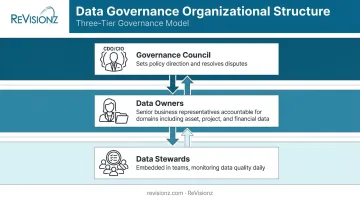
The governance council sits at the center. It sets policy direction, resolves ownership disputes, and requires visible executive sponsorship (typically a CDO or CIO) to carry weight across the organization. Without that sponsorship, council decisions get ignored the moment they conflict with a business unit's preferences.
Data owners are senior business representatives accountable for specific domains: asset data, project data, financial data. Their responsibilities include:
- Approving or denying access requests within their domain
- Resolving classification disputes when teams disagree on sensitivity levels
- Contributing to policy updates as regulatory requirements shift
Data stewards operate closer to the ground. They monitor quality day to day, maintain data definitions, and enforce policy in practice. Many organizations embed stewards directly inside technical or business teams rather than centralizing them, which keeps enforcement close to where data actually gets created and used.
This structure mirrors McKinsey's research on governance value: link governance to transformation priorities, appoint domain owners and stewards, and track value continuously rather than treating it as a one-time compliance exercise.
The Architecture Behind Data Governance: Core Components
This is where policy becomes practice. Four technical components form the backbone of enforceable governance.
- Data catalog: the operational hub. It indexes all data assets, giving stewards and analysts a single place to search, classify, and assess quality. Without it, governance policies exist in a vacuum with no connection to actual data.
- Metadata management and lineage tracking: shows where data originates and how it transforms as it moves through systems. This supports audit trails and compliance reporting, and it's often the first thing regulators or auditors ask for after an incident.
- Automated data quality monitoring: defined thresholds, freshness rules, and alerts that catch problems before they spread downstream. Manual quality checks don't scale; automated ones do.
- Access control and security architecture: RBAC, encryption, and classification-driven enforcement applied consistently across every system, not just the ones IT happens to control tightly.
Extending Architecture to Engineering and Asset Data
Standard governance frameworks were largely built for transactional business data: customer records, financial transactions, sales figures. They fall short when applied to engineering and asset information: P&IDs, 3D models, asset registers, and digital twins.
This gap matters. A materials catalog with duplicate entries is annoying. A P&ID that doesn't match the as-built asset is a safety incident waiting to happen.
Industrial data standards help bridge that gap. CFIHOS, governed under IOGP JIP36, standardizes how capital-facility information gets handed over between operators, contractors, and equipment suppliers. ISO 15926 and ISO 8000 add semantic consistency and quality requirements for process-plant lifecycle data.
This is the specific territory ReVisionz operates in. Rather than pushing a single software platform, ReVisionz takes a technology-agnostic approach, working across AVEVA, Hexagon, Cognite, and OpenText environments depending on what a client already has in place. Its AI-powered Main Information Contractor+ (MIC+) service was built specifically to turn unstructured engineering data scattered across EPC handovers and legacy systems into lifecycle-ready, governed information owner-operators can actually trust and use.
A Phased Roadmap to Implement Data Governance Architecture
Governance programs that try to cover everything at once tend to stall. A phased approach works better.
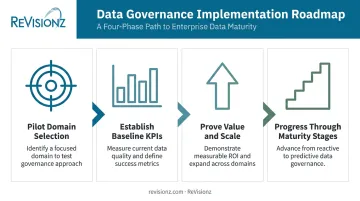
- Start with a pilot domain. Pick one high-value area, such as asset data or project data, rather than attempting an enterprise-wide rollout on day one.
- Establish baseline KPIs. Track documented ownership percentages, data quality scores, and issue resolution time before and after the pilot.
- Prove value, then scale. Use pilot results to justify expansion into additional domains.
- Progress through maturity stages. Move from reactive, ad hoc practices toward a state where governance is embedded in every architecture decision, not bolted on afterward.
According to Gartner's data governance maturity research, most organizations sit at a low maturity level today, which highlights how much room exists for improvement.
Reaching that maturity depends on more than KPIs and pilot data, though. Change management matters as much as tooling, and it gets underestimated constantly. A perfectly designed catalog fails if nobody updates it, and role-based training determines whether stewards actually use the systems built for them.
Programs that invest equally in adoption and technology tend to stick. Those that treat training as an afterthought often slide back into old habits within months.
Frequently Asked Questions
What is the architecture of data governance?
Data governance architecture refers to the combination of data catalogs, lineage tools, access controls, and quality monitoring systems that technically enforce governance policies. It works alongside the organizational structure of council, owners, and stewards.
What are the pillars of data governance?
The four core pillars are people, policies, processes, and technology. Some frameworks treat data quality management as a related fifth element, though this isn't universally standardized.
What is the difference between data governance and data architecture?
Governance defines the rules for data access, use, and accountability. Architecture is the technical design and systems that enforce those rules across the organization.
Who owns data governance in an organization?
Ownership is shared: an executive sponsor or CDO drives strategy, data owners hold accountability for specific domains, and data stewards handle daily enforcement and quality monitoring.
What frameworks are commonly used for data governance?
DAMA-DMBOK, TOGAF, and the Zachman Framework are the most referenced. Most enterprises adapt elements from multiple frameworks rather than adopting one wholesale.
How long does it take to implement a data governance architecture program?
Timelines vary by organizational scale and complexity. Most successful programs start with a phased pilot in one domain before expanding gradually across the enterprise.