Introduction
Walk into any engineering review at an energy, chemicals, mining, or manufacturing company today, and you'll hear "digital enablement" and "digital transformation" tossed around like synonyms. They're not.
Vendors pitch both. Internal teams request budget for both. Leadership often approves projects without knowing which one they actually need.
That confusion has a cost. Misjudging scope affects capital allocation, how success gets measured, and how fast asset-intensive operators see returns on safety, compliance, and uptime investments.
The stakes are real: 70% of digital transformations fall short of their stated objectives, according to BCG's analysis of 825 senior executives. Programs with clear strategy, governance, and adoption plans hit success rates near 80%. Programs without that clarity don't come close.
This article breaks down what separates enablement from transformation, where each one fits, and how owner-operators can sequence both to protect ROI.
TL;DR
- Digital transformation reinvents business models and operations enterprise-wide using technology.
- Digital enablement optimizes existing systems to extract maximum value from current investments.
- Enablement moves faster and targets current KPIs, while transformation unfolds strategically over multiple years.
- Following transformation, enablement drives adoption and sustained value from earlier tech investments.
- For asset-heavy industries, this choice shapes total cost of ownership, compliance, and asset performance.
Digital Enablement vs Digital Transformation: Quick Comparison
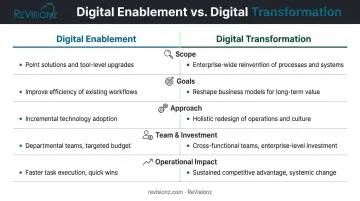
The two approaches diverge across scope, goals, execution approach, investment, and operational impact—here's how they stack up side by side.
| Dimension | Digital Enablement | Digital Transformation |
|---|---|---|
| Scope | Localized to a process, platform, or team | Organization-wide, spanning multiple business units |
| Goals | Improve specific, already-tracked metrics | Reimagine how value gets delivered internally and externally |
| Approach | Refine, train, and optimize what exists | Replace or reinvent systems, workflows, and culture |
| Team & Investment | Small, agile teams; lower budget; short timelines | Cross-functional, executive-led; higher investment; multi-year |
| Operational Impact | Faster AIM/EAM adoption, better maintenance data usability | New operating models like enterprise-wide digital twins |
Why Scope Alone Doesn't Determine Success
Here's a detail most vendors won't tell you: BCG found no significant success-rate difference between narrow initiatives and company-wide programs, meaning scope isn't the deciding factor. Strategy, governance, adoption planning, and platform design matter far more than how big the project looks on paper.
That's an important distinction for engineering and operations leaders evaluating proposals. A tightly scoped enablement project with strong governance can outperform a sprawling transformation initiative that lacks one.
Which One Does Your Organization Need?
Deciding between enablement and transformation comes down to four questions:
- What's your current digital maturity? If your data is fragmented, systems are disconnected, or you're still running on paper-based processes, transformation likely needs to come first.
- How urgent is the problem? A safety-critical adoption gap on an existing EAM platform calls for enablement now, not a three-year strategic overhaul.
- What's your available budget and timeline? Enablement projects run in weeks or months. Transformation programs run for years and require sustained executive sponsorship.
- Are existing tech investments underutilized? If you already purchased the platform but adoption is weak, that's an enablement problem, not a technology problem.
Choose enablement if a system is in place but underperforming or poorly adopted. Choose transformation if legacy infrastructure limits growth, safety, or competitiveness.
For most owner-operators, the two approaches work together rather than as a strict choice. Transformation defines the strategy and target operating model, while enablement implements it, drives adoption, and sustains the value over time.
This sequencing reflects ReVisionz's approach: build the transformation strategy first, then implement and sustain the technology that delivers on it.
What is Digital Enablement?
Digital enablement is the tactical use of tools, training, and data practices that help people and systems extract full value from technology already deployed, or newly implemented. For engineering, maintenance, and operations teams in process industries, this usually means making existing platforms actually usable, not replacing them.
Core benefits tie directly to operations:
- Higher user adoption of engineering and AIM platforms
- Improved data usability for predictive maintenance
- Reduced total cost of ownership on existing tech investments
- Stronger regulatory and safety compliance through better data governance
Three Forms of Enablement
Enablement typically shows up in one of three forms:
- Process/workflow enablement: refining how teams execute existing tasks, removing friction from handoffs between engineering, maintenance, and operations.
- Technology adoption enablement: training and change management that gets users actually working inside the platforms already purchased.
- Data enablement: structuring and enriching engineering data so it's usable across the asset lifecycle, not locked in disconnected systems.
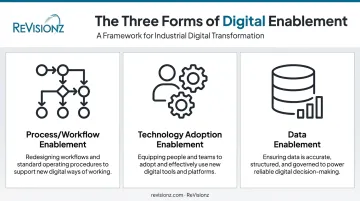
ReVisionz builds these three enablement types into most engagements, tailoring the mix to where a client's data and platforms currently fall short.
Use Cases of Digital Enablement
Enablement fits naturally at specific points in an asset's lifecycle: right after an AIM, EAM, or ERP go-live; during project handover from an EPC to operations; or as an ongoing layer of asset performance management.
Real-world scenarios include:
- An oil and gas facility struggling with handover data quality between construction and operations
- A chemical plant enriching disconnected piping specification data across multiple legacy systems
- A mining operation monitoring asset performance through better-structured maintenance data
Aker BP offers a clear example. Engineers were spending up to 15 hours a week manually assembling lube-oil charts, time-series data, and work orders ahead of maintenance meetings.
After Cognite Data Fusion contextualized data across four source systems into a single dashboard, that same prep work dropped to near zero. No new platform was purchased. The existing data just became usable.
What is Digital Transformation?
Digital transformation is the organization-wide reinvention of business models and operations using digital technology. For capital-intensive industries moving toward digital twins and Industry 4.0 operating models, this is the strategic layer that decides what the future operating model actually looks like.
Core benefits operate at a different scale than enablement:
- Predictive analytics deployed across entire operations, not a single unit
- New operating models, including remote or autonomous operations
- Long-term competitiveness and asset performance gains across a portfolio
Three Categories of Transformation
Transformation initiatives generally fall into three buckets:
- Technology-led transformation: enterprise adoption of cloud, IoT, and AI across operations
- Business-model transformation: rethinking how the organization delivers value to customers or manages assets
- Organizational and cultural transformation: shifting roles, skills, and decision-making structures to match new digital capabilities
Use Cases of Digital Transformation
Transformation shows up in enterprise-wide digital twin programs, full asset information management strategy rollouts, or wholesale replacement of legacy engineering systems across multi-site operations. EPC firms modernizing project delivery workflows and owner-operators building integrated digital twins across their portfolios are typical examples.
Emirates Global Aluminium's Al Taweelah facility is a strong illustration. Starting in 2021, EGA deployed more than 80 Industry 4.0 use cases across operations, including AI-based failure prediction and computer vision, while upskilling over 20% of its workforce.
The results, independently reported by the World Economic Forum's Global Lighthouse Network, included 90% SOP compliance, a 22% reduction in mean time to repair, and a 12% increase in overall equipment effectiveness.
This reflects a rebuilt operating model, not a single optimized workflow.
Real-World Example: Enablement and Transformation in Action
A process industry client came to ReVisionz after external audits exposed serious gaps in its asset management function. Flaws in safety assurance practices and undetected blind risks had gone unnoticed across operations, maintenance, planning, and scheduling teams, until regulators found them first.
The trigger: a compliance mandate. Audit findings created immediate pressure from both regulators and senior leadership to show corrective action, fast.
The response combined transformation strategy with enablement execution:
- Within two months, ReVisionz delivered two enterprise-level governance documents defining the target operating model
- Within three weeks, a four-day cross-functional workshop surfaced blind risks and capability gaps across teams
- Audit findings were mapped against a new capability framework to build a long-term improvement roadmap
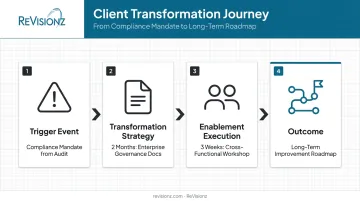
The outcome wasn't just a compliance checkbox. The client walked away with governance structure and regulatory credibility that reduced ongoing safety incident exposure, while aligning resources toward the highest-value fixes first.
This is the sequencing that works: define the strategy and target state first (transformation), then implement the governance, training, and data practices that make it stick (enablement).
If your organization is sitting on an underused platform or a fresh audit finding, that's the starting point for a maturity conversation. ReVisionz's asset information management and digital transformation team can help map the next steps.
Conclusion
Enablement and transformation aren't competing options. They're sequential phases of the same journey. Transformation sets the vision and target operating model, while enablement operationalizes it, drives adoption, and keeps the value flowing long after the initial rollout ends.
Organizations that treat them as either/or choices run into one of two traps: they overspend on transformation programs nobody adopts, or they underinvest in strategy and end up optimizing a system that was never right for the job.
For asset-intensive operators, getting this sequencing right isn't academic. It shows up directly in the metrics that matter most:
- Lower total cost of ownership across the asset lifecycle
- Stronger safety and compliance postures
- Asset performance that holds up well past the first quarter after go-live
Frequently Asked Questions
What is digital enablement?
Digital enablement uses digital tools, training, and data practices to help people and processes get maximum value from existing technology investments. It is tactical and typically targets a specific system, workflow, or team.
What are examples of digital enablement solutions?
Common examples include AIM data enrichment programs, workflow automation, CRM or EAM optimization, and targeted user training and change management initiatives. Each focuses on improving adoption or usability of technology already in place.
Does digital enablement require new technology investments?
No. Digital enablement typically works within your existing systems, focused on improving adoption, data quality, and workflow performance. Digital transformation, by contrast, often involves new platforms as part of a broader organizational overhaul.
What is digital transformation?
Digital transformation is the organization-wide reinvention of business models, processes, and culture using digital technology. It is strategic, spans multiple business units, and typically unfolds over multiple years.
Is digital enablement part of digital transformation or a separate initiative?
Enablement typically functions as a complementary, sequential phase that operationalizes and sustains a broader transformation strategy. Some transformation programs build enablement in from the start; others treat it as a distinct follow-on initiative.
How do I know if my organization needs digital enablement or digital transformation?
Look at your current digital maturity, budget, and whether the goal is optimizing existing systems or reinventing operations entirely. Underused platforms point to enablement; fundamentally limiting legacy infrastructure points to transformation.