
Introduction
A missing $300 bearing can shut down an entire production line. A warehouse stuffed with obsolete spares can tie up millions in working capital that never gets used. Both scenarios point to the same root cause: materials management gone wrong.
In capital-intensive industries like oil & gas, petrochemicals, and mining, the stakes are even higher. Companies collectively hold an estimated $50 billion in spares and inventory. Yet many still struggle with poor asset availability and unplanned downtime, according to McKinsey research on asset reliability.
This guide breaks down what materials management actually means and the "5 R's" that define excellence. It also covers core functions, the materials manager's role, and the benefits and challenges of managing materials at scale.
Key Takeaways
- Materials management controls material flow across procurement, production, and an asset's full operating life in asset-intensive industries
- The 5 R's (right materials, time, amount, price, and source) form the framework for excellence
- Strong materials management reduces waste and directly protects operational reliability
- Poor CMMS and ERP data quality is one of the biggest hidden threats to materials management success
What Is Materials Management?
Materials management is a core function of supply chain management. It plans, sources, and controls the flow of raw materials, components, spare parts, and finished goods to meet production and operational demands.
The underlying goal is straightforward: get the right materials to the right place, at the right time, in the right quantity, at the right price. That sounds simple on paper. In practice, it requires coordinating procurement, warehousing, transportation, and planning across dozens of stakeholders.
In asset-heavy sectors, materials management stretches far beyond typical production inputs. It covers:
- Spare parts and MRO (maintenance, repair, and operations) inventory
- Equipment bills of material (BOMs) tied to critical machinery
- Long-lead engineered items that can take months to procure
- Materials tied directly to plant uptime, safety, and regulatory compliance
A missing gasket is annoying. A missing long-lead compressor part during a turnaround can cost weeks of lost production.
Materials Management vs. Inventory Management
These two terms get used interchangeably, but they're not the same thing.
Inventory management is narrower, focusing on stock levels, replenishment timing, and tracking what's on the shelf.
Materials management is the broader umbrella, encompassing inventory management plus procurement, warehousing, transportation, and demand planning. Think of inventory management as one gear inside the larger materials management machine.
Materials Management vs. Supply Chain Management
Supply chain management (SCM) is the bigger picture, spanning the entire network — from raw material suppliers all the way to end customers, including logistics, supplier collaboration, and distribution strategy.
Materials management sits inside SCM as the internal-facing function, concerned with what happens once materials enter your organization: how they're planned, procured, stored, and consumed to keep operations running.
The 5 R's of Materials Management
Ask any experienced materials manager what "doing this job well" means, and you'll hear some version of the 5 R's. This framework, rooted in classic procurement principles, gives materials management its operational north star.
- Right Materials – Sourcing items with the correct quality, specification, and quantity. Get this wrong, and you risk production delays or, worse, installing the wrong part during a maintenance window.
- Right Time – Materials and spares need to show up exactly when needed. This matters for planned turnarounds, but it's just as critical for unplanned equipment failures where every hour of downtime costs money.
- Right Amount – Too much inventory ties up capital. Too little causes stockouts. Accurate demand forecasting is what keeps this balance in check.
- Right Price – Cost-effective purchasing, without cutting corners on quality or safety. Cheapest isn't always right, especially for safety-critical spares.
- Right Source – Reliable, vetted suppliers who consistently deliver. This means ongoing supplier performance monitoring, not a one-time qualification checklist.

These aren't independent goals. They're interconnected. Chase the "right price" too aggressively, and you may compromise the "right materials" or "right source." Effective materials management means balancing all five simultaneously.
Core Functions of Materials Management
Materials management runs on five interconnected functions, not a single task.
Material Requirements Planning (MRP) A systematic method for calculating what materials are needed, in what quantity, and when. MRP relies on production schedules, demand forecasts, and bills of material to avoid both shortages and overstock.
Procurement/Purchasing Management Sourcing suppliers, negotiating pricing and contract terms, and managing the purchase-order-to-invoice cycle. This function directly influences the "right price" and "right source" objectives.
Inventory Management Monitoring stock levels, setting reorder points, and classifying materials by importance. Many organizations use ABC analysis here, ranking items by value and criticality so high-impact spares get more attention than low-value consumables. A $50,000 pump seal, for instance, warrants tighter monitoring than a bin of standard fasteners.
Warehouse Management Governing physical storage, layout, and handling. Poor warehouse organization is an overlooked cost driver: misplaced items lead to duplicate purchases and wasted labor hunting for parts that are already on-site.
Transportation/Logistics Management Coordinating how materials move from suppliers to facilities. This includes carrier selection, route optimization, and timing deliveries to match production or maintenance schedules.
These five functions rarely operate in isolation. A weak link in one, like warehouse mismanagement, tends to create downstream problems in inventory accuracy and procurement decisions.
Role of the Materials Manager
The materials manager sits at the intersection of procurement, operations, and maintenance. Their core responsibilities include:
- Supporting production planning by ensuring material availability aligns with schedules
- Coordinating procurement activities and supplier relationships
- Overseeing inventory levels across warehouses and stores
- Managing facility and warehouse operations
Cross-functional collaboration is where this role gets tested. Maintenance and engineering teams depend on materials managers to have critical spare parts on hand before equipment fails, not after. When that handoff breaks down, unplanned downtime follows.
Meeting that expectation demands a specific mix of skills. Key skills for the role include:
- Demand forecasting and inventory analytics
- Supplier negotiation
- Data analysis and pattern recognition
- ERP/CMMS proficiency (SAP, Maximo, and similar platforms)
- Strong cross-departmental communication
Organizations that treat materials management as an isolated back-office function often face inventory gaps and slower response when equipment fails. The discipline works best when tightly connected to how maintenance and engineering teams operate day to day.
Benefits of Effective Materials Management
Get materials management right, and the payoff shows up across the balance sheet and the plant floor.
Cost reduction and waste minimization Optimized inventory levels reduce carrying costs and write-offs from dead stock. Digital MRO procurement solutions alone can drive inventory reductions of up to 30% and cost savings of 15 to 20%, according to McKinsey's research on digital MRO procurement.
Improved productivity and uptime When spares are available when needed, less time gets lost to stockouts or misplaced inventory. This matters most in industries where downtime is measured in millions per hour, not minutes.
Stronger decision-making and compliance Accurate, real-time data on inventory levels, usage patterns, and supplier performance gives leadership better visibility for both operational and regulatory decisions.
This is the space where ReVisionz's Materials Management Practice focuses its work with asset-heavy operators. The team cleans up materials data and structures catalogs and bills of material, building the data foundation that makes these benefits achievable rather than theoretical.
Common Challenges in Materials Management (and How to Solve Them)
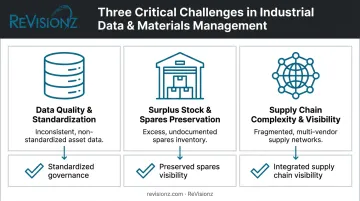
Even well-run operations hit friction. Here are the three challenges that show up most often in asset-intensive industries.
Data Quality and Standardization
Inconsistent item descriptions, duplicate records, and spelling variations in CMMS or ERP systems wreak havoc on inventory accuracy. A part named "3IN GATE VALVE" and another named "3-INCH VALVE, GATE" might be the exact same item, but your system won't know that.
The result: unnecessary overstocking or costly emergency purchasing when a part everyone assumed was "already in stock" turns out to be a duplicate ghost record.
Specialized data cleansing and enrichment methodologies can resolve this at scale. ReVisionz's expanded Materials Management Practice handles exactly this kind of large-scale cleanup for owner-operators managing sprawling, decades-old materials catalogs.
Surplus Stock and Spares Preservation
Excess inventory ties up capital because companies often default to manufacturer-recommended stocking levels instead of conducting a technical review of what's actually critical to their operations. Not every spare the OEM suggests deserves a permanent shelf spot. The fix: a criticality-based review that weighs actual failure history and lead times against the OEM's default recommendations.
Supply Chain Complexity and Limited Visibility
Long lead times for engineered equipment, combined with global sourcing, make it hard to track what's actually available and when it will arrive. Digital tools that provide real-time inventory and supply chain visibility go a long way toward closing this gap, replacing guesswork with actual data.
Frequently Asked Questions
What is meant by materials management?
Materials management is the planning, sourcing, and control of materials as they flow from procurement through production and use. It ensures the right materials are available at the right time, quantity, and price.
What does a material manager do?
A materials manager supports production planning, coordinates procurement, oversees inventory levels, and manages warehouse operations. They also work closely with maintenance and engineering teams to keep critical spares available.
What skills are needed for material management?
Key skills include demand forecasting, supplier negotiation, data analysis, and ERP/CMMS proficiency. Strong cross-departmental communication is essential since the role touches procurement, operations, and maintenance alike.
What are the 5 R's of material management?
The 5 R's are right materials, right time, right amount, right price, and right source. Together they form the objective framework that guides materials management decisions.
What is the difference between materials management and inventory management?
Inventory management is a subset focused on stock levels and replenishment. Materials management is the broader function that also covers procurement, warehousing, and logistics.
Why does materials management matter more in asset-intensive industries?
In industries like oil & gas and mining, materials management directly affects equipment uptime, safety, and regulatory compliance. A stockout of critical spares can halt operations entirely, and process industry downtime already costs an estimated trillion dollars a year.