
Without context, a tag number is just a string of characters. Teams end up guessing which drawing is current, searching multiple systems for the same equipment record, or trusting a spec sheet that was superseded years ago. That guesswork creates real safety, compliance, and cost exposure.
Poor data quality costs organizations at least $12.9 million per year on average, according to Gartner research. This article breaks down what metadata management actually means, why it matters for asset-heavy industries, and how to build a foundation that holds up under audit, turnaround, and digital twin pressure.
Key Takeaways
- Metadata gives raw engineering data the context needed for confident decisions.
- Unmanaged metadata leads to duplicate records, lost documentation, and compliance risk.
- The metadata management tools market is projected to grow at a 21.22% CAGR through 2034.
- Strong metadata practices reduce total cost of ownership and support digital twin readiness.
- Data governance frameworks work alongside metadata management, not in place of it.
What Is Metadata? Types and Examples
Metadata is data about data. It's the descriptive layer that tells you what a piece of information actually is, where it came from, and how to trust it.
Take a tag number on a P&ID: the tag itself is just an identifier. The metadata around it includes the equipment type, physical location, installation date, and the current document revision. That context turns a random code into something an engineer can act on.
Metadata generally falls into four categories:
- Technical metadata – file format, system source, or data structure (for example, the software version a P&ID was created in)
- Business metadata – definitions and business rules tied to a data element, like what counts as "critical equipment"
- Administrative metadata – ownership, creation date, and access rights (who approved a datasheet, and when)
- Descriptive/structural metadata – how records relate to each other, such as which instruments connect to a specific pump

Metadata vs. the Data Itself
Here's the distinction that trips people up: a P&ID drawing file is the data. The revision number, approval status, and associated tag list attached to that file are the metadata. Without metadata, you have a picture; with it, you have a document you can trust for maintenance planning or an audit.
What Is Metadata Management?
Metadata management is the combination of people, processes, and technology used to capture, organize, and govern metadata across its entire lifecycle. It's an ongoing discipline that spans engineering, operations, and IT, not a one-time IT checkbox project.
This connects directly to Asset Information Management (AIM) and digital twin programs. Organizations can't build a trusted digital twin on metadata nobody maintains. ISO 55013:2024 makes this explicit, addressing how organizations manage asset data and documented information to sustain its usefulness over time.
Passive vs. Active Metadata
Most organizations start with passive metadata: manually logged inventories that sit static until someone needs them.
Gartner describes this as metadata that's captured but rarely analyzed for usage or performance patterns.
Active metadata flips that model. It uses AI and machine learning to continuously tag, classify, and detect patterns in real time, turning a static inventory into a continuously useful resource.
The shift toward active metadata reflects broader market momentum. Fortune Business Insights values the metadata management tools market at $14.36 billion in 2025, growing to $81.15 billion by 2034 at a 21.22% compound annual growth rate. That's a global, cross-industry figure, not an industrial-only benchmark, but it signals how seriously organizations are starting to treat this discipline.
Does metadata really need active management? Yes. Left alone, metadata drifts. Tag descriptions go stale, duplicate records pile up, and nobody's sure which version of a spec is current. In a process plant, that's more than an inconvenience: it becomes a safety and compliance liability.
Why Metadata Management Matters for Asset-Intensive Industries
Reliable metadata underpins the decisions that keep a plant running safely and on budget.
Turnaround planning and maintenance scheduling depend on trusting that an equipment record actually reflects current conditions. If the metadata is wrong, planners work from bad assumptions, and that shows up as unplanned downtime or rework.
The problem isn't limited to turnarounds, either. Engineers and geoscientists in exploration and production reportedly spend more than half their time searching for and assembling data rather than analyzing it, according to research published through the Society of Petroleum Engineers. That's time not spent solving actual engineering problems.
Reducing Total Cost of Ownership
Bad metadata drives rework. Engineering teams re-verify specs that should have been trustworthy the first time. Well-managed metadata prevents that cycle, cutting the hidden costs that accumulate across an asset's life.
Compliance and Process Safety
Regulatory audits require accurate process safety information. When metadata identifies which document version is current and who approved it, audits move faster, with less risk of citation.
Bridging EPC Handover to Operations
The handover from EPC contractor to owner-operator is often where asset data quality breaks down. Missing vendor documents, incomplete datasheets, and unmanaged redlines create what's sometimes called "content debt" — problems that surface months or years later during a maintenance event.
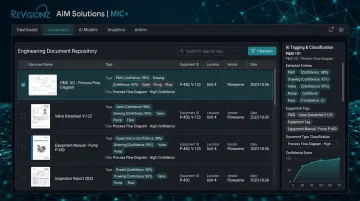
This is where structured metadata practices earn their keep. ReVisionz's AIM Solutions and its MIC+ (Main Information Contractor+) service apply AI-driven tagging and classification to unstructured engineering documents, turning fragmented handover data into information that's usable across the asset lifecycle, not just archived and forgotten.
How Metadata Management Works: Key Components
Building a working metadata program comes down to five interconnected pieces.
- Set a metadata strategy. Align it with your broader data or AIM strategy. Decide which data assets and business drivers matter most before investing in tools.
- Capture and store metadata. Identify internal and external sources — engineering tools, historians, EDMS platforms, and P&ID archives — and tie capture requirements to governance standards from day one.
- Integrate and publish metadata. Use data catalogs and business glossaries so teams can find asset information without hunting across five different systems. Lineage tracking then confirms where that data came from and whether it can be trusted.
- Govern metadata quality. Establish clear ownership and standards, plus metrics that track how metadata is created and used across the organization.
- Enable active, AI-driven management. Automated tagging and classification are becoming essential, especially for unstructured engineering drawings and legacy documents that were never indexed properly.
Why Automation Matters Here
Manually tagging thousands of legacy P&IDs isn't realistic for most teams. AI and natural language processing can detect document identifiers, asset tags, and operational keywords in unstructured content, then classify that information into structured formats. This is the principle behind ReVisionz's Main Information Contractor+ (MIC+) service, which applies AI to accelerate legacy document remediation for asset-intensive operators.
Metadata Management vs. Data Governance
These two disciplines get confused constantly, and the confusion causes real friction in transformation programs.
Data governance is the broader framework: the policies and standards that determine how data should be managed and used across an organization. It answers questions like who's accountable for data quality and who can access what.
Metadata management is the operational discipline that lives inside that framework. It's the practical mechanism that makes governed data findable, understandable, usable, and trustworthy day to day.
| Dimension | Data Governance | Metadata Management |
|---|---|---|
| Role | Sets policy and accountability | Executes the operational work |
| Example | Decides who can access safety-critical asset data | Ensures that data is properly tagged and discoverable |
| Scope | Enterprise-wide decision rights | Day-to-day tagging, classification, cataloging |
Put simply: governance decides the rules. Metadata management makes the rules actually work in practice.
Metadata Management Best Practices and Common Challenges
Getting metadata management right doesn't require an unlimited budget. It requires the right amount of investment, applied consistently.
Give it "just enough" investment. Under-resourcing leads to retrieval headaches and duplicate records. Over-investing in tools nobody uses is just as wasteful. Aim for the middle. That balance is hardest to hold when the underlying data is inconsistent to begin with.
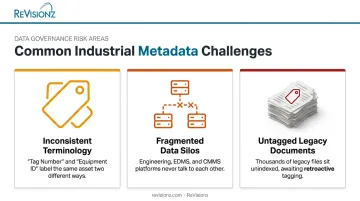
Common challenges in industrial settings include:
- Inconsistent terminology across legacy systems — one system calls it a "tag number," another calls the same thing an "equipment ID"
- Fragmented data silos between engineering, EDMS, and CMMS platforms that were never designed to talk to each other
- Legacy documents with no metadata at all, requiring retroactive tagging before they're usable
Industry-wide standardization efforts like CFIHOS exist specifically to address this terminology problem, creating a common reference language for tag and equipment classes across the process industries. But standardization alone won't sustain quality without someone owning it day to day.
Assign metadata stewardship. Someone needs to own metadata quality, not as a side task but as a defined role. Embed that stewardship within your broader digital transformation roadmap rather than treating metadata as a one-off cleanup project. Programs that skip this step tend to see quality erode again within a year or two.
Frequently Asked Questions
Does metadata need to be managed?
Yes. Unmanaged metadata quickly becomes outdated or inconsistent, causing retrieval issues, duplicated records, and reduced trust in your data. Active management prevents these problems before they compound.
What is the difference between metadata management and data governance?
Data governance sets the policies, standards, and accountability structures for data across an organization. Metadata management is the operational practice that implements those standards, making data findable and usable day to day.
What is metadata, and what are some examples?
Metadata is "data about data" — the context that describes a piece of information. A tag number's associated equipment type, install date, and document revision are all examples of metadata.
What are the main types of metadata?
The four main types are: technical (system and format details), business (definitions and rules), administrative (ownership and access), and descriptive/structural (how records relate to one another).
What tools are used for metadata management?
Common tools include data catalogs, business glossaries, and data lineage platforms. AI-powered active metadata platforms are increasingly used for automated tagging and classification of unstructured content.
How does metadata management support digital twins and asset information management?
Accurate, well-governed metadata is the foundation that links engineering, operational, and maintenance data together. Without it, a digital twin has no reliable way to connect a 3D model to real-world asset conditions.