: Key Use Cases & Benefits](https://file-host.link/website/revisionz-wa5qbp/assets/blog-images/0f75f0d6-0cdb-4ac3-a7db-a2ea83d131b9/1784635627657436_05481a85509146fba15701527cdf5e36/360.webp)
Introduction
Asset-intensive operators are under pressure from every direction. Aging infrastructure, tighter margins, and stricter safety rules leave little room for guesswork in how teams maintain and operate equipment.
Many treat data analytics as just another IT buzzword, but for plants, mines, and pipelines, its value shows up in concrete, measurable ways: fewer breakdowns, safer shifts, and lower repair bills.
This article breaks down what data analytics in asset management actually means and the core use cases driving results across oil & gas, chemicals, mining, and manufacturing. It also covers the specific KPIs worth tracking, not just the theoretical upside.
TL;DR
- Raw data (sensor readings, maintenance logs, inspections) becomes maintenance, reliability, and capital-planning decisions
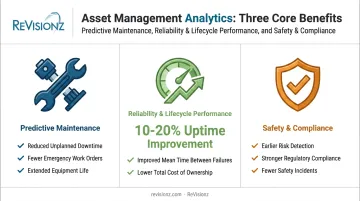
- Predictive maintenance, reliability gains, and compliance are the three benefit categories with the clearest operational payoff
- Only 23% of industrial companies base operational decisions on data, per an ARC/Plant Services survey
- Its value compounds only when it's built on clean, governed, lifecycle-ready asset data
What Is Data Analytics in Asset Management?
In plain terms, data analytics in asset management means using information from sensors, maintenance systems, inspections, and financial records to understand, predict, and improve how physical assets perform across their lifecycle.
Engineering, maintenance, reliability, and operations teams apply it daily across oil & gas, chemicals, mining, and manufacturing to lower total cost of ownership, improve uptime, and strengthen safety performance.
The Four Types of Asset Analytics
Analytics maturity builds in layers, each one adding more predictive power and complexity:
| Type | Answers | Common Tools |
|---|---|---|
| Descriptive | What happened? | Dashboards, KPI reports, historical trend data |
| Diagnostic | Why did it happen? | Root cause analysis, failure mode correlation |
| Predictive | What will happen next? | Statistical models, machine learning on sensor data |
| Prescriptive | What should we do about it? | Optimization engines for scheduling and resourcing |
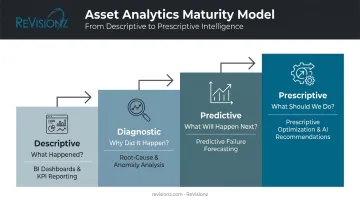
Most organizations start with descriptive and diagnostic work because it's achievable with data they already have. Predictive and prescriptive analytics require cleaner, better-structured data feeding into the model, which is where many programs stall.
Key Advantages of Data Analytics in Asset Management
The advantages below focus on measurable, operational outcomes: the metrics asset-intensive businesses already track around downtime, cost, reliability, and compliance.
Predictive Maintenance & Reduced Unplanned Downtime
Predictive maintenance uses sensor and IoT data alongside historical maintenance records to forecast equipment failures before they happen, rather than relying on fixed time-based schedules.
In practice, this looks like continuous condition monitoring feeding machine learning models that flag anomalies and estimate remaining useful life for critical equipment. Vibration sensors on a pump, for example, can detect bearing wear weeks before a scheduled inspection would have caught it.
Why this matters:
- Catching failures early avoids emergency repairs and the premium costs that come with them
- Teams shift from reactive firefighting to scheduled, planned maintenance windows
- An offshore operator that applied 30 years of historical data across nine platforms achieved a 20% reduction in downtime and added over 500,000 barrels of annual production, according to McKinsey
KPIs impacted:
- Mean Time Between Failures (MTBF)
- Mean Time To Repair (MTTR)
- Unplanned downtime hours
- Maintenance cost per asset
This advantage matters most for high-value, safety-critical, or hard-to-access equipment such as offshore platforms, rotating machinery, and remote infrastructure, where both failure costs and access costs run high.
Improved Asset Reliability & Lifecycle Performance
This use case applies performance and utilization data across an asset's full lifecycle to optimize how it's operated, maintained, and eventually replaced.
Practically, this means combining engineering data, work order history, and performance metrics into one source of truth to support reliability-centered maintenance strategies. Instead of guessing when a compressor needs an overhaul, teams can see actual wear trends against design specifications.
Why this matters:
- Visibility into asset health trends supports smarter capital planning
- Extends useful asset life and reduces total cost of ownership
- Deloitte's analysis estimates predictive maintenance programs can improve equipment uptime and availability by 10% to 20%, while cutting maintenance-planning time by up to half
KPIs impacted:
- Overall Equipment Effectiveness (OEE)
- Asset utilization rate
- Total cost of ownership
- Asset availability
The stakes are highest for large, multi-site operations with aging infrastructure and significant capital tied up in physical assets, where a bad replacement decision on one unit can ripple across a whole facility's budget.
Stronger Safety, Risk & Regulatory Compliance
Applying analytics to operational, inspection, and process safety data helps identify risk before an incident occurs, while keeping documentation audit-ready.
Real-time monitoring dashboards and automated compliance reporting flag deviations from safe operating limits or regulatory thresholds as they happen, rather than during a quarterly review when it's too late to intervene.
Why this matters:
- Earlier risk detection reduces safety incidents and regulatory findings
- Automated reporting cuts down manual compliance effort
- NIOSH concluded that proximity detection technology could have helped prevent 80% of 33 mining fatalities tied to continuous mining machines since 1984
KPIs impacted:
- Recordable incident rate
- Number of compliance findings or audit exceptions
- Time to close corrective actions
The risk profile is highest in hazardous-process environments such as oil & gas, petrochemicals, and mining, where a single safety incident carries financial and reputational costs far beyond the immediate repair.
What Happens When Asset Data Analytics Is Missing or Ignored
Skip the analytics layer, and the consequences don't stay hidden for long. Here's what tends to show up:
- Reactive maintenance driven by guesswork instead of data, with breakdowns dictating the schedule
- Higher failure rates because there's no early warning signal to act on
- Rising costs over time as small, unaddressed issues compound into major repairs
- Difficulty scaling or standardizing practices across multiple sites
- Greater safety and compliance exposure from fragmented, untrustworthy asset records
Poor maintenance strategies alone can reduce a plant's productive capacity by 5% to 20%, and unplanned downtime costs industrial manufacturers an estimated $50 billion annually, according to Deloitte's research. None of that is inevitable. It's the cost of operating without visibility.
How to Get the Most Value from Asset Management Analytics
Analytics only delivers value when it's built on clean, governed, lifecycle-ready asset data, not bolted onto disorganized legacy records. Insights also need to be acted on consistently. A dashboard that nobody uses to change a maintenance schedule isn't delivering value, no matter how sophisticated the model behind it.
Practical steps to get there:
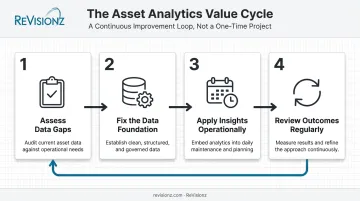
- Start with an assessment: identify where asset data is fragmented, inaccurate, or missing before investing in advanced analytics or AI tools
- Fix the foundation first: standards, governance, and a single source of truth matter more than the analytics platform itself
- Apply insights operationally: feed predictive findings into actual scheduling and planning decisions, not just reports
- Review outcomes on a regular cadence: analytics value compounds with continuous refinement, not a one-time rollout
This is where firms like ReVisionz typically get involved. ReVisionz helps owner-operators transform unstructured engineering and asset data into lifecycle-ready information, including through its AI-powered Main Information Contractor+ (MIC+) offering. This ensures the data foundation holds up under the weight of predictive and prescriptive analytics.
Conclusion
The real value of data analytics in asset management lies beyond the dashboard. It brings control and clarity to maintenance and operational decisions that used to run on instinct.
Reduced downtime and stronger reliability compound over time. So does better compliance, but only when these gains sit on top of a governed, well-structured data foundation. Skip that step, and even the best predictive model will be working with bad inputs.
Treat analytics as a capability that matures over years rather than a software purchase you check off a list. Partnering with ReVisionz, an experienced digital asset transformation consultancy, can shorten that maturity curve considerably.
Frequently Asked Questions
What does an asset data analyst do?
An asset data analyst collects, cleans, and analyzes asset performance and maintenance data to generate insights that inform reliability, maintenance, and capital investment decisions. They typically work across CMMS, ERP, and sensor data sources.
What are the 5 P's of asset management?
The 5 P's (Policy, People, Processes, Plant/Physical assets, and Performance measurement) are a commonly referenced framework for structuring asset management strategy across an organization, though it isn't a formal ISO standard.
What are the 4 types of data analytics?
Descriptive analytics explains what happened, diagnostic explains why, predictive forecasts what's likely next, and prescriptive recommends the best action. Each type builds on the last in complexity and decision-making value.
How does predictive maintenance use data analytics?
Sensor and historical maintenance data feed machine learning models that forecast equipment failures before they occur. This enables condition-based maintenance, acting on actual asset health, instead of rigid time-based schedules.
What data sources feed asset management analytics?
Common sources include IoT and sensor data, CMMS/EAM work order history, engineering and design records, inspection reports, and financial or operational systems like ERP platforms.
Do smaller operations need data analytics for asset management, or only large enterprises?
Any asset-intensive operation benefits from right-sized analytics, regardless of size. Smaller operators often get the most value starting with descriptive or diagnostic analytics before advancing toward predictive capabilities.