
Introduction
Every Process Hazard Analysis you'll ever run depends on one thing: complete, accurate Process Safety Information. Under 29 CFR 1910.119(d), OSHA requires employers to compile PSI before conducting any PHA. Skip this step, or compile it poorly, and every downstream PSM element built on that foundation becomes suspect.
Here's the problem: PSI rarely lives in one place.
- Chemical data sits in SDS binders
- Process technology hides in decades-old design files
- Equipment specs scatter across P&IDs that may not match what's installed in the field
Compiling it all is often the most time-consuming, error-prone part of any PSM program.
This guide walks through OSHA's exact PSI requirements, a practical compilation process, the mistakes that trigger citations, and how to keep your PSI accurate long after the initial push.
Key Takeaways
- PSI must cover chemical hazards, process technology, and process equipment, per 29 CFR 1910.119(d)
- Compilation must be finished before any PHA begins
- Outdated P&IDs and disconnected storage systems are recurring sources of PSM findings
- Linking PSI updates to Management of Change keeps information current as assets age
What Is Process Safety Information (PSI)?
PSI is the written documentation of chemical, process technology, and equipment hazards tied to covered processes involving highly hazardous chemicals. Rather than a single document, it's a compiled record that OSHA treats as one of 14 interconnected elements of the Process Safety Management standard.
Positioned right after Employee Participation and directly ahead of Process Hazard Analysis, PSI is the technical foundation everyone else builds on:
- PHA teams use it to identify and evaluate hazards
- Operators reference it for safe operating limits
- Auditors check it against actual field conditions
- Emergency planners rely on it to anticipate worst-case scenarios
Think of PSI as the plant's factual memory. Without it, a PHA team is guessing.
Why it matters beyond compliance: Facilities with complete, current PSI catch deviations before they become incidents. They make faster, better-informed operating decisions. Accurate design data also protects asset integrity over the long haul, reducing the guesswork that leads to premature equipment failure or unplanned downtime.
OSHA's Process Safety Information Requirements Under 29 CFR 1910.119(d)
29 CFR 1910.119(d) states plainly: employers "shall complete a compilation of written process safety information before conducting any process hazard analysis."
For processes where original data no longer exists, OSHA allows employers to develop the information using process engineering evaluation and best available data. It must still be detailed enough to support a meaningful PHA.
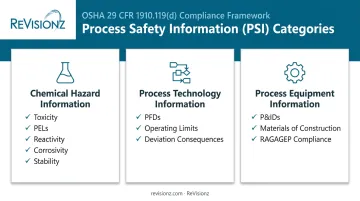
The requirement breaks into three categories.
Chemical Hazard Information
At minimum, PSI must document:
- Toxicity data
- Permissible exposure limits (PELs)
- Physical data
- Reactivity data
- Corrosivity data
- Thermal and chemical stability data
- Hazards from foreseeable inadvertent mixing of materials
Safety Data Sheets meeting 29 CFR 1910.1200(g) can satisfy this requirement, but only "to the extent" they contain the required fields. An SDS often lacks process-specific reactivity or corrosivity data. Relying on the SDS alone, without checking each field against your actual process conditions, lets gaps slip into your PSI package.
Process Technology Information
This category covers:
- Block flow diagrams or simplified process flow diagrams (PFDs)
- Process chemistry
- Maximum intended inventory
- Safe upper and lower operating limits (temperature, pressure, flow, composition)
- Consequences of deviation, including impacts on employee safety and health
Where original technical data no longer exists, OSHA permits developing this information alongside the PHA itself, provided it's specific enough to support the analysis.
Process Equipment Information
Equipment data is typically the hardest category to compile, since it depends on design records that may be decades old. Required fields include:
- Materials of construction
- P&IDs
- Electrical classification
- Relief system design and design basis
- Ventilation system design
- Design codes and standards used
- Material and energy balances (for processes built after May 26, 1992)
- Safety systems, such as interlocks and detection/suppression systems
Employers must also document that equipment complies with RAGAGEP — Recognized and Generally Accepted Good Engineering Practice. For equipment built to standards no longer in general use, you need to determine and document that it's still designed, maintained, and operating safely. That determination often requires field verification, not just a records search.
How to Build a PSI Compilation: Step-by-Step Implementation
Compiling PSI isn't a one-week project on any facility with real operating history. Here's a sequence that works.
Inventory every covered process and HHC. Document maximum on-site quantities to define the scope of your compilation. This step determines everything that follows.
Compile chemical hazard data. Cross-reference current SDSs against the seven required data points. Flag any missing reactivity, corrosivity, or stability data for engineering follow-up rather than assuming the SDS is sufficient.
Document process technology. Create or validate block flow diagrams, safe operating limits, and deviation consequences with input from process engineers who understand why the limits exist, not just what they are.
Confirm equipment information. Verify P&IDs against as-built field conditions. This is where most gaps surface. If original design codes and standards can't be located, reconstruct them through field verification and engineering judgment.
Establish a maintenance protocol tied to MOC. Any physical or procedural change should automatically trigger a PSI review. Without this link, your compilation starts decaying the day after you finish it.
OSHA's PSM Covered Chemical Facilities National Emphasis Program tells inspectors exactly what to pull during a PSI audit:
- Chemical lists and maximum intended inventories
- Safe operating limits
- P&IDs with legends
- Relief device documentation
- Design codes and standards
Inspectors also visually inspect relief and vent systems in the field. In other words, they go looking for exactly the gaps that fragmented PSI compilation tends to produce.
Common PSI Management Pitfalls to Avoid
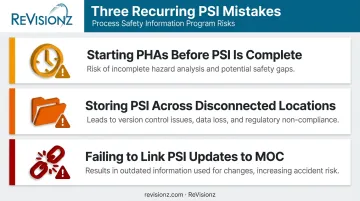
Most PSI problems trace back to a handful of recurring mistakes.
Starting PHAs before PSI is complete. This seems obvious, but schedule pressure pushes teams to start analysis with partial data. The result: analysis gaps that surface during revalidation and force expensive rework.
Storing PSI across disconnected locations. Shared drives, filing cabinets, personal laptops, old SharePoint sites — when PSI is scattered, nobody can produce a complete package quickly during an audit, an MOC review, or an actual emergency.
Failing to link PSI updates to MOC. This is the silent killer. Without that link, P&IDs, SDSs, and operating limits drift out of sync with real operations, one small change at a time, until nobody trusts the documentation anymore.
These gaps aren't hypothetical. The CSB's investigation into the Husky Superior refinery incident found that critical FCC unit process-technology and hazard information from 1960 and 2016 licensor manuals was missing from the facility's PSI package entirely.
The CSB's recommendation afterward: include and actively maintain licensor manuals as part of the PSI record for the life of the unit. A single missing document category can undermine an entire PSM program.
Best Practices for Digitizing and Sustaining PSI Long-Term
PSI is a living dataset that requires structure and ownership, not a one-time compliance folder you file away.
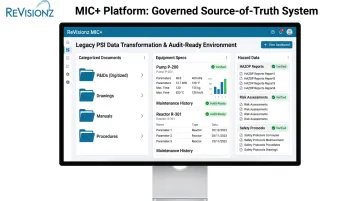
Centralize PSI in a single digital source of truth. Paper binders and shared drives don't scale. When PHA teams, operators, maintenance, and auditors all pull from the same governed system, discrepancies get caught early instead of during an incident investigation.
Tie reviews to your PHA revalidation cycle. OSHA doesn't mandate a separate PSI review interval. Best practice ties periodic verification to the five-year PHA revalidation cycle under 1910.119(e)(6), with continuous MOC-triggered updates filling the gaps in between.
Move toward structured, lifecycle-ready data. Static PDFs and scanned drawings can't feed analytics or predictive maintenance programs. Engineering data platforms and Asset Information Management (AIM) programs convert unstructured PSI into data that supports real-time compliance dashboards and condition-based decision-making.
This is where ReVisionz's AIM practice, led by Andrew Sheedy, focuses its work with owner-operators. The goal: a governed "source of truth" that keeps P&IDs, equipment specs, and hazard data aligned across engineering, operations, and maintenance instead of drifting apart over time.
ReVisionz's AI-powered Main Information Contractor+ (MIC+) service tackles exactly this problem. It takes years of unstructured legacy PSI data and organizes it into a digital, audit-ready environment that doesn't require a full re-compilation every time an auditor shows up.
Involve engineering, operations, and safety together. PSI created in isolation by one department almost always misses field realities that another department would have caught. Cross-functional input during creation and updates keeps the data accurate.
Frequently Asked Questions
What are the 14 elements of PSM?
The 14 elements are: Employee Participation, Process Safety Information, Process Hazard Analysis, Operating Procedures, Training, Contractors, Pre-startup Safety Review, Mechanical Integrity, Hot Work Permit, Management of Change, Incident Investigation, Emergency Planning and Response, Compliance Audits, and Trade Secrets.
What are the 4 pillars of process safety?
CCPS defines four pillars: Commit to Process Safety, Understand Hazards and Risk, Manage Risk, and Learn from Experience. PSI directly supports the "Understand Hazards and Risk" pillar, since it's the raw data that makes hazard understanding possible.
What is an MSDS now called?
It's called a Safety Data Sheet (SDS). OSHA's 2012 update aligned the Hazard Communication Standard with the Globally Harmonized System, replacing the old MSDS format with a standardized 16-section SDS under 29 CFR 1910.1200(g).
What are the 4 parts of OSHA?
OSHA's regulations under Title 29 CFR group into four areas: General Industry (Part 1910), Construction (Part 1926), Maritime (Parts 1915, 1917, 1918), and Agriculture (Part 1928).
How does PSI differ from a Process Hazard Analysis (PHA)?
PSI is the compiled factual data about chemicals, technology, and equipment. PHA is the systematic analysis that uses that data to identify and evaluate hazards. PSI has to exist first; PHA can't function without it.
How often must PSI be reviewed and updated?
OSHA sets no fixed PSI review interval. Best practice ties verification to the five-year PHA revalidation cycle, with immediate updates through the MOC process whenever a physical or procedural change occurs.