Introduction
A blown seal on a critical pump shouldn't turn into a three-day production stoppage. Yet in plenty of asset-intensive operations, that's exactly what happens because MRO procurement gets treated as an afterthought.
Maintenance, repair, and operations purchasing directly shapes uptime, safety, and total cost of ownership. Still, many organizations manage it with fragmented buying and poor spend visibility, compounded by maintenance data that never talks to procurement systems.
The result: overspending on rush orders, stockouts on critical spares, unplanned downtime, and maintenance teams stuck firefighting instead of planning.
This article breaks down seven proven MRO procurement strategies that move teams from reactive purchasing to a data-driven model built for maintenance excellence. The data underneath those strategies matters just as much as the strategies themselves.
Key Takeaways
- MRO procurement success combines sourcing discipline with maintenance planning, from standardization to criticality-based purchasing
- Reactive, emergency buying costs more than planned purchasing through rush fees and expedited freight
- Clean, structured asset and materials data determines whether any MRO strategy delivers results
- Treating MRO as a strategic category delivers measurable gains in uptime, compliance, and cost control
What Is MRO Procurement?
MRO procurement covers the sourcing of goods and services that keep equipment, assets, and facilities running. Unlike direct materials, none of it becomes part of a finished product.
Common MRO categories in asset-intensive industries include:
- Spare parts and repair components
- PPE and safety equipment
- Lubricants and industrial fluids
- Tools and calibration equipment
- Cleaning and facility supplies
- Third-party repair and maintenance services
MRO spans hundreds of low-dollar SKUs across dozens of suppliers. As a result, it represents a meaningful and frequently underestimated share of total indirect spend, one that rarely gets the sourcing rigor applied to direct materials.
Defining an MRO Procurement Strategy
An MRO procurement strategy is a structured, proactive framework that connects sourcing, inventory management, and maintenance planning. Instead of buying parts reactively after something breaks, it aligns purchasing decisions with actual asset criticality and failure data.
The goal extends beyond lower unit prices to reducing total cost of ownership and downtime risk across the full asset base.
The MRO Purchasing Process: From Request to Reorder
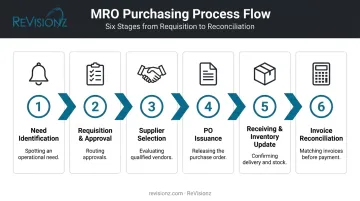
A typical MRO purchase moves through a defined sequence:
- Need identification – often triggered by a CMMS or EAM alert flagging a failing component or low inventory
- Requisition and approval – the request routes through approval workflows based on value and category
- Supplier selection – buyer sources from a preferred vendor or contract
- Purchase order issuance – terms, pricing, and delivery are locked in
- Receiving and inventory update – parts arrive, inventory records update
- Invoice reconciliation – payment matches the PO and receipt
That process looks very different depending on whether the purchase is planned or an emergency.
Planned vs. Emergency Purchasing
Routine, forecasted parts move smoothly through catalog ordering or blanket agreements, with negotiated pricing and predictable lead times. Emergency purchases skip most of that discipline entirely.
When a critical asset fails without warning, maintenance teams often bypass standard sourcing channels, pay premium prices, and absorb expedited freight costs just to get equipment running again. That urgency erodes the savings built through standardization and supplier consolidation elsewhere in the program.
Cutting that reliance on emergency buying starts before a failure ever happens. The differentiator between an efficient purchasing process and a manual, siloed one usually comes down to system integration. When CMMS or EAM platforms connect directly to procurement or ERP systems, maintenance alerts can trigger requisitions automatically—cutting the lag between "part is needed" and "part is ordered."
7 MRO Procurement Strategies for Maintenance Excellence
Strategy 1: Standardize and Centralize Your MRO Catalog
Most plants accumulate duplicate SKUs over time: the same bearing described three different ways by three different sites, purchased at three different prices. SKU rationalization fixes this by consolidating inconsistent item descriptions into one managed catalog with standardized part numbers and approved suppliers.
A global metals company used text analytics to match thousands of MRO SKUs into a universal catalog. The result: overall MRO spend fell 20%, according to a McKinsey analysis of digital MRO procurement.
Beyond cost, a centralized catalog means:
- Fewer maverick purchases outside approved channels
- Faster price benchmarking across sites
- Quicker ordering for maintenance crews who no longer hunt through inconsistent part descriptions
Strategy 2: Consolidate and Rationalize the Supplier Base
Cutting vendors indiscriminately backfires: you lose sourcing flexibility for niche parts. A smarter approach groups suppliers by category and performance, aiming for a manageable core panel (two or three strategic vendors) per basket rather than dozens of one-off relationships.
One industrial company with more than $250 million in annual MRO spend used ERP controls to direct purchases toward a small set of strategic suppliers per category. That consolidation cut total cost of ownership for MRO procurement by more than 15%, per the same McKinsey research.
Fewer, stronger supplier relationships also mean:
- Real volume leverage in pricing negotiations
- Fewer purchase orders and invoices to process
- Better service-level agreements from vendors who value a larger account
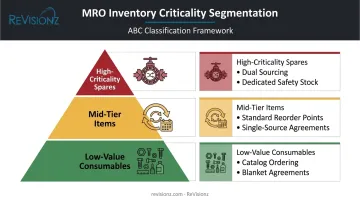
Strategy 3: Segment MRO Categories by Criticality
Not every part deserves the same sourcing effort. ABC analysis tiers MRO items by operational criticality and value, matching inventory strategy to actual business risk instead of treating every SKU the same way.
In practice, this looks like:
- High-criticality spares (think: the only pump keeping a production line alive) justify dual sourcing and dedicated safety stock
- Mid-tier items get standard reorder points and single-source agreements
- Low-value consumables, like cleaning supplies or common fasteners, suit catalog ordering or blanket purchasing agreements with minimal oversight
This tiering prevents two common failures: over-investing in inventory for parts that barely matter, and under-protecting the handful of components that actually determine whether the plant runs.
Strategy 4: Shift From Reactive to Predictive Purchasing
Predictive purchasing pulls maintenance data—failure patterns, asset condition, usage trends—directly into procurement planning, forecasting part needs before a breakdown forces an emergency order.
The stakes here are significant. Siemens estimates unplanned downtime costs the world's 500 largest companies $1.4 trillion annually, equal to roughly 11% of their revenues, based on 181 interviews with maintenance, engineering, and IT professionals across industrial sectors.
At the plant level, that averages $253 million per year for a large facility, according to Siemens' 2024 True Cost of Downtime report.
Predictive purchasing directly targets that exposure by:
- Flagging parts likely to fail based on condition data, not just calendar intervals
- Reducing emergency orders and the expedited freight that comes with them
- Giving procurement lead time to negotiate rather than pay premium rush pricing
Strategy 5: Digitize Procurement With eProcurement and Automation Tools
Manual MRO purchasing (spreadsheets, email approvals, disconnected systems) hides where money actually goes. eProcurement platforms with automated reorder points and contract compliance tools change that by making spend visible in real time.
Even simple digital controls pay off quickly. McKinsey found that using optical character recognition tools to digitize MRO contracts and invoices typically produced 5% savings, largely by enforcing contract terms that were already negotiated but weren't being followed.
AI-enabled spend analytics take this further, surfacing hidden tail spend and maverick purchasing patterns buried across dozens of sites and thousands of transactions that manual review would never catch.
Strategy 6: Use Vendor-Managed Inventory and Long-Term Agreements for High-Frequency Items
For items consumed constantly and predictably (filters, lubricants, PPE), vendor-managed inventory (VMI) shifts replenishment responsibility to the supplier. The vendor monitors stock levels and triggers reorders directly, freeing maintenance teams from routine reordering.
VMI only works under two conditions:
- Reliable, accurate consumption data feeding the supplier's replenishment triggers
- A rationalized supplier relationship built on trust, not just a transactional purchase order
That's why VMI ties directly back to Strategies 2 and 4. Without supplier consolidation and clean demand data, VMI arrangements tend to break down fast, leading to either overstock or unexpected shortages.
Strategy 7: Build Governance Around Asset and Materials Master Data
Every strategy above (standardization, criticality segmentation, predictive planning, VMI) depends on one thing underneath it: clean, structured data connecting engineering and asset records to procurement and maintenance systems.
Without that foundation, standardization efforts stall because nobody agrees on which SKU is which. Criticality tiers get built on incomplete asset registers. Predictive models forecast against inconsistent maintenance history.
Few organizations tackle this systematically. Firms like ReVisionz build this governance layer directly, connecting materials catalogs, asset registers, and ERP systems into a single source of truth that keeps the other six strategies from unraveling.
Why Asset and Materials Data Quality Powers MRO Procurement Success
MRO strategies only work as well as the data underneath them. Inconsistent tagging, duplicate part records, and disconnected CMMS, ERP, and EAM systems undermine standardization, criticality segmentation, and predictive planning at the same time.
Building a Single Source of Truth
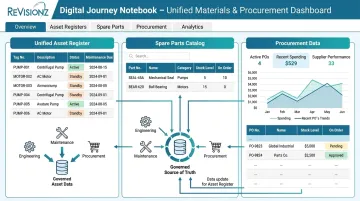
The fix is a single source of truth for materials master data—one that connects engineering documentation, spare parts catalogs, and procurement systems. When that connection exists, demand planning gets more accurate and supplier negotiations get stronger, because everyone is working from the same validated numbers.
This is the specific gap ReVisionz's Materials Management Practice addresses. Working with owner-operators across energy, chemicals, mining, and manufacturing, the practice transforms fragmented, unstructured asset and materials data into information that's lifecycle-ready, procurement-ready, and genuinely usable.
The firm's AI-powered Main Information Contractor+ (MIC+) service extends this further. MIC+ repairs data gaps, aligns information across systems, and prepares load files for CMMS and EAM platforms.
The result is a shared, governed source of truth for procurement and maintenance teams, replacing competing spreadsheets. It's a clear example of how data enrichment and governance technology moves MRO procurement from reactive to proactive.
The business case is straightforward:
- Lower total cost of ownership through fewer duplicate purchases and better negotiated terms
- Stronger safety and regulatory compliance from accurate, accessible asset records
- Better ROI on both maintenance and procurement technology investments, since clean data is what makes those systems actually work as designed
Common MRO Procurement Pitfalls That Undermine Maintenance Excellence
Even well-intentioned MRO programs stumble on the same few mistakes.
Treating MRO as too small to matter. Because individual purchases are low-dollar, organizations skip the sourcing rigor applied to direct materials, despite MRO representing a meaningful share of total indirect spend across the enterprise.
Letting maverick spend persist. Without a preferred supplier program or catalog discipline, purchasing decentralizes back to individual sites and technicians, eroding whatever savings a centralized strategy achieved. McKinsey's research points to fragmented vendor networks and inconsistent free-text item descriptions as recurring symptoms of this problem.
Chasing unit price instead of total cost. A cheaper part that fails twice as often, ships slower, or requires more labor to install isn't actually cheaper. Total cost of ownership (downtime risk, quality, lifecycle cost) matters more than the number on the invoice.
Frequently Asked Questions
What is MRO in procurement?
MRO stands for maintenance, repair, and operations spend—goods and services that keep equipment and facilities running rather than becoming part of a finished product. It typically falls under indirect procurement.
What is an MRO procurement strategy?
An MRO procurement strategy is a structured, proactive framework combining sourcing discipline, inventory management, and maintenance planning. The goal is reducing total cost of ownership and downtime, not just cutting unit prices.
What is the MRO purchasing process?
The process runs from need identification (often a CMMS alert) through requisition, approval, supplier selection, PO issuance, receiving, and invoice reconciliation. Planned purchases follow this smoothly; emergencies often skip steps.
How is MRO procurement different from direct materials procurement?
MRO involves high-volume, low-value, often unpredictable buying across thousands of SKUs. Direct materials procurement is planned, forecasted, and tied directly to product output.
How does predictive maintenance improve MRO procurement outcomes?
Predictive maintenance feeds failure patterns and asset condition data into procurement planning, forecasting part needs before breakdowns happen. That reduces emergency purchasing and the premium pricing that comes with it.
Why is asset data quality important for MRO procurement success?
Clean, connected asset and materials data is what makes standardization, criticality segmentation, and predictive purchasing actually work. Without it, every downstream strategy is built on shaky ground.