ISO 8000 exists to fix exactly this problem. It's the international standard series for data quality and master data, developed by ISO Technical Committee 184/SC4, and it treats data quality as something you can actually verify against a stated requirement, not an abstract goal everyone nods along to.
This guide covers what ISO 8000 is, how its parts are structured, the core concepts you need to understand (portability, provenance, quality dimensions), why it matters for capital-intensive operations, and how organizations approach compliance.
Key Takeaways
- ISO 8000 is the only ISO series dedicated to data quality, unlike ISO/IEC 25012 or DAMA DMBOK
- Numbering signals scope: Parts 1–99 general, 100–199 master data, 200+ specialized types
- Portability and provenance are central: data must outlive the software that created it
- Self-certification is always permitted; ECCMA's MDQM offers optional third-party validation
What Is ISO 8000? Understanding the International Data Quality Standard
ISO 8000 describes the features and requirements for standardized exchange of master data among business partners. It establishes two things every data leader cares about: portability (data that works outside the system that created it) and organization-specific uniqueness, meaning "true" master data is verifiably what it claims to be.
Here's the part most explanations skip: ISO 8000 doesn't define quality as a fixed checklist. It treats quality as context-dependent.
A product record might satisfy every requirement for warehouse picking but fail completely for regulatory reporting, because each use case specifies different data requirements. Quality, in ISO 8000 terms, means verifiable against a stated specification, not a vague aspiration.
Origin and Governing Body
ISO 8000 is developed by ISO/TC 184/SC 4, the subcommittee responsible for "industrial data." Its member nations include some of the world's largest industrial economies, including the US, Germany, Japan, the UK, and China.
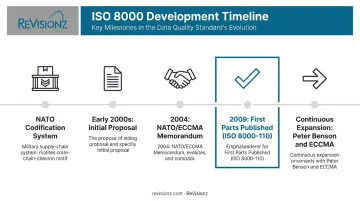
The standard's roots go back further than most people realize. Its founding principles trace to the NATO Codification System, originally built to standardize product descriptions across military supply chains and inventory management. NATO's AC/135 and ECCMA formalized that connection in a 2004 memorandum aimed at promoting the codification approach as an international standard.
Quick facts on the timeline:
- First proposed in the early 2000s
- Initial parts, including ISO 8000-110, published starting in 2009
- Continuously expanded since, with Peter Benson and ECCMA serving as long-standing project leaders
A common mix-up: ISO 8000 (data quality) is not the same as ISO 80000 (quantities and units used in science and engineering). The similar numbering trips up more people than you'd expect.
Practically, the goal is straightforward: better master data means lower procurement costs, tighter inventory optimization, and smoother system integration during ERP implementations.
The Structure of ISO 8000: How the Series Is Organized
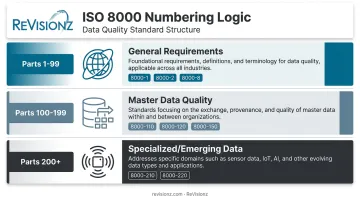
Before looking at individual parts, understand the numbering logic:
- Parts 1–99: General, horizontal requirements applicable to every industry
- Parts 100–199: Master data specifically, the range with the most real-world implementation
- Parts 200+: Specialized and emerging data types, like sensor data
General Data Quality (Parts 1–99)
Three parts form the backbone, and ISO designates all three as "horizontal deliverables," meaning every other part builds on them:
- ISO 8000-1 (Overview): introduces the series
- ISO 8000-2 (Vocabulary): defines shared terminology
- ISO 8000-8 (Concepts and Measuring): the normative part explaining how syntactic, semantic, and pragmatic quality get measured
Beyond these foundations, a set of process and governance parts round out this range. ISO 8000-51 covers the exchange of data governance policy statements, while ISO 8000-61, 62, 63, and 64 address process reference models, organizational maturity assessment, and process measurement.
Master Data Quality (Parts 100–199)
This is where most implementation work actually happens. ISO 8000-110 covers the exchange of characteristic master data: syntax, semantic encoding, and conformance requirements that can be checked by computer. ISO 8000-100 serves as its overview companion.
Several parts build on that foundation:
- ISO 8000-114, 115, 116: quality identifiers and legal entity identifiers, including requirements for portable data formats
- ISO 8000-120, 130, 140: provenance, accuracy, and completeness, the trio that proves data is trustworthy rather than merely present
- ISO 8000-150: defines data quality roles and responsibilities within an organization
Specialized and Emerging Data Types (Parts 200+)
Newer additions reflect where industrial data is heading. ISO 8000-210 and 8000-220 define quality characteristics and measurement methods for sensor data streams, directly relevant to IoT sensors and connected industrial equipment producing continuous data feeds.
The series keeps expanding. Recent and upcoming parts address natural location identifiers and identifiers used in distributed ledgers, including blockchain applications. These additions show ISO 8000 evolving well beyond its 2009 origins to keep pace with modern data ecosystems.
Core Concepts Every Data Quality Professional Should Understand
The Three Measurable Quality Dimensions
ISO 8000-8 defines three types of quality, and the difference between them matters more than most training programs suggest:
| Dimension | What it measures | How it's verified |
|---|---|---|
| Syntactic | Conformance to format and structure | Automated format checks |
| Semantic | Correct encoding of meaning | Validation against open technical dictionaries |
| Pragmatic | Fitness for the intended purpose | Testing against the stated use case |
A record can pass syntactic checks (right format) and semantic checks (right meaning) and still fail pragmatically if it doesn't serve the purpose someone actually needs it for.
Master Data, Not Just "Data"
These three dimensions apply to every data category, but ISO 8000 concentrates its heaviest requirements on master data, the shared, agreed-upon business objects an organization references repeatedly, such as products, parties, locations, and equipment. It's distinct from transactional data (a specific purchase order) or reference data (a list of country codes). Master Data Management exists to govern this category, and it's the part of the data landscape ISO 8000 focuses on most heavily.
Portability: Why It's the Whole Point
Master data must also endure long after any single system disappears. Software gets replaced every 5-10 years. Data often needs to survive decades, especially in asset-intensive industries. ISO 8000 requires data to use an agreed syntax and explicit semantic encoding so it stays usable long after the application that created it is gone. This single requirement explains most of what ISO 8000 actually does.
Provenance and Quality Identifiers
Portability keeps data usable, but usability alone doesn't prove it can be trusted. ISO 8000 requires data to carry verifiable information about where it came from and how it's been transformed. This includes concepts like Authoritative Legal Entity Identifiers, which trace ownership and legal responsibility for data back to a specific, verifiable source. Without provenance, a "quality" claim is just an assertion.
Open Technical Dictionaries
Provenance confirms where data came from, but semantic encoding requires a shared vocabulary too, which is where companion standard ISO 22745 comes in. Open technical dictionaries, such as the ECCMA Open Technical Dictionary, give organizations a common vocabulary so a "valve" means the same thing across every system it touches.
Why ISO 8000 Matters for Asset-Intensive Industries
Engineering, procurement, and asset data in oil & gas, chemicals, and manufacturing all face the same root problems ISO 8000 was built to solve:
- Inconsistent master data across ERP, EAM, and engineering systems
- Poor or missing provenance, making it impossible to trust where a value came from
- Non-portable formats that break during system migrations or software upgrades
Any one of these creates costly errors during equipment handover, maintenance planning, or compliance reporting. All three together can derail an entire digital transformation program.
Digital twin and Asset Information Management programs depend on these same fundamentals. For a digital twin, portability and semantic consistency are non-negotiable requirements. If asset data can't survive a system migration, the "single source of truth" a digital twin promises falls apart within a few years.
This is the terrain ReVisionz works in daily. As a digital asset transformation consultancy, ReVisionz brings more than two decades of experience in AIM and data migration and enrichment methodologies. That experience helps owner-operators and EPCs structure and govern master data in ways that align with standards-based data quality principles like those in ISO 8000.
In practice, that has meant building tag registers that automatically generate current asset registry reports, or validating and enriching asset records against a zero-rework standard before a system goes live.
The specifics vary by client, but the goal stays constant: data that remains accurate, traceable, and usable long after the project team moves on, supporting safer, more compliant operations.
ISO 8000 Compliance and How It Compares to Other Data Quality Standards
Is Certification Required?
No. ISO standards are built for self-certification. Organizations can assess and declare their own conformity without external validation, and ISO itself doesn't perform certification or issue certificates for any of its standards.
Third-party certification is optional, but it adds credibility, particularly when demonstrating compliance to partners or regulators matters more than internal confidence does.
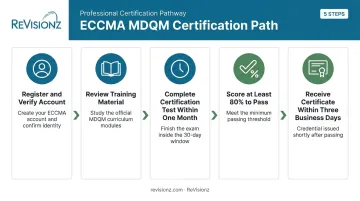
ECCMA's Master Data Quality Manager (MDQM) certification is the most established third-party route:
- Register and verify your account
- Review the provided training material
- Complete the certification test within one month
- Score at least 80% to pass
- Receive your certificate within three business days
Renewal requires the same 80% threshold, keeping the credential tied to current practice rather than a one-time test.
How ISO 8000 Compares to Other Data Quality Frameworks
ISO 8000 doesn't exist in isolation. It's often compared to ISO/IEC 25012 and to DAMA's DMBOK paired with Six Sigma/TDQM.
ISO 8000 vs. ISO/IEC 25012
These two get confused constantly, but they're complementary, not competing:
| Standard | What It Defines |
|---|---|
| ISO 8000 | How to verify and exchange quality data (the mechanics) |
| ISO/IEC 25012 | Which quality characteristics exist, such as accuracy, completeness, and consistency |
ISO/IEC 25012 supplies the vocabulary for defining what good looks like. ISO 8000 supplies the enforceable process for proving you've achieved it.
ISO 8000 vs. DAMA DMBOK and Six Sigma/TDQM
DAMA's DMBOK is a knowledge framework, not a standard. It describes practices and terminology broadly but doesn't prescribe testable requirements. Six Sigma and TDQM treat data quality as a continuous improvement problem, using cycles like DMAIC to reduce defects over time.
ISO 8000 differs from both because it's normative and auditable. You generate a compliant data exchange file, run it through a check, and get a pass/fail answer. Neither DMBOK nor Six Sigma gives you that kind of binary result.
Frequently Asked Questions
What are the ISO 8000 standards?
ISO 8000 is the ISO series for data quality and master data. It organizes into general (1–99), master data (100–199), and specialized (200+) parts, covering everything from vocabulary to exchange syntax and provenance.
What is ISO 8000 classification?
ISO 8000 classifies the series by number range: general data quality parts, master data quality parts, and specialized data type parts. Each range addresses a distinct scope within the broader standard.
Is ISO 8000-compliant data portable?
Yes. Portability is a core requirement: data must use an agreed syntax and explicit semantic encoding. This lets any application interpret the data independently of the one that created it.
Is ISO 8000 certification mandatory?
No. ISO 8000 always permits self-certification. Third-party certification, such as ECCMA's MDQM, is optional and adds an extra layer of confidence for partners and regulators.
How does ISO 8000 differ from ISO 9001?
ISO 9001 specifies requirements for a general quality management system. ISO 8000 focuses specifically on the quality, exchange, and portability of data itself.
Which industries use ISO 8000?
Adoption spans supply chain, government, defense, healthcare, and asset-intensive process industries, driven by procurement efficiency, regulatory compliance, and the need for reliable master data exchange.