Common Challenges With Industrial Data
Organizations pursuing digital transformation encounter recurring, structural challenges that prevent industrial data from being broadly usable or trusted across teams, slowing progress and limiting impact.
Data Lacks Context
Industrial data is collected continuously but is rarely connected to the broader operational reality. When large amounts of data lack context, domain experts struggle to understand what is happening and why it matters.
Systems Don’t Work Together
Data is spread across control systems, engineering tools and maintenance platforms that were never designed to connect. This separation prevents a shared understanding of operations and limits insight across teams.
Trust in Data Is Fragile
When data quality varies or lineage is unclear, confidence erodes quickly. Teams hesitate to rely on analytics or recommendations when the origin and preparation of data cannot be traced.
Value Stops at the Pilot Stage
Many organizations are struggling to justify investing in implementing pilot projects at scale. Without standardized foundations, analytics and digital solutions are costly to maintain and difficult to reuse across assets or sites.
Bringing Structure to Industrial Data
ReVisionz’ Industrial DataOps solutions focus on the full journey of industrial data. We know how to translate different systems and data formats into one cohesive vision of an Asset. From how it is collected and normalized to how it is contextualized, visualized and shared, each step supports decision-making across your organization.
Managing this journey end-to-end breaks down silos and improves the availability and usability of data across the asset lifecycle. The result is data that supports coordinated decision-making so organizations can operate with greater clarity and control.
Building on the Right Foundation
Industrial DataOps provides organizations with interconnected capabilities that determine how well data can be trusted, how quickly teams can act on it and how far your digital transformation can go.

Common Data Architecture
A common data model standardizes the way industrial data is created and maintained across your organization.

System Integration
Allows connectivity and relationships between ET, OT and IT systems to support a unified view of your assets.

Visualization
Provides end users with multiple ways to consume information created by Industrial DataOps within a single pane of glass.

Contextualization
Connects systems, data sources and tools to accelerate decision-making and enable capabilities like predictive maintenance, increased productivity and faster time to value.

Governance, Validation & KPIs
Provides a framework that allows a site or company to manage their asset information as data.
Industrial Data Operations (DataOps) Technology Partners
Our deep expertise across industry-leading digital platforms enables ReVisionz to design and deliver solutions that transform complex information into a strategic business asset.






Establish a Foundation for Industrial DataOps
Industrial Connectivity
We establish reliable connectivity by:
- Enabling seamless communication across industrial equipment and devices.
- Creating networks that move data from the field into digital systems.
- Connecting legacy systems with modern IoT technologies to support advanced data operations.
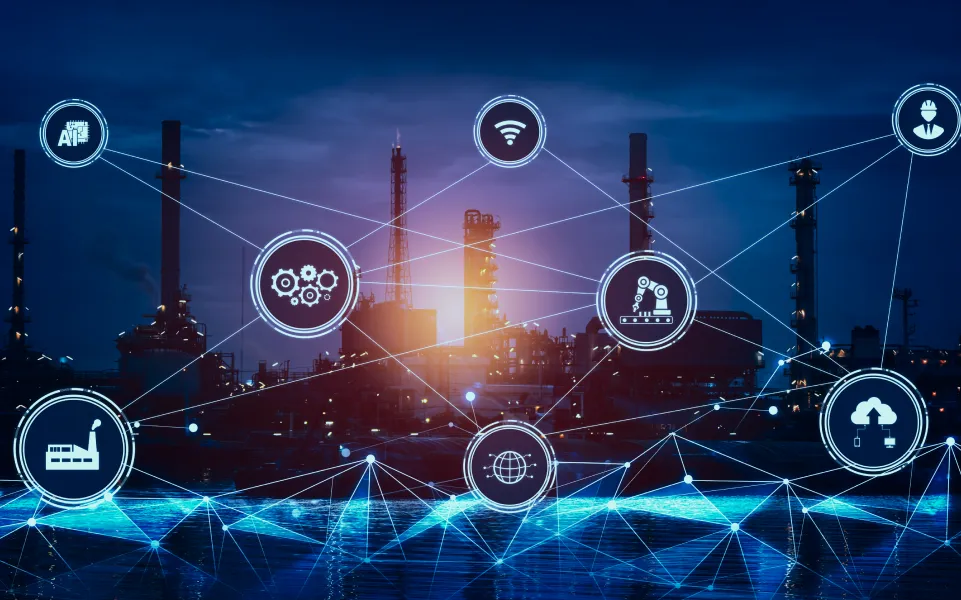
Data Collection & Normalization
We prepare industrial data for use by:
- Aggregating data from sensors, machines and operational systems.
- Converting disparate data into consistent normalized formats.
- Supporting valid comparisons and computation across data points.

Contextualization & Modeling
We make data meaningful by:
- Contextualizing around the assets and processes it describes.
- Embedding data within its operating environment to explain why conditions occur.
- Applying data models that simulate scenarios and guide strategic decisions.

Integration Governance & Scale
We enable sustainable use of industrial data by:
- Integrating data from multiple sources into unified views.
- Applying governance practices that protect integrity access and compliance.
- Supporting scalable data infrastructures that grow with analytics and machine learning needs.


Change Enablement & Training
The success of your Industrial DataOps initiative is directly tied to people embracing and adopting your new solution. Successful transformations require a strategy for the technological, organizational and individual impacts of related changes.
ReVisionz integrates client-customized change enablement and training in all our services to help you achieve the intended outcomes for your assets and prepare your organization to maximize value delivery from your projects.
The success of your Industrial DataOps initiative is directly tied to people embracing and adopting your new solution. Successful transformations require a strategy for the technological, organizational and individual impacts of related changes.
ReVisionz integrates client-customized change enablement and training in all our services to help you achieve the intended outcomes for your assets and prepare your organization to maximize value delivery from your projects.
Effective & Actionable Change
Our approach to change management is based on the PROSCI industry model. We adapted the model to increase the effectiveness of asset and process safety information management transformations across your site or enterprise. It considers change management from the perspective of four key levers:

Leadership & Ownership
Establishing alignment of leaders and teams, alignment of roles with capabilities and expectations, and defined ownership.

Communication
Sharing the vision, the business case, the plan, and the expected outcomes.

Knowledge Transfer & Training
Developing and delivering training to build sustainable skills and capabilities.

Business Readiness & Measurement
Understanding organizational impacts, assessing and enabling readiness, and measuring progress and risk.












 consult with an expert