



Chapter 1: The Human Factor in Transformation
Digital transformation can reshape how industrial organizations operate. Many teams introduce new tools with the expectation of stronger performance, clearer visibility and better control of information.
In practice, the technology will perform as designed, but the risk is that transformation might be slower because, without a change enablement strategy, people tend to default to working in their previous ways. As a result, adoption might lag, which ultimately delays value realization.
This pattern is fairly common across complex organizations. The technical side moves forward while the people who rely on the tools each day feel unsure about how their work will change. That uncertainty creates hesitation and workarounds that weaken the outcomes leaders had hope to achieve.
This chapter launches our Change Enablement Series, which explores the people side of transformation and the practices that help organizations move from technical installation to real operational change. Chapter 1 focuses on the human factor and why adoption stalls when teams are not engaged or supported through transition.
At ReVisionz, we guide organizations through this challenge by placing people at the center of digital programs from the beginning. Our change enablement approach aligns communication, people readiness, sustainable training and adoption with the realities of frontline work. This gives teams the clarity they need to participate in change and helps leaders move their vision into daily practice.
Why Transformations Miss the Mark
The belief that transformation fails due to weak technology misses the core issue. Most processes and systems function as intended, but the people expected to use them haven’t been part of the journey or received the adequate guidance needed to work in new ways.
Numerous studies indicate that the human aspect of transformation is often disregarded. A study by Prosci states that projects with good change management are 6x more likely to fulfill or surpass goals. And up to 80% of digital initiatives underperform because organizations focus on “digitizing processes” rather than enabling people to work differently.
Other findings show that many transformations underperform because organizations concentrate on digitizing existing processes instead of helping people adopt new behaviors. This gap generally appears early.
In practice, it becomes obvious when individuals continue to revert back to familiar habits. As an example, they may continue to manage documents “off system” or bypass new workflows because understanding “why” the change is happening has not been effectively communicated. These behaviors take root quietly and can slow adoption long before leadership notice.
Change enablement addresses this pattern by creating clarity. It helps teams understand what is changing and why the shift matters. When people understand the purpose, adoption strengthens and the transformation gains momentum, leading to a long-term sustainable solution.
The Cost of Ignoring People
When change doesn’t consider the impact on workers, adoption stalls and efficiency drops. Confusion becomes the norm, and people revert to older methods because they don’t feel ready to adopt a new way of working.
This can result in a cumulative effect that slows progress, including productivity dips, inconsistent decision-making and too much time spent correcting behaviors.
Focused communication and engagement also plays a critical role in preventing these issues. These are often mislabeled as soft skill work, when in reality it is more closely aligned with operational risk management. Without clear communication and engagement about impacts and benefits (the “why”), people don’t have the context they need to support the change.
Change enablement gives teams a structure to manage the “people side” of change. It helps organizations communicate and engage the changes effectively, involve the right people and build confidence throughout the transition.
Sign That Change Is Breaking Down
There are recognizable signs that a project needs stronger change enablement support. One of the earliest is when a project begins with strong messaging at kick-off but fails to maintain consistent and targeted communication as the project progresses. Another is when updates focus only on technical readiness items rather than explaining the impacts and benefits of why change is happening.
These signs include:
- Stakeholders who feel informed but are not involved and are disconnected from decisions.
- Training that is planned as a one-time event instead of an ongoing role-based learning path.
- A growing gap between leadership vision and frontline execution.
When these conditions appear, adoption becomes uncertain. People fall back into old routines because the new environment feels unclear. This leads to rework, delays or the need for corrective actions after go-live.
Recognizing these signals provides an opportunity to adjust the approach before the project loses momentum.
The Journey to Sustained Adoption
ReVisionz structures the change enablement practice to help people move through digital transformation with clarity. Our approach focuses on understanding how work will shift, preparing teams for that shift and reinforcing how organizations will adopt and sustain changes. Each stage is interrelated.
- Stakeholder & Impact Analysis: Understanding who’s affected and how their work changes.
- Readiness Planning: Preparing the organization to operate in the new environment
- Targeted Communication: Consistently explaining the “why,” not just the “what” at every level so teams understand why it matters.
- Capability Building: Role-based training, coaching and knowledge retention focused on adoption sustainment.
- Adoption Measurement: Insights that reveal where additional support may be needed and how teams are responding to the change by tracking engagement, usage and performance metrics
- Reinforcement: Strategy that supports sustaining adoption through leadership, recognition and continuous improvement.
Moving Toward Sustainable Transformation
Technology can introduce new capabilities, but the sustained impact comes from people who understand how to work in the new environment. When workers feel prepared and supported, transitions become smoother and confidence builds. These conditions help organizations realize value sooner because teams begin using new tools in a consistent and reliable way.
ReVisionz supports this journey by guiding organizations through the human side of transformation. We help teams understand the purpose behind the change and how their work will evolve. This clarity reduces hesitation and creates a sense of ownership that carries through the transition.
When people feel equipped to participate and can see how the change supports their work, the organization moves forward with a shared sense of direction. That unity creates a foundation for transformation that lasts. Success is ultimately tied to integrating people into new digital ways of working.
In addition to implementing technology, ReVisionz enables people to transform how work gets done. We keep transformation on track by aligning people at every level, which enables momentum, trust and results.
Chapter 2: Built In, Not Bolted On
Most projects begin with confidence. There is a plan, a timeline, a clear scope and a strong technical solution. On paper, everything appears ready.
What usually goes unasked is a simpler and more uncomfortable question: What will actually change in the way people work when the system goes live?
If change enablement is an afterthought, the question of its necessity arises far too late in the process. Leaders get the green light that the system is ready, yet teams hesitate. The disconnect between a finished product and actual adoption only becomes apparent at the final stage of the project.
At ReVisionz, we view this as a deliberate design decision. A project can be structured around technical delivery, or it can encompass delivery alongside readiness, adoption and the essential information people need to embrace new ways of working with confidence.
Why Change Enablement Cannot Be Added at the End
Several sources highlight common failure triggers specifically tied to inadequate change support, including:
- User Resistance: ~50-70% of EDMS projects meet resistance from users due to lack of engagement and preparation.
- Inadequate Training: ~60-80% of organizations cite insufficient training/adaptation as a major reason for EDMS implementations to underperform.
These failure rates aren’t only about ‘technical rollout issues.’ They reflect the system being in place but not delivering the value expected because users don’t adopt it and processes aren’t changed. That’s exactly the problem change enablement addresses.
This impact of not having change enablement practices on each stage of a project is well studied and can also be explained per project phase:
- Strategy & Initiation: With change enablement, the project may lose momentum or stall by 30-40%. This can be attributed to areas such as weak sponsorship and unclear success definition.
- Requirements & Design: Low user involvement resulting in issues such as poor taxonomy fit may result in 20-40% misalignment with ‘real work’.
- Build & Migration: The data is migrated but not trusted or used. This can be attributed to ~50% of post-go-live issues being people/process-related.
- Testing & Deployment: Users are unprepared for new ways of working, resulting in 60-70% resistance at go-live.
- Adoption & Stabilization: 70-85% of projects fail to achieve sustained adoption, and people revert to shared drives and workarounds.
- Benefits Realization: Only 15-25% realize intended business value, which can be attributed to no ownership, no reinforcement, and no metrics.
The bottom line is that when change enablement is embedded across the program/project lifecycle, success rates commonly rise into the 85-95% range, with measurable improvements in adoption, compliance, reduced rework, and search and retrieval efficiency.
Designing Change Into the Project From Day 1
What “Built In” Really Means
“Built in, not bolted on” means change enablement is part of planning and execution from the start. It shapes how the project is mobilized, how risks are identified and how progress is measured along the way.
When change enablement principles are applied early, projects are better positioned to deliver outcomes that are adopted rather than simply implemented. Change activities sit inside the project rather than beside it. This approach will help influence decisions and reveal risks while there is still time to act.
How Early Integration Changes the Trajectory
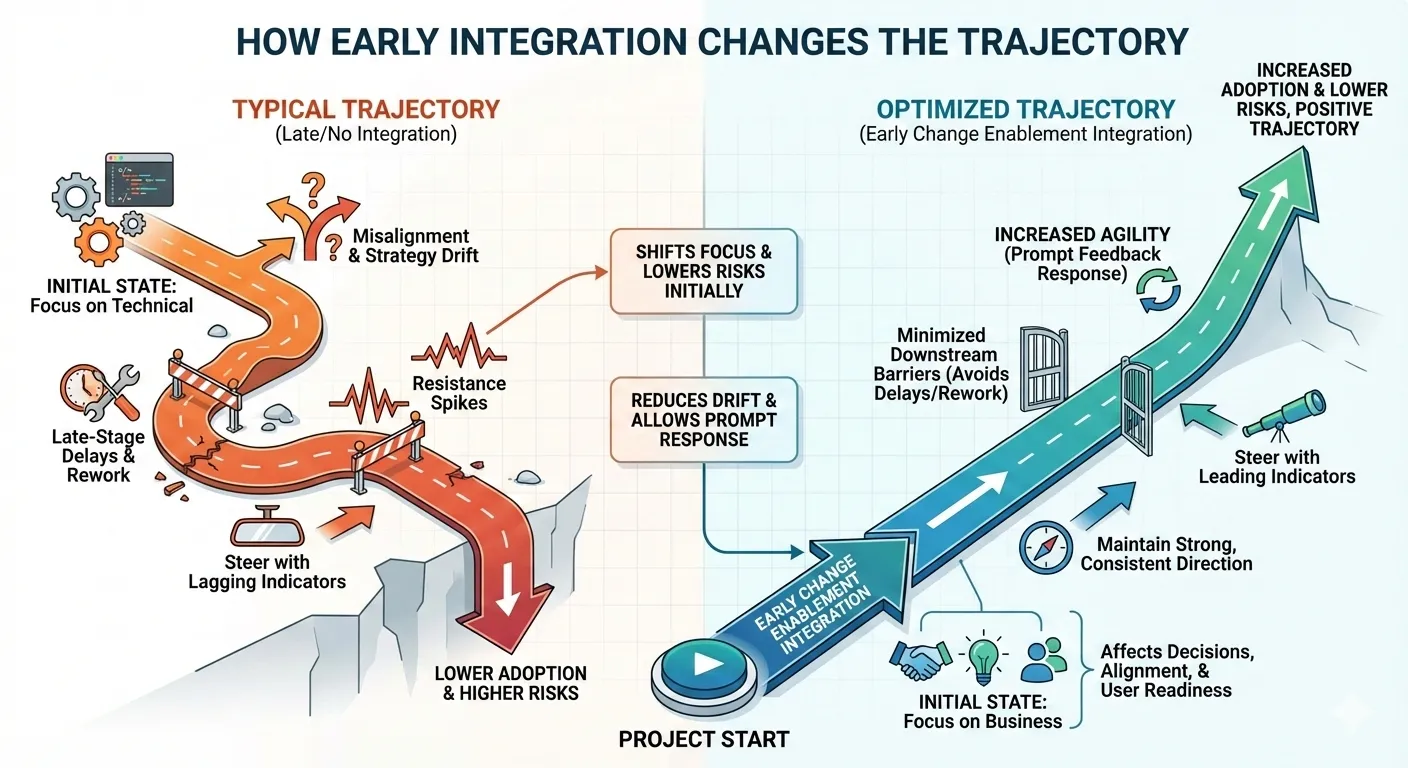
Promoting early sponsorship and alignment reduces strategy drift, allowing the project to maintain a strong, consistent direction rather than dealing with misalignment halfway through. This enables the project to respond promptly to real-world feedback, which increases agility and allows leaders to steer initiatives using leading indicators rather than lagging ones.
Early relationship-building is the foundation that allows change enablement to work. When trust is built at the beginning of a project, stakeholders are more willing to engage, share concerns and adapt their ways of working, long before resistance becomes visible.
In the coming weeks, look out for Chapter 3, where we’ll take a deeper look at why trust and relationship-building are essential outcomes of early change enablement in projects.
What ReVisionz Does During Planning & Mobilization
ReVisionz starts change enablement throughout planning and mobilization. We want to prepare the organization for what’s ahead, not react to opposition or misunderstanding.
Early activities focus on understanding impact and readiness across the organization, which creates the foundation for targeted engagement in real conditions rather than assumptions.
Key areas of focus typically include:
- Aligning leaders around a shared case for change and what success looks like beyond go-live.
- Identifying impacted groups and clarifying how work will shift by role.
- Early identification of internal change champions ensures the change is carried out by credible relationships that already exist within the organization.
- Establishing governance that supports communication and engagement.
- Defining roles that are changing and mapping where resistance might emerge.
- Developing early messaging that connects the change to daily work.
- A roadmap that includes human factors into technological delivery strategies.
These activities support awareness and inform how communication and training should be structured later, based on real impacts instead of generic assumptions.
Change Enablement as a Living Discipline
One of the most common misconceptions about change enablement is that it can be completed through a checklist. In reality, change doesn’t unfold that way. Adoption moves unevenly across roles and environments.
Change enablement is something that ReVisionz does as a practice because it happens all the way through a project’s lifecycle. As things change, so do our understanding, skills and trust. Adoption can’t just happen after training or when the system goes live. It needs to be developed over all phases of the project.
From Adoption Signals to Operational Performance
Making Adoption Measurable
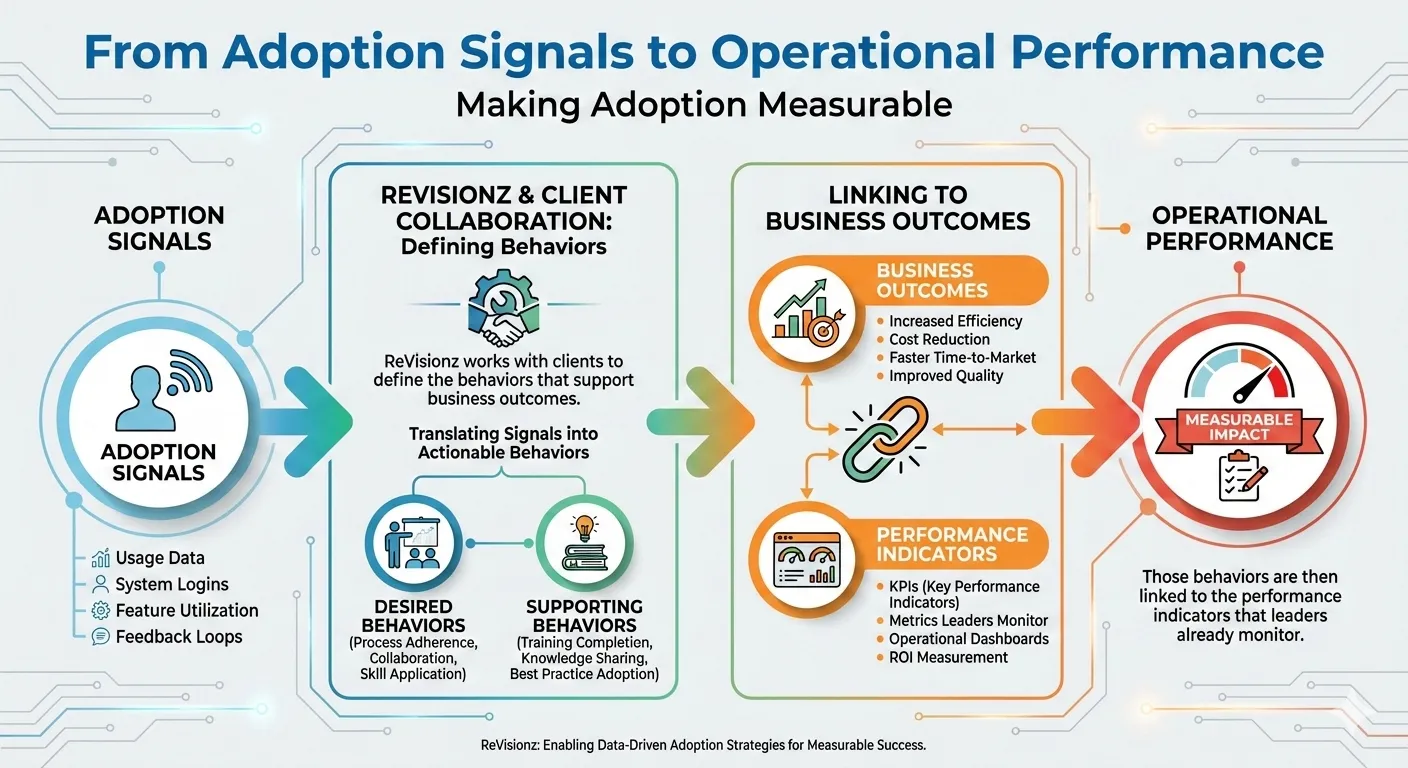
ReVisionz works with clients to define the behaviors that support business outcomes. Those behaviors are then linked to the performance indicators that leaders already monitor.
When these indicators are defined early, they create a practical feedback loop. Shifts in performance prompt questions about behavior and readiness rather than reactive blame. Additionally, teams can reinforce communication, adjust training or reengage impacted groups before issues compound.
This approach moves organizations away from assumption and toward facts. Adoption then becomes something that is observed and managed throughout execution rather than hoped for at the end.
Leadership Roles & Shared Accountability
When leaders are engaged from the beginning, they can have clarity on how roles will change and what support their teams will need. ReVisionz translates between technical delivery and operational results.
That way, leaders can explain why changes are important and how they fit into daily work. This clarity builds trust and makes adoption stronger through daily decisions and interactions.
Change then becomes something leaders can actively guide instead of something they inherit at project close.
Redefining What Success Looks Like
When change enablement is built in from the start, success takes on a different meaning.
Projects are no longer judged solely by technical completion. Instead, success is reflected in whether people feel prepared, confident and capable in the new environment. This shift ultimately protects return on investment that can otherwise erode quietly after delivery.
Early integration also improves stability. Engagement continues throughout the project rather than peaking at kick-off and go-live.
Turning Intent Into Daily Practice
Change enablement works best when it’s part of how projects are designed and delivered. When people are considered early, transformation becomes more durable and less disruptive.
ReVisionz helps organizations build this foundation by aligning people, processes and technology from the beginning. We bring structure to the human side of change so teams can focus on doing their work well in a new environment and minimize productivity disruption.
Following the human factors introduced in Chapter 1, this chapter prepares the ground for Chapter 3, where we will focus on stakeholder engagement, ownership and how organizations know when change is truly taking hold across people and roles.
Chapter 3: Systems Change, Success Depends on People
While tools manage and control our information more effectively, a successful implementation ultimately depends on how well our people understand, adopt and integrate the tool into their daily work.
That’s why ReVisionz’ implementation approach puts people at the center by focusing on awareness, role-based training and the support needed to build confidence and enable lasting change.
Yet even with strong planning and well-designed programs, the real test of change begins once new tools and processes move from project plans into everyday operations. Tools may be in place, processes documented and decisions made, but people are still figuring out what actually changed for them and what is now expected day to day.
This is usually when confidence drops and old ways of working return.
The sections that follow look at stakeholder engagement and human impact as practical foundations instead of supporting activities. When people are involved early and their concerns are understood, risk is visible sooner and ownership develops naturally as work evolves.
At ReVisionz, this people-centered approach shapes how we guide organizations through transformation, so change does not stop at the time of delivery but continues into everyday practice.
Why Stakeholder Engagement Anchors Successful Change
Stakeholder engagement provides grounded insight into how work truly happens. End users can see practical problems that rarely surface in design sessions. When those insights are captured early, the project is able to adjust before friction occurs.
Engagement also protects momentum. Many projects begin with strong kick-off messaging, then fall quiet while technical work progresses. During that silence, teams lose sight of the project objectives, and by the time go-live arrives, the change feels abrupt rather than expected. Consistent engagement keeps the change visible and connected to daily work, which helps sustain forward motion.
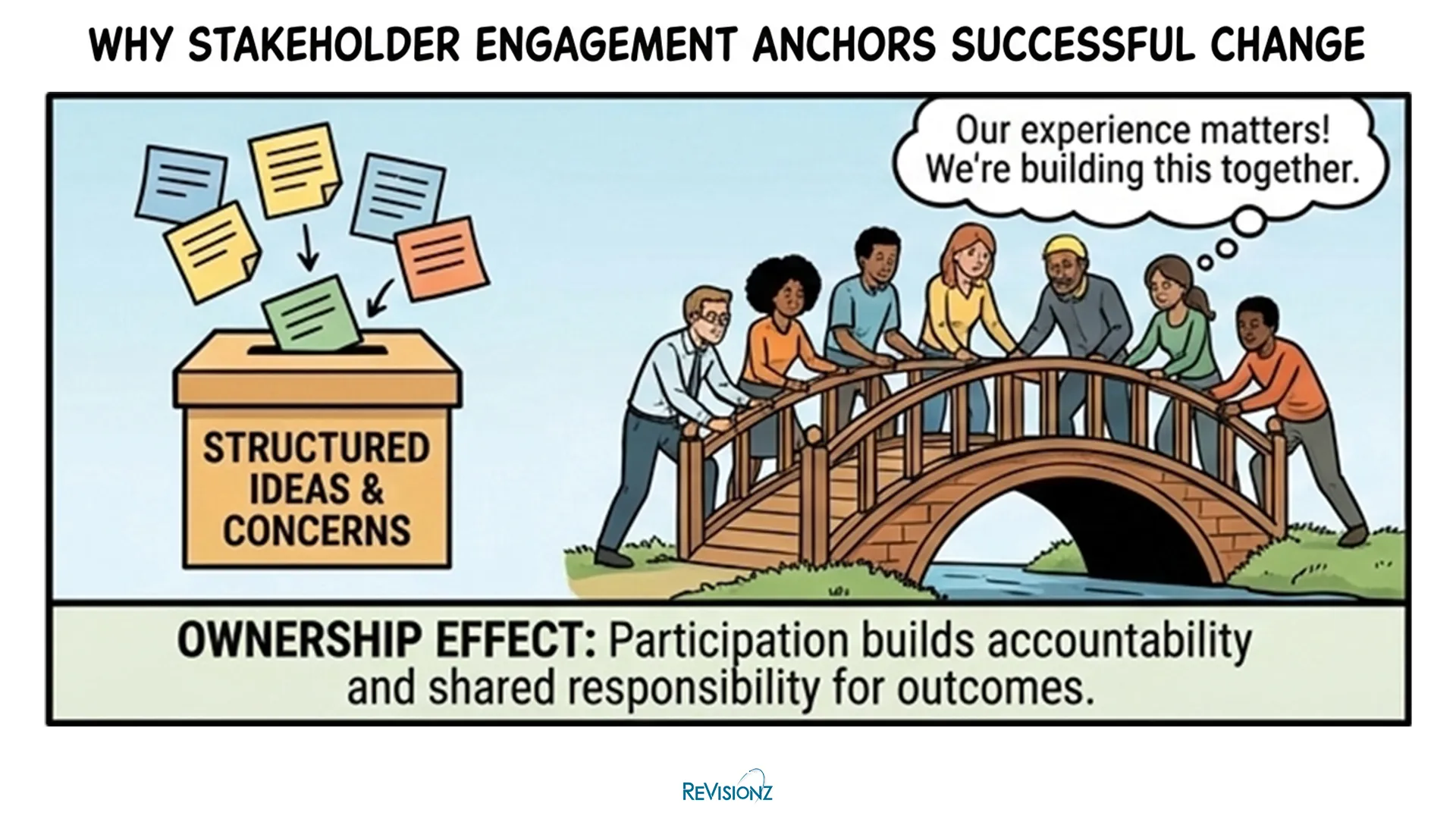
There is also an ownership effect that emerges when engagement is done well. Giving stakeholders a structured way to raise concerns and contribute ideas signals that their experience matters. Even when not every suggestion is adopted, the act of participation builds accountability and shared responsibility for outcomes.
These benefits become clearer when engagement is treated as ongoing rather than episodic, which leads directly into how resistance is surfaced and addressed.
How Proactive Engagement Reduces Resistance & Builds Ownership
Resistance is usually a response to uncertainty rather than opposition. When engagement is proactive, concerns surface while there is still time to respond. This allows project teams to listen, clarify and adapt rather than react after resistance has taken hold.
Early engagement also reveals realities that leadership may not see, such as cultural sensitivities, informal practices and operational shortcuts. Addressing these realities through targeted communication and training reduces the need for corrective action later.
Hidden dependencies often emerge through this process as well. These may include reliance on another group, timing assumptions or manual steps that bridge system gaps. When these dependencies are identified early, the leaders can successfully design a project around them.
Once these dynamics are understood, the next challenge becomes identifying who is affected most and how deeply their work will change.
Mapping the Human Impact
Identifying Who Is Most Affected
Understanding human impact starts with process analysis. Without examining how work flows today and how it will change, organizations risk overlooking entire groups. For example, a responsibility that exists today could shift or disappear.
ReVisionz uses process impact analysis to surface these shifts. This work highlights where responsibilities move, where decision points change and where the largest adjustments in execution will occur. It also exposes system touch points and workflow changes that alter how people interact with information.
Tools That Clarify Influence & Readiness
To make insights actionable, ReVisionz applies structured stakeholder analysis tools, such as RACI matrices, influence and interest grids, impact assessments and persona views. These frameworks help visualize who is affected, how strongly and where engagement effort should be focused.
Rather than treating stakeholders as a single audience, this approach recognizes varying levels of influence, readiness and exposure to change.
Shaping Communication, Training & Engagement
Once impact is clear, communication can become targeted. Training aligns to roles within end-to-end processes, rather than job titles, and engagement strategies focus on groups with the greatest exposure and influence.
This also enables more meaningful readiness assessments. Instead of relying on general sentiment, readiness can be evaluated by group, which allows support to be directed where it’s most needed without overlooking less visible roles
Preparing & Guiding Adoption
Moving From Awareness to Ownership
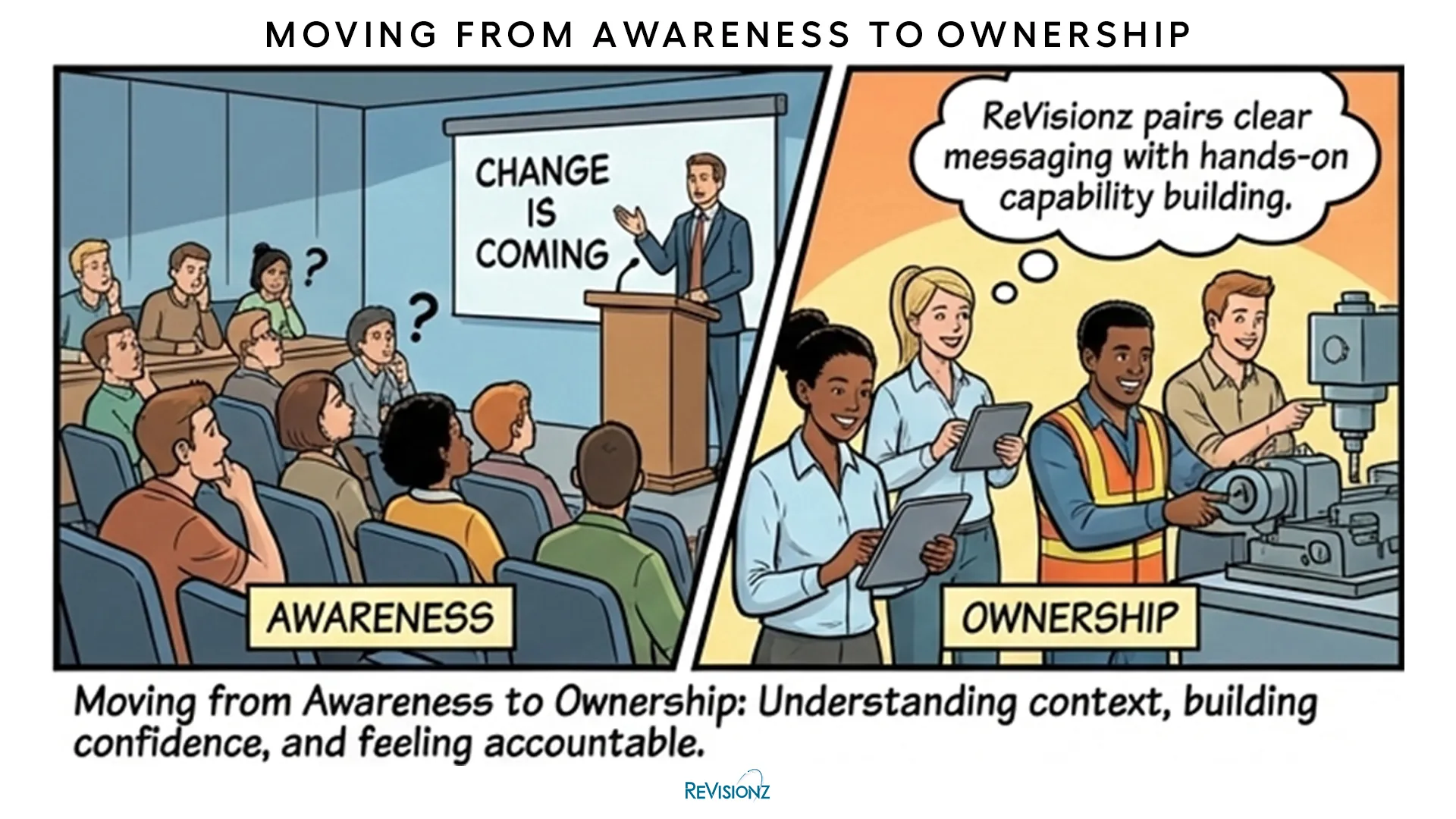
Awareness alone does not change behavior. Ownership develops when people understand the context for change, build confidence in new ways of working and feel accountable for outcomes.
ReVisionz supports this progression by pairing clear messaging with hands-on capability building. Training focuses on real work scenarios rather than abstract system features. Also, leadership reinforcement helps translate expectations into daily decisions, making the change tangible.
Embedding Adoption Into Daily Work
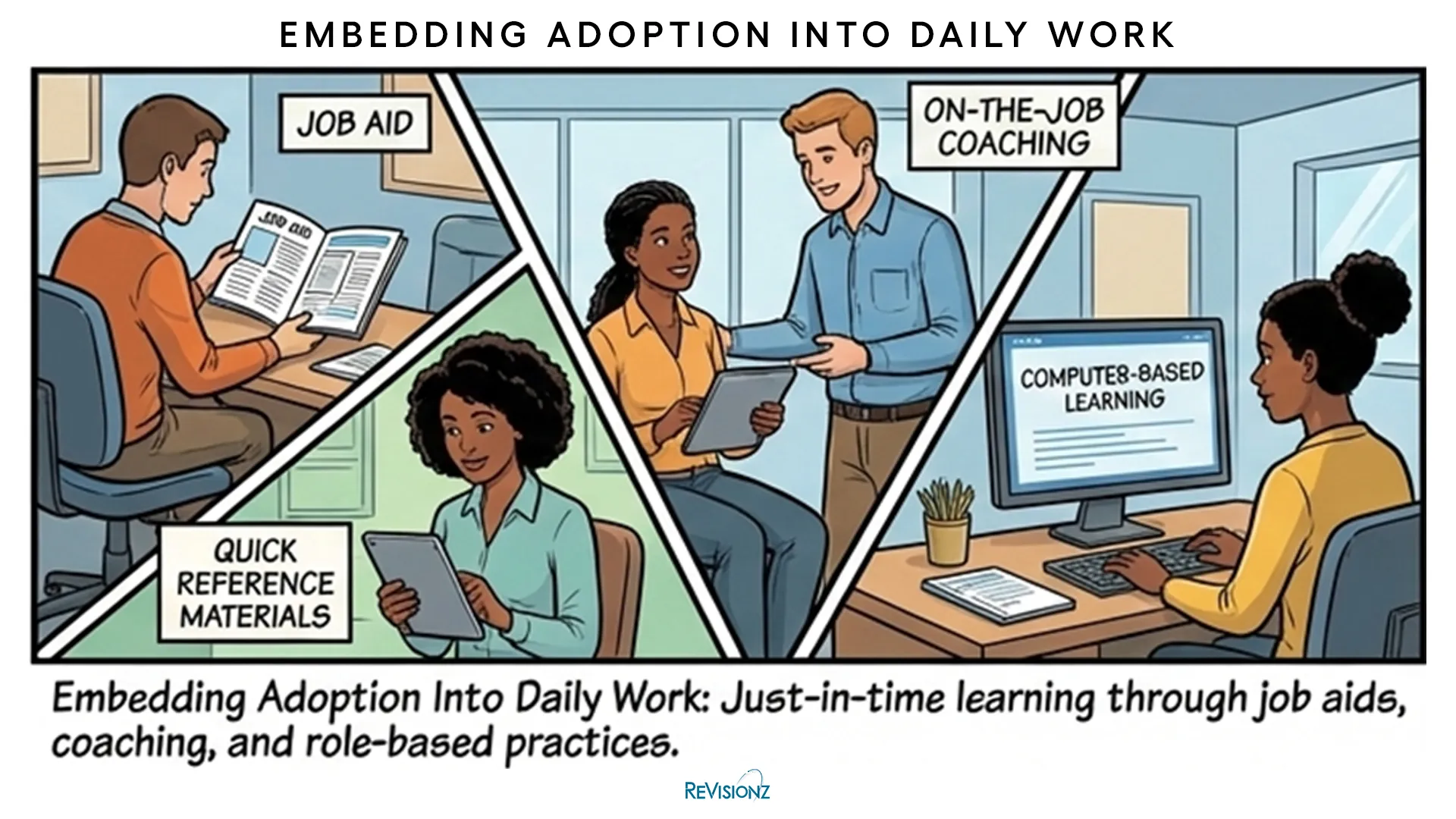
Adoption weakens when learning is treated as a one-time event. ReVisionz designs adoption to live inside daily routines through methods such as on-the-job coaching, role-based practices, job aids and quick reference materials that support just-in-time learning.
Learning is most effective when it aligns with how people work, arriving close to execution so it builds retention and confidence instead of fading too early or creating frustration too late. ReVisionz also focuses on longer-term sustainment training through computer-based learning strategies to enable our clients to be set up for future onboarding and retention.
What Strong Engagement Changes in Practice
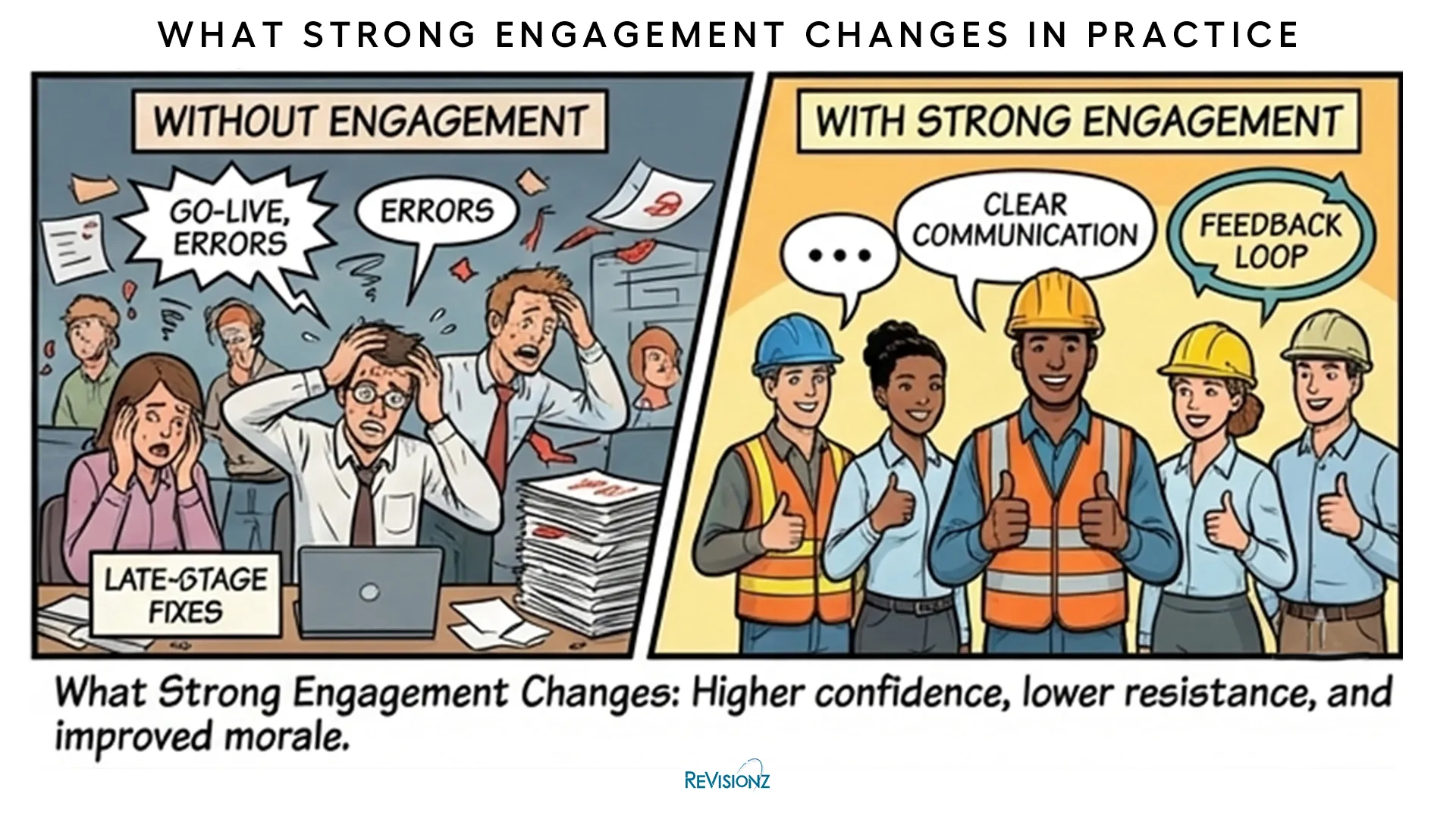
Projects that involve end users early and maintain two-way communication see measurable differences at go-live. Confidence is higher, resistance is lower and morale improves because people feel prepared rather than surprised. Feedback loops also allow teams to adjust throughout delivery instead of relying on late-stage fixes.
Measuring Success Beyond Attendance
Attendance does not indicate readiness. That’s why ReVisionz looks for evidence that new behaviors are taking hold.
What Signals Adoption
We assess whether people are reverting to old methods, following new processes and using tools with confidence. These behavioral signals provide insight into whether the change is stabilizing or at risk.
Assessing Capability Across Roles
Capability varies by role. For instance, a casual user requires different proficiency than a system administrator. ReVisionz uses role-specific assessments, hands-on exercises, adoption surveys and self-assessments where appropriate. On-the-job performance provides additional confirmation of readiness.
These methods are sometimes underestimated because they do not resemble traditional deliverables. In practice, they provide the most reliable indication of whether the organization can sustain the change.
Linking Adoption to Business Performance
Adoption activities are tied to business outcomes by identifying the behaviors that drive performance, then tracking whether those behaviors are present. When KPIs such as uptime, utilization or safety are defined early, shifts in performance can signal adoption challenges before they escalate.
This creates an early warning system that allows intervention while the project is still in motion.
Carrying Change Forward
Change holds when people are engaged early and supported as their work changes. This chapter explored how stakeholder involvement, human impact mapping and adoption-focused measures reduce risk, build ownership and sustain momentum beyond go-live.
When learning aligns with execution and readiness is measured through real behaviors, organizations can have clear insight into how change is actually taking hold. These practices move adoption from something hoped for at the end of a project to something tangible and manageable throughout delivery.
At ReVisionz, we embed this people-centered approach into governance and execution so change becomes repeatable instead of reactive. The result is transformation that carries into daily work rather than stalling after implementation.
Chapter 4: Sustaining Success Beyond Go-Live
At ReVisionz, change enablement is designed with the understanding that implementation marks the beginning of operational change rather than the end of a project.
Many industrial companies discover that momentum becomes fragile during the implementation and go live stage. Training programs reach their highest intensity during implementation, but once the system launches, attention returns to priorities while teams continue trying to adjust to new expectations.
This final chapter looks past implementation. It focuses on how organizations sustain change once systems are live and how ReVisionz supports clients in building the structure, leadership alignment and operational ownership required for improvements to continue after the project concludes.
When Does Momentum Fade?
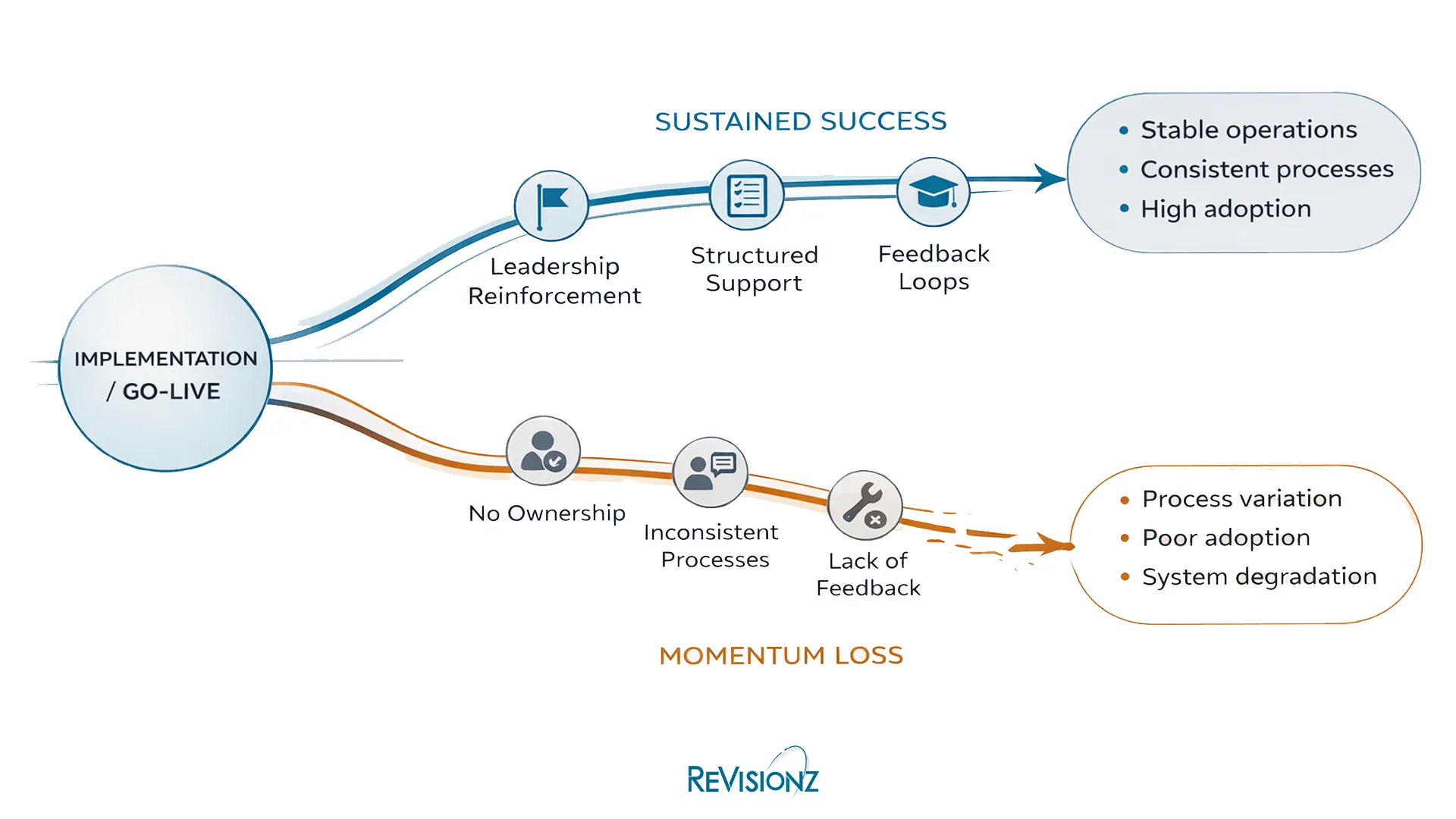
Implementation creates a concentrated period of attention, as teams receive quick guidance when questions arise. But when the project phase concludes, that structure may naturally begin to dissolve.
Employees return to focusing on operational demands and stall out on learning the new tools. They might make small changes to best fit their needs. But over time, these adjustments affect how consistently the system is sustained.
Here are some examples of erosion of the intent of the system:
- Processes start to vary between teams and locations.
- Document governance follows different paths depending on who is involved.
- Early frustrations stay unresolved when no clear feedback mechanism exists.
Sustaining change requires deliberate support during this stage when new practices are still taking shape.
Designing Sustainment Into the Project Lifecycle
ReVisionz addresses post-implementation challenges by treating sustainment as a defined stage of transformation rather than a task that begins after the project ends. Our objective is to guide clients through the transition from project execution to operational ownership while maintaining momentum.
Transitioning Responsibility to Operational Teams
One of the most important aspects of sustainment involves transferring responsibility from the project team to operational leaders. ReVisionz supports a phased transition that helps teams assume ownership gradually while the project structure is still active.
This approach prevents the abrupt handoffs that leave operational teams responsible for systems they haven’t fully integrated into their daily work.
Establishing the Operational Structure
During this transition, ReVisionz works with clients to establish the framework that supports stable operations.
Key components typically include:
- Defined system ownership so employees understand who manages ongoing system changes.
- Tiered support models that provide clear escalation paths when issues arise.
- Operational job aids and quick reference guides that support employees during real tasks rather than relying solely on classroom training.
- Adoption and information quality metrics that reveal how consistently the system supports work.
These elements create continuity between the project environment and the operational environment that follows implementation.
Enforcing New Ways of Working
Stability develops gradually as employees gain experience with the system in real situations. Additionally, confidence grows when people understand how the system supports their responsibilities.
ReVisionz supports this stage through reinforcement practices that maintain alignment after go-live.
Leadership Visibility & Clear Expectations
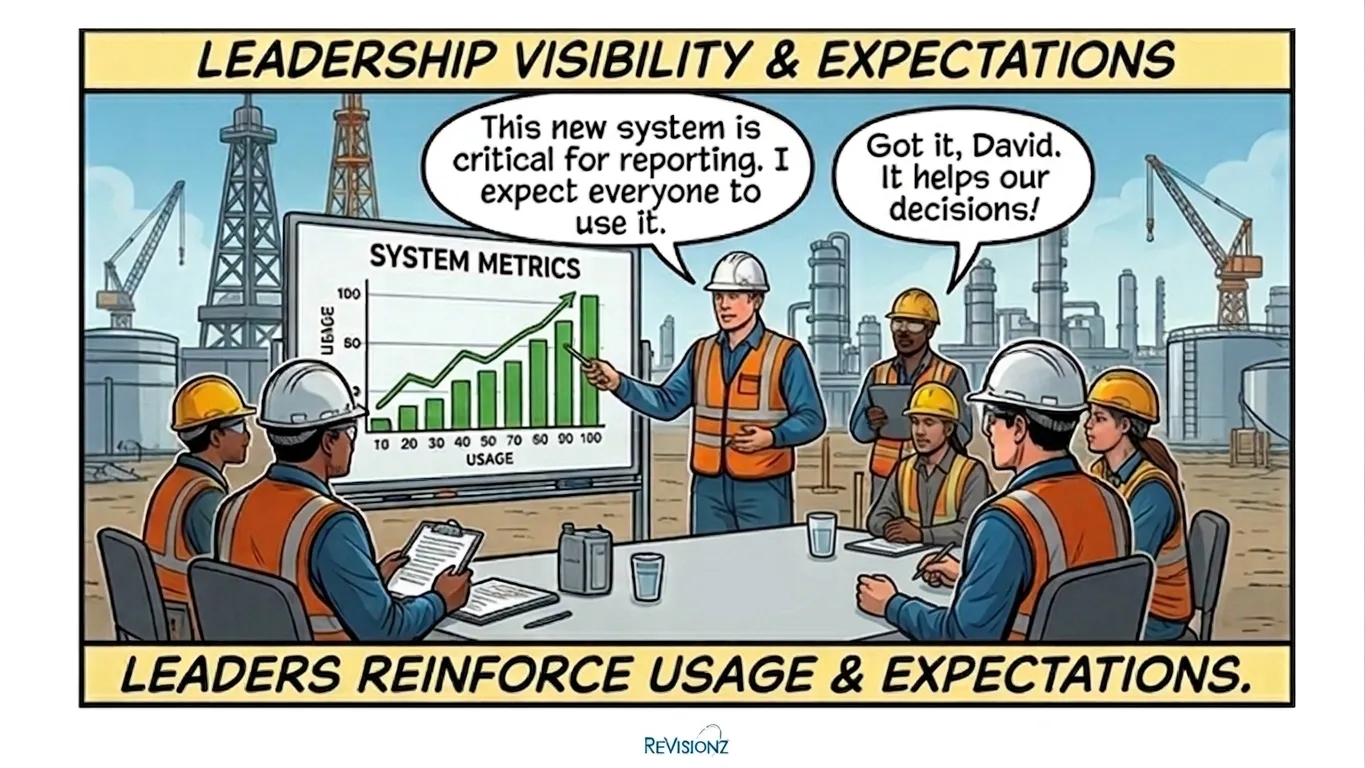
When leaders reference the new system during operational discussions and reinforce expectations for its use, employees are more likely to recognize that the change is central to how the organization operates.
Communication also evolves during this stage. Messaging shifts away from preparing teams for future changes and toward demonstrating how the system supports everyday work and decision making.
Feedback That Drives Improvement
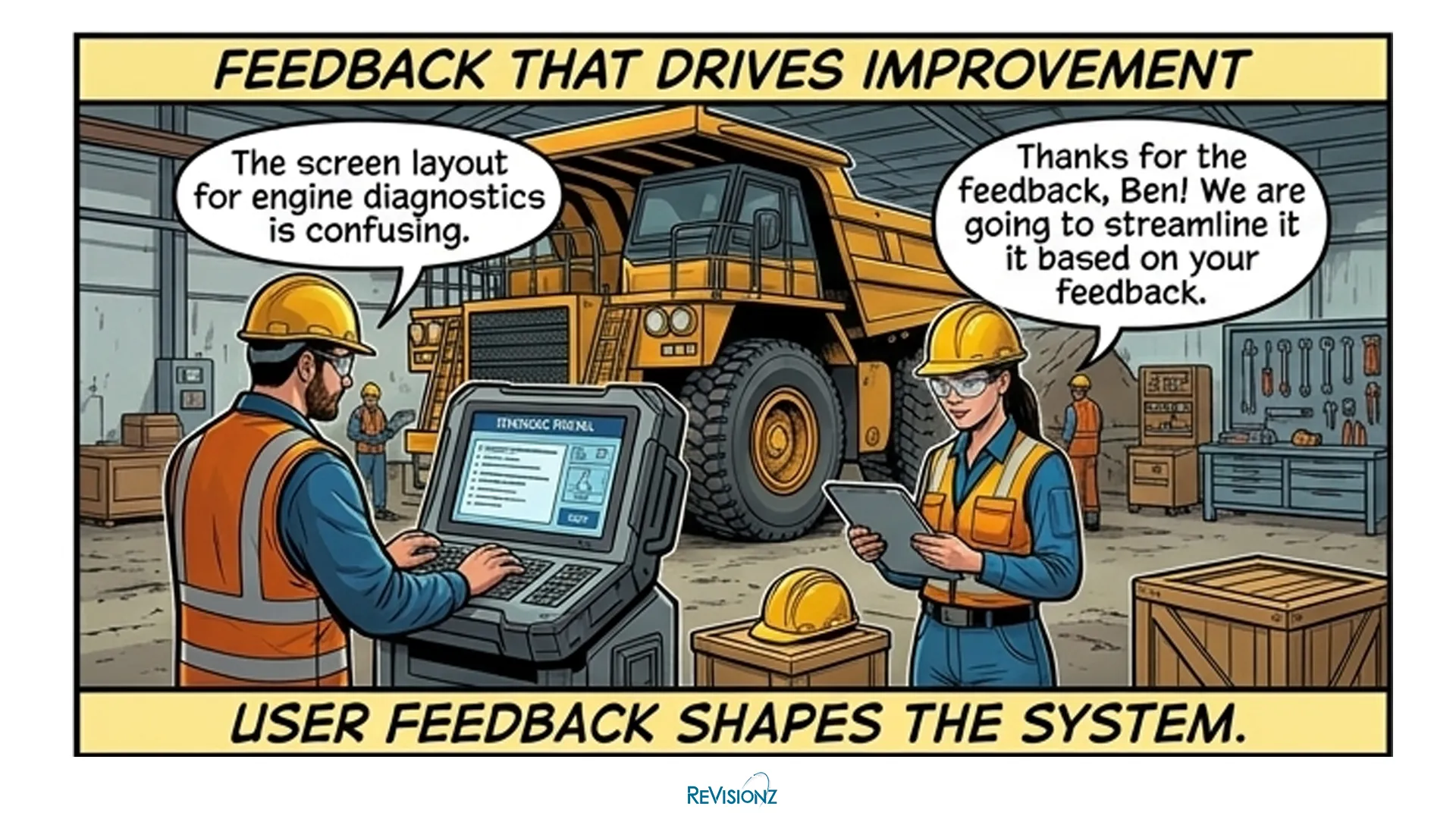
Employees become more confident when they see that their experiences lead to improvements. ReVisionz encourages organizations to establish structured feedback channels that allow users to surface operational challenges and suggest refinements.
When feedback leads to visible improvements, the system becomes something people shape together rather than something imposed during a project.
Targeted Learning & Coaching
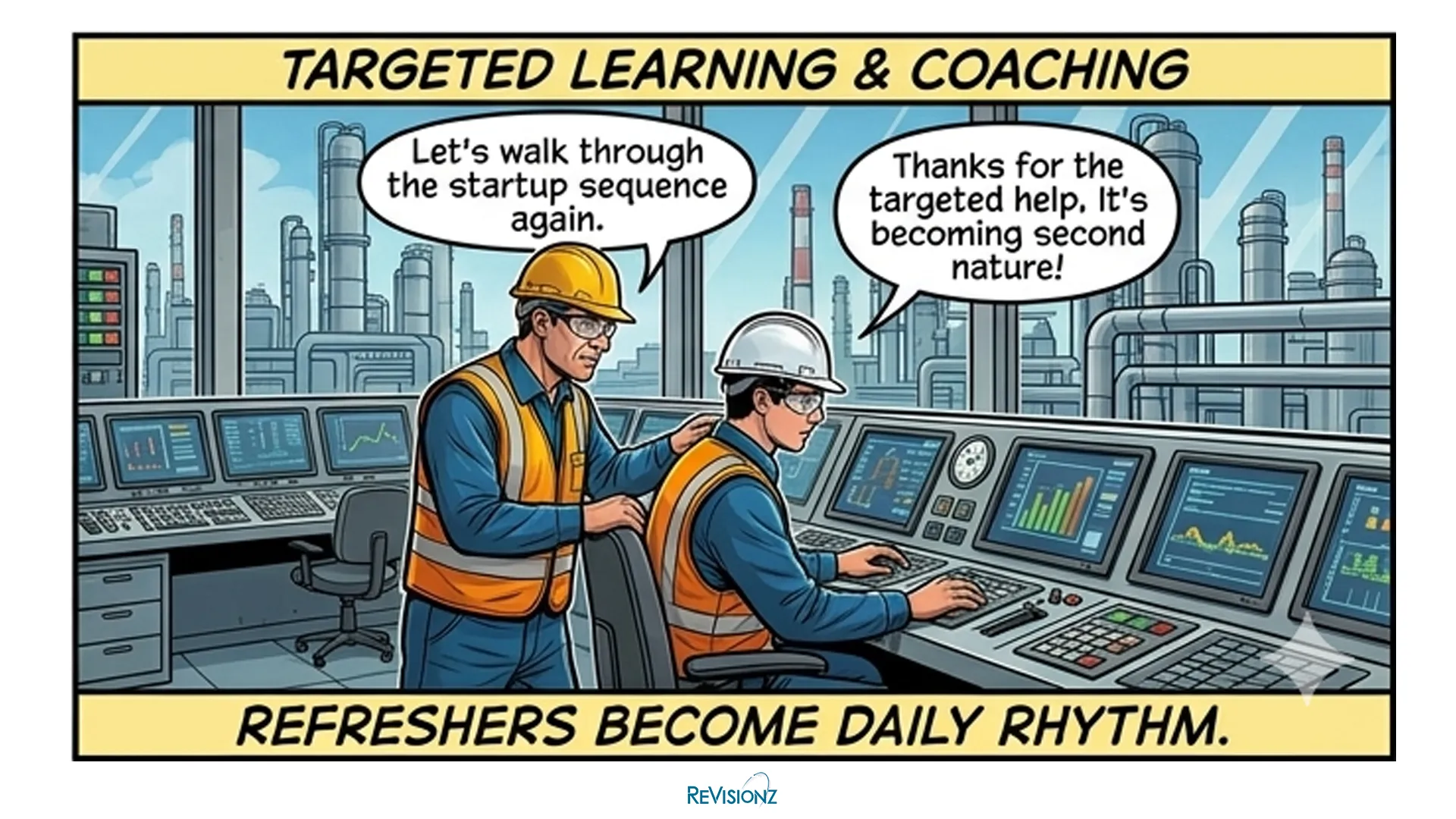
Refresher sessions, coaching engagements and targeted support helps organizations address real challenges while reinforcing the behaviors that support the end-to-end processes and system design.
Through continued reinforcement, the system will gradually become part of the normal rhythm of work rather than a recent change.
The Importance of Operational Credibility
Change initiatives gain traction when they reflect the realities of how work is performed. In complex environments, transformation cannot be guided purely from a project or technology perspective. It needs to reflect operational constraints, engineering dependencies and safety requirements that shape how decisions are made in the field and in the office.
ReVisionz brings experience across operations, engineering, asset management and health and safety disciplines. This hands-on perspective allows our change enablement strategies to align with the way work moves through an organization rather than how it appears in theory.
Operational teams recognize when change guidance reflects their environment. Conversations can become more productive when the people guiding the transformation understand the pressures and responsibilities that influence daily work. This shared understanding builds credibility and encourages more open engagement from stakeholders across the organization.
By grounding change enablement in operational context, ReVisionz helps organizations strengthen trust across teams while establishing systems that support work performance.
Building Internal Leadership
A successful transformation creates capability within the organization itself. ReVisionz works with clients to train leaders who can guide change after the project phase concludes.
Knowledge Transfer Through Participation
Internal leaders participate in governance discussions, process design sessions and operational planning throughout the project lifecycle. This involvement helps them understand not only how the system functions, but also why certain decisions were made during its design in support of the processes.
Role-Based Coaching
Coaching helps people understand how their responsibilities evolve within the new environment. Also, organizations that invest in this capability begin to develop a culture where change becomes part of normal operations.
Characteristics of a self-sustaining change culture include:
- Continued role-based training for both new and existing employees.
- Onboarding programs that reflect updated systems and processes.
- Regular feedback channels that encourage operational insight.
- Leadership reinforcement that connects system usage to organizational goals.
When these elements exist, improvement becomes a continuous activity rather than a response to isolated projects.
Making Change Last
The real measure of change enablement appears in daily work. Systems deliver value when teams rely on them consistently, processes remain aligned across roles and employees understand how new ways of working support their responsibilities.
ReVisionz helps organizations reach that point by embedding change enablement into the way work is managed and governed. Defined responsibilities and practical feedback channels give teams a clear path to raise challenges and refine processes as they gain experience with the system.
Throughout this series, we explored how organizations prepare people for transformation and engage stakeholders during implementation. This effort is intended to stabilize adoption once systems are live. The aim of that work is a successful rollout that equips the organization to sustain progress and continue improving as it moves forward.
If your organization is preparing for its next digital transformation initiative, ReVisionz can help you move forward with clarity and direction. Our experts guide your digital journey by establishing the practices that sustain change and support long-term success on your journey.
